
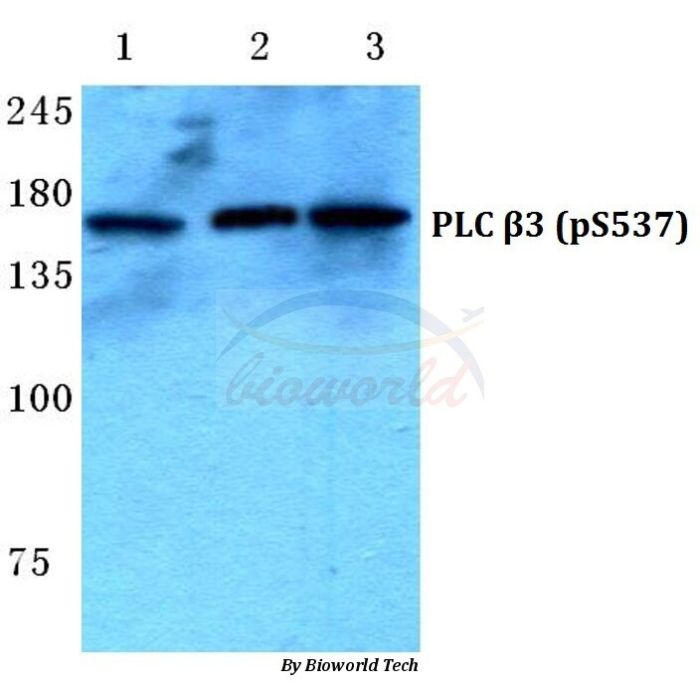
PLC β3 (phospho-S537) polyclonal, anti-human, mouse, rat
€328.00
In stock
SKU
BS4864
Background:
A total of eight mammalian PLC isozymes have been described (PLC β1, PLC β2, PLC β3, PLC β4, PLC γ1, PLC γ2, PLC δ1 and PLC δ2) with molecular weights ranging from 85 to 150 kDa. The γ-type enzymes are unique in that they contain SH2 and SH3 domains. Moreover, the two γ-type enzymes, but not the β and δ isozymes, are subject to activation by a number of protein tyrosine kinases which associate with their SH2 domains and induce their activation by phosphoryation. In contrast, activation of PLC β1, PLC β2 and PLC β3 is mediated by the α subunits of the Gq class of heterotrimeric G proteins and by certain βγ G protein subunits. The regulatory mechanisms for PLC δ1 and PLC δ2 are as yet not resolved.
Alternative Name:
1-phosphatidylinositol 4,5-bisphosphate phosphodiesterase β-3, Phosphoinositide phospholipase C-β-3, Phospholipase C-β-3, PLC-β3, 1-phosphatidylinositol 4,5-bisphosphate phosphodiesterase beta-3, Phosphoinositide phospholipase C-beta-3, Phospholipase C-beta-3, PLC-beta-3, PLCB3, PLCβ3
Application Dilution: WB: 1:500~1:1000
Specificity: p-PLC β3 (S537) polyclonal antibody detects endogenous levels of PLC β3 protein only when phosphorylated at Ser537.
Immunogen:
Synthetic phosphopeptide derived from human PLC β3 around the phosphorylation site of Serine 537.
MW: ~ 150 kDa
Swis Prot.: Q01970
Purification & Purity:
The antibody was affinity-purified from rabbit antiserum by affinity-chromatography using epitope-specific immunogen and the purity is > 95% (by SDS-PAGE).
Format:
1 mg/ml in Phosphate buffered saline (PBS) with 0.05% sodium azide, approx. pH 7.2.
Storage:
Store at 4°C short term. Aliquot and store at -20°C long term. Avoid freeze-thaw cycles.
For research use only, not for use in diagnostic procedure.
A total of eight mammalian PLC isozymes have been described (PLC β1, PLC β2, PLC β3, PLC β4, PLC γ1, PLC γ2, PLC δ1 and PLC δ2) with molecular weights ranging from 85 to 150 kDa. The γ-type enzymes are unique in that they contain SH2 and SH3 domains. Moreover, the two γ-type enzymes, but not the β and δ isozymes, are subject to activation by a number of protein tyrosine kinases which associate with their SH2 domains and induce their activation by phosphoryation. In contrast, activation of PLC β1, PLC β2 and PLC β3 is mediated by the α subunits of the Gq class of heterotrimeric G proteins and by certain βγ G protein subunits. The regulatory mechanisms for PLC δ1 and PLC δ2 are as yet not resolved.
Alternative Name:
1-phosphatidylinositol 4,5-bisphosphate phosphodiesterase β-3, Phosphoinositide phospholipase C-β-3, Phospholipase C-β-3, PLC-β3, 1-phosphatidylinositol 4,5-bisphosphate phosphodiesterase beta-3, Phosphoinositide phospholipase C-beta-3, Phospholipase C-beta-3, PLC-beta-3, PLCB3, PLCβ3
Application Dilution: WB: 1:500~1:1000
Specificity: p-PLC β3 (S537) polyclonal antibody detects endogenous levels of PLC β3 protein only when phosphorylated at Ser537.
Immunogen:
Synthetic phosphopeptide derived from human PLC β3 around the phosphorylation site of Serine 537.
MW: ~ 150 kDa
Swis Prot.: Q01970
Purification & Purity:
The antibody was affinity-purified from rabbit antiserum by affinity-chromatography using epitope-specific immunogen and the purity is > 95% (by SDS-PAGE).
Format:
1 mg/ml in Phosphate buffered saline (PBS) with 0.05% sodium azide, approx. pH 7.2.
Storage:
Store at 4°C short term. Aliquot and store at -20°C long term. Avoid freeze-thaw cycles.
For research use only, not for use in diagnostic procedure.
| Is Featured? | No |
|---|
Write Your Own Review