
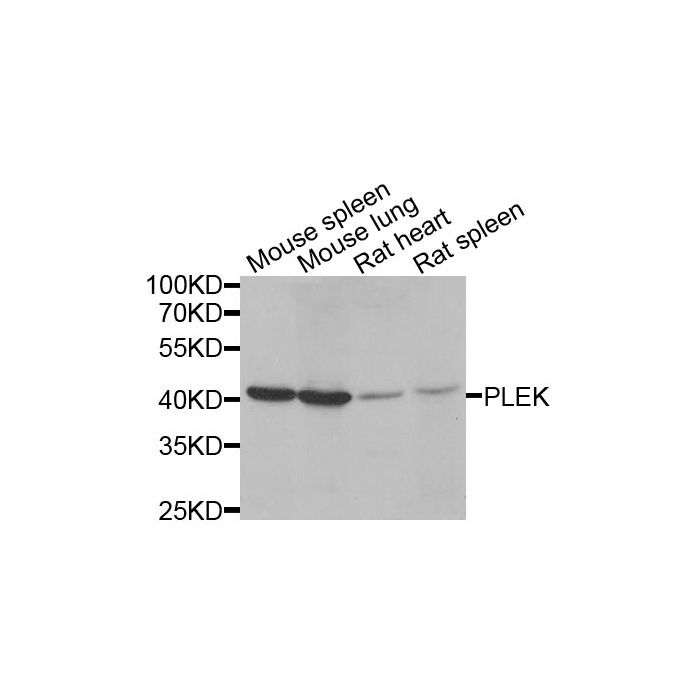
PLEK polyclonal, anti-human, mouse, rat
€388.00
In stock
SKU
BS8116
Background:
Activation of protein kinase C (PKC) in platelets results in immediate phosphorylation of pleckstrin (previously called 40K or P47), the major PKC substrate in platelets. Pleckstrin contains a Ca2+-binding ‘EF-hand’ structure and PKC phosphorylation sites at Ser-113 and Ser-117. The N and C termini of pleckstrin contain two pleckstrin homology domains (PH), which mediate protein-protein and protein-lipid interactions. Pleckstrin is highly expressed in human neutrophils. Pleckstrin is rapidly phosphorylated following treatment of neutrophils in response to inflammatory stimuli, probably by nonconventional PKC isoforms delta or zeta, which are expressed in human neutrophils. Phosphorylation by nonconventional PKC isoforms induces a conformational change in pleckstrin that promotes its interaction with membranes and/or with the cytoskeleton, serving to target proteins or lipids recognized by PH domains to sites where they can contribute to the microbicidal response.
Alternative Name:
Pleckstrin, Platelet 47 kDa protein, p47, PLEK, P47
Application Dilution: WB: 1:500~1:2000, IHC: 1:50~1:200
Specificity: PLEK polyclonal antibody detects endogenous levels of PLEK protein.
Immunogen:
Recombinant full length Human PLEK.
MW: ~ 40 kDa
Swis Prot.: P08567
Purification & Purity:
The antibody was affinity-purified from rabbit antiserum by affinity-chromatography using epitope-specific immunogen and the purity is > 95% (by SDS-PAGE).
Format:
1mg/ml in PBS with 0.1% Sodium Azide, 50% Glycerol.
Storage:
Store at 4°C short term. Aliquot and store at -20°C long term. Avoid freeze-thaw cycles.
For research use only, not for use in diagnostic procedure.
Activation of protein kinase C (PKC) in platelets results in immediate phosphorylation of pleckstrin (previously called 40K or P47), the major PKC substrate in platelets. Pleckstrin contains a Ca2+-binding ‘EF-hand’ structure and PKC phosphorylation sites at Ser-113 and Ser-117. The N and C termini of pleckstrin contain two pleckstrin homology domains (PH), which mediate protein-protein and protein-lipid interactions. Pleckstrin is highly expressed in human neutrophils. Pleckstrin is rapidly phosphorylated following treatment of neutrophils in response to inflammatory stimuli, probably by nonconventional PKC isoforms delta or zeta, which are expressed in human neutrophils. Phosphorylation by nonconventional PKC isoforms induces a conformational change in pleckstrin that promotes its interaction with membranes and/or with the cytoskeleton, serving to target proteins or lipids recognized by PH domains to sites where they can contribute to the microbicidal response.
Alternative Name:
Pleckstrin, Platelet 47 kDa protein, p47, PLEK, P47
Application Dilution: WB: 1:500~1:2000, IHC: 1:50~1:200
Specificity: PLEK polyclonal antibody detects endogenous levels of PLEK protein.
Immunogen:
Recombinant full length Human PLEK.
MW: ~ 40 kDa
Swis Prot.: P08567
Purification & Purity:
The antibody was affinity-purified from rabbit antiserum by affinity-chromatography using epitope-specific immunogen and the purity is > 95% (by SDS-PAGE).
Format:
1mg/ml in PBS with 0.1% Sodium Azide, 50% Glycerol.
Storage:
Store at 4°C short term. Aliquot and store at -20°C long term. Avoid freeze-thaw cycles.
For research use only, not for use in diagnostic procedure.
| Is Featured? | No |
|---|
Write Your Own Review