
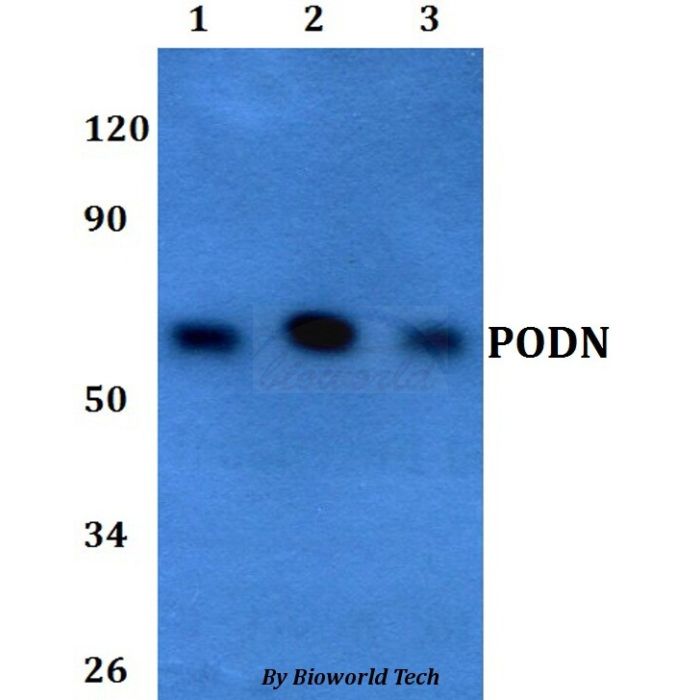
PODN polyclonal, anti-human, mouse, rat
€305.00
In stock
SKU
BS60696
Background:
Non-collagenous proteins of the small leucine-rich repeat (SLR) protein family are considered important components of the extracellular matrix. The extracellular matrix plays an integral role in the pivotal processes of development, tissue repair and metastasis by regulating cell proliferation, differentiation, adhesion and migration. Podocan, also known as PCAN, SLRR5A or PODN, is a 613 amino acid secreted protein belonging to the small leucine-rich proteoglycan (SLRP) family and the class V subfamily. Expressed in kidney, heart, liver, pancreas and vascular smooth muscle cells, Podocan exists as three alternatively spliced isoforms containing twenty LRR (leucine-rich repeats), a unique N-terminal cysteine-rich cluster pattern and a highly acidic C-terminal domain. Podocan is considered a glycoprotein containing N-linked oligosaccharides that may be involved in growth regulation in cardiovascular tissues. Encoded by a gene located on human chromosome 1, Podocan interacts type I collagen (COL1).
Alternative Name:
Podocan, PODN, SLRR5A, UNQ293, PRO332
Application Dilution: WB: 1:500~1:1000
Specificity: PODN polyclonal antibody detects endogenous levels of PODN protein.
Immunogen:
A synthetic peptide corresponding to residues in Human PODN.
MW: ~ 69 kDa
Swis Prot.: Q7Z5L7
Purification & Purity:
The antibody was affinity-purified from rabbit antiserum by affinity-chromatography using epitope-specific immunogen and the purity is > 95% (by SDS-PAGE).
Format:
1 mg/ml in Phosphate buffered saline (PBS) with 15 mM sodium azide, approx. pH 7.2.
Storage:
Store at 4°C short term. Aliquot and store at -20°C long term. Avoid freeze-thaw cycles.
For research use only, not for use in diagnostic procedure.
Non-collagenous proteins of the small leucine-rich repeat (SLR) protein family are considered important components of the extracellular matrix. The extracellular matrix plays an integral role in the pivotal processes of development, tissue repair and metastasis by regulating cell proliferation, differentiation, adhesion and migration. Podocan, also known as PCAN, SLRR5A or PODN, is a 613 amino acid secreted protein belonging to the small leucine-rich proteoglycan (SLRP) family and the class V subfamily. Expressed in kidney, heart, liver, pancreas and vascular smooth muscle cells, Podocan exists as three alternatively spliced isoforms containing twenty LRR (leucine-rich repeats), a unique N-terminal cysteine-rich cluster pattern and a highly acidic C-terminal domain. Podocan is considered a glycoprotein containing N-linked oligosaccharides that may be involved in growth regulation in cardiovascular tissues. Encoded by a gene located on human chromosome 1, Podocan interacts type I collagen (COL1).
Alternative Name:
Podocan, PODN, SLRR5A, UNQ293, PRO332
Application Dilution: WB: 1:500~1:1000
Specificity: PODN polyclonal antibody detects endogenous levels of PODN protein.
Immunogen:
A synthetic peptide corresponding to residues in Human PODN.
MW: ~ 69 kDa
Swis Prot.: Q7Z5L7
Purification & Purity:
The antibody was affinity-purified from rabbit antiserum by affinity-chromatography using epitope-specific immunogen and the purity is > 95% (by SDS-PAGE).
Format:
1 mg/ml in Phosphate buffered saline (PBS) with 15 mM sodium azide, approx. pH 7.2.
Storage:
Store at 4°C short term. Aliquot and store at -20°C long term. Avoid freeze-thaw cycles.
For research use only, not for use in diagnostic procedure.
| Is Featured? | No |
|---|
Write Your Own Review