
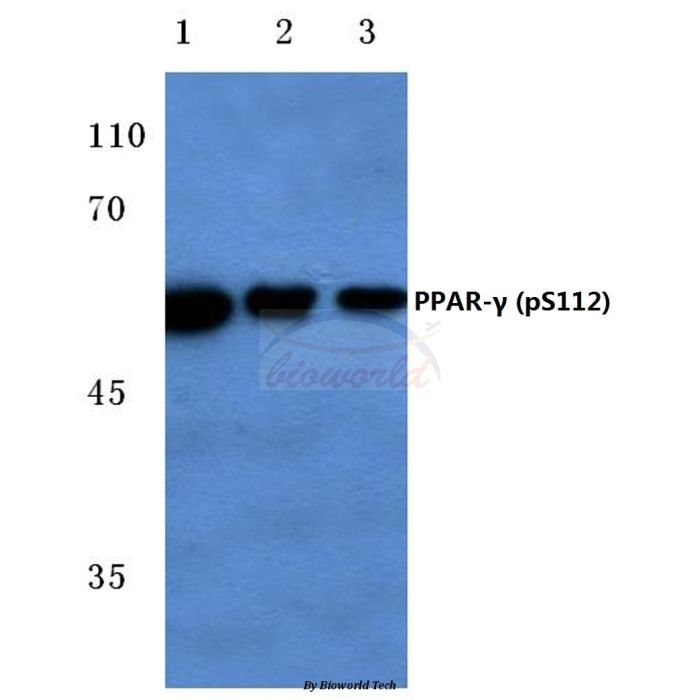
PPARγ (phospho-S112) polyclonal, anti-human, mouse, rat
€328.00
In stock
SKU
BS4444
Background:
PPAR gamma is implicated in numerous diseases including obesity, diabetes, atherosclerosis and cancer. PPAR gamma activators include prostanoids, fatty acids, thiazolidinediones and N-(2-benzoylphenyl) tyrosine analogues. A key component in adipocyte differentiation and fat-specific gene expression, PPAR gamma may modulate macrophage functions such as proinflammatory activities, and stimulate oxidized low-density lipoprotein (x-LDL) uptake. A Pro12Ala polymorphism of the PPAR gamma2 gene has been reported to reduce transactivation activity in vitro. This substitution may affect the immune response to ox-LDL and be associated with type 2 diabetes. In addition, the Pro12Ala variant of the PPAR gamma2 gene maybe correlated with abdominal obesity in type 2 diabetes.
Alternative Name:
Peroxisome proliferator-activated receptor gamma, Short name=PPAR-gamma, Nuclear receptor subfamily 1 group C member 3, PPARG, NR1C3, PPAR γ, PPARγ
Application Dilution: WB: 1:500~1:1000, IHC: 1:50~1:200
Specificity: p-PPARγ (S112) polyclonal antibody detects endogenous levels of PPARγ protein only when phosphorylated at Ser112.
Immunogen:
Synthetic phosphopeptide derived from human PPARγ around the phosphorylation site of Serine 112.
MW: ~ 54 kDa
Swis Prot.: P37231
Purification & Purity:
The antibody was affinity-purified from rabbit antiserum by affinity-chromatography using epitope-specific immunogen and the purity is > 95% (by SDS-PAGE).
Format:
1 mg/ml in Phosphate buffered saline (PBS) with 0.05% sodium azide, approx. pH 7.2.
Storage:
Store at 4°C short term. Aliquot and store at -20°C long term. Avoid freeze-thaw cycles.
For research use only, not for use in diagnostic procedure.
PPAR gamma is implicated in numerous diseases including obesity, diabetes, atherosclerosis and cancer. PPAR gamma activators include prostanoids, fatty acids, thiazolidinediones and N-(2-benzoylphenyl) tyrosine analogues. A key component in adipocyte differentiation and fat-specific gene expression, PPAR gamma may modulate macrophage functions such as proinflammatory activities, and stimulate oxidized low-density lipoprotein (x-LDL) uptake. A Pro12Ala polymorphism of the PPAR gamma2 gene has been reported to reduce transactivation activity in vitro. This substitution may affect the immune response to ox-LDL and be associated with type 2 diabetes. In addition, the Pro12Ala variant of the PPAR gamma2 gene maybe correlated with abdominal obesity in type 2 diabetes.
Alternative Name:
Peroxisome proliferator-activated receptor gamma, Short name=PPAR-gamma, Nuclear receptor subfamily 1 group C member 3, PPARG, NR1C3, PPAR γ, PPARγ
Application Dilution: WB: 1:500~1:1000, IHC: 1:50~1:200
Specificity: p-PPARγ (S112) polyclonal antibody detects endogenous levels of PPARγ protein only when phosphorylated at Ser112.
Immunogen:
Synthetic phosphopeptide derived from human PPARγ around the phosphorylation site of Serine 112.
MW: ~ 54 kDa
Swis Prot.: P37231
Purification & Purity:
The antibody was affinity-purified from rabbit antiserum by affinity-chromatography using epitope-specific immunogen and the purity is > 95% (by SDS-PAGE).
Format:
1 mg/ml in Phosphate buffered saline (PBS) with 0.05% sodium azide, approx. pH 7.2.
Storage:
Store at 4°C short term. Aliquot and store at -20°C long term. Avoid freeze-thaw cycles.
For research use only, not for use in diagnostic procedure.
| Is Featured? | No |
|---|
Write Your Own Review