
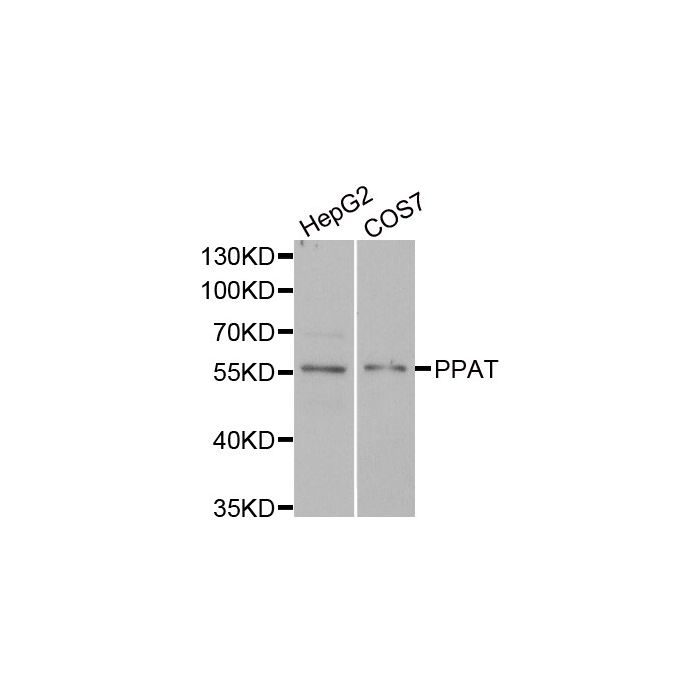
PPAT polyclonal, anti-human, monkey
€388.00
In stock
SKU
BS8365
Background:
Atase (amidophosphoribosyltransferase), also known as PPAT (phosphoribosyl pyrophosphate (PRPP) amidotransferase), PRAT or GPAT (glutamine phosphoribosyl pyrophosphate amidotransferase), is a ubiquitously expressed N-terminal nucleophile-type glutamine amidotransferase that belongs to the purine/pyrimidine phosphoribosyltransferase family. Existing as a homotetramer, Atase plays an important role in purine metabolism. More specifically, Atase functions as regulatory enzyme and contains one glutamine amidotransferase type-2 domain. Binding a magnesium ion and a 4Fe-4S cluster as cofactors, Atase catalyzes the first step (the rate-limiting step) in the purine nucleotide biosynthesis pathway, a two-step reaction that results in the formation of phosphoribosylamine from PRPP and glutamine. The first step of this reaction is catalyzed by the N-terminal glutaminase domain while the second step is catalyzed by the C-terminal PRTase domain.
Alternative Name:
Amidophosphoribosyltransferase , Atase, Glutamine phosphoribosylpyrophosphate amidotransferase, GPAT, PPAT, GPAT
Application Dilution: WB: 1:500 - 1:2000
Specificity: PPAT polyclonal antibody detects endogenous levels of PPAT protein.
Immunogen:
Recombinant full length Human PPAT.
MW: ~ 57 kDa
Swis Prot.: Q06203
Purification & Purity:
The antibody was affinity-purified from rabbit antiserum by affinity-chromatography using epitope-specific immunogen and the purity is > 95% (by SDS-PAGE).
Format:
1mg/ml in PBS with 0.1% Sodium Azide, 50% Glycerol.
Storage:
Store at 4°C short term. Aliquot and store at -20°C long term. Avoid freeze-thaw cycles.
For research use only, not for use in diagnostic procedure.
Atase (amidophosphoribosyltransferase), also known as PPAT (phosphoribosyl pyrophosphate (PRPP) amidotransferase), PRAT or GPAT (glutamine phosphoribosyl pyrophosphate amidotransferase), is a ubiquitously expressed N-terminal nucleophile-type glutamine amidotransferase that belongs to the purine/pyrimidine phosphoribosyltransferase family. Existing as a homotetramer, Atase plays an important role in purine metabolism. More specifically, Atase functions as regulatory enzyme and contains one glutamine amidotransferase type-2 domain. Binding a magnesium ion and a 4Fe-4S cluster as cofactors, Atase catalyzes the first step (the rate-limiting step) in the purine nucleotide biosynthesis pathway, a two-step reaction that results in the formation of phosphoribosylamine from PRPP and glutamine. The first step of this reaction is catalyzed by the N-terminal glutaminase domain while the second step is catalyzed by the C-terminal PRTase domain.
Alternative Name:
Amidophosphoribosyltransferase , Atase, Glutamine phosphoribosylpyrophosphate amidotransferase, GPAT, PPAT, GPAT
Application Dilution: WB: 1:500 - 1:2000
Specificity: PPAT polyclonal antibody detects endogenous levels of PPAT protein.
Immunogen:
Recombinant full length Human PPAT.
MW: ~ 57 kDa
Swis Prot.: Q06203
Purification & Purity:
The antibody was affinity-purified from rabbit antiserum by affinity-chromatography using epitope-specific immunogen and the purity is > 95% (by SDS-PAGE).
Format:
1mg/ml in PBS with 0.1% Sodium Azide, 50% Glycerol.
Storage:
Store at 4°C short term. Aliquot and store at -20°C long term. Avoid freeze-thaw cycles.
For research use only, not for use in diagnostic procedure.
| Is Featured? | No |
|---|
Write Your Own Review