
PPM2C polyclonal, anti-human, mouse, rat
€388.00
In stock
SKU
BS8138
Background:
Pyruvate dehydrogenase phosphatase (PDP) is a serine phosphatase that catalyzes the dephosphorylation and reactivation of the alpha subunit of the E1 component of the mitochondrial pyruvate dehydrogenase multienzyme complex. PDP is a heterodimer that consists of catalytic and regulatory subunits. PDPc (pyruvate dehydrogenase phosphatase, catalytic subunit 1), also known as Protein phosphatase 2C, is a 537 amino acid protein that is localized within the mitochondrial matrix. PDPc is stimulated by calcium binding and utilizes two magnesium ions as cofactors. PDPc efficiently dephosphorylates all three phosphorylation sites located on the alpha chain of the E1 component, which simultaneously activates pyruvate dehydrogenase to convert pyruvate to acetyl-CoA for utilization in the Kreb’s Cycle. Defects in the gene encoding PDPc are the cause of pyruvate dehydrogenase phosphatase deficiency, which results in lactic acidosis and neurological dysfunction.
Alternative Name:
[Pyruvate dehydrogenase [acetyl-transferring]]-phosphatase 1, mitochondrial, PDP 1, Protein phosphatase 2C, Pyruvate dehydrogenase phosphatase catalytic subunit 1, PDPC 1, PDP1, PDP, PPM2C
Application Dilution: WB: 1:500~1:2000, IHC: 1:50~1:200
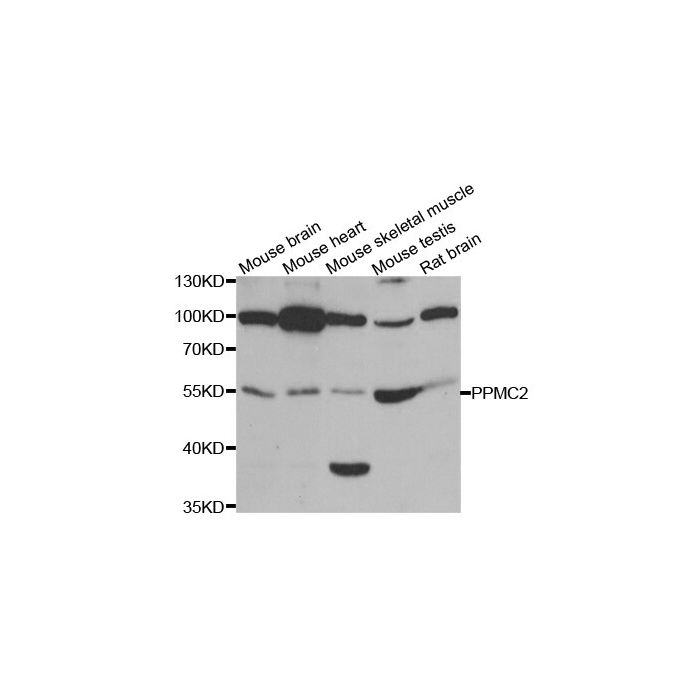
Specificity: PPM2C polyclonal antibody detects endogenous levels of PPM2C protein.
Immunogen:
Recombinant full length Human PPM2C.
MW: ~ 61 kDa
Swis Prot.: Q9P0J1
Purification & Purity:
The antibody was affinity-purified from rabbit antiserum by affinity-chromatography using epitope-specific immunogen and the purity is > 95% (by SDS-PAGE).
Format:
1mg/ml in PBS with 0.1% Sodium Azide, 50% Glycerol.
Storage:
Store at 4°C short term. Aliquot and store at -20°C long term. Avoid freeze-thaw cycles.
For research use only, not for use in diagnostic procedure.
Pyruvate dehydrogenase phosphatase (PDP) is a serine phosphatase that catalyzes the dephosphorylation and reactivation of the alpha subunit of the E1 component of the mitochondrial pyruvate dehydrogenase multienzyme complex. PDP is a heterodimer that consists of catalytic and regulatory subunits. PDPc (pyruvate dehydrogenase phosphatase, catalytic subunit 1), also known as Protein phosphatase 2C, is a 537 amino acid protein that is localized within the mitochondrial matrix. PDPc is stimulated by calcium binding and utilizes two magnesium ions as cofactors. PDPc efficiently dephosphorylates all three phosphorylation sites located on the alpha chain of the E1 component, which simultaneously activates pyruvate dehydrogenase to convert pyruvate to acetyl-CoA for utilization in the Kreb’s Cycle. Defects in the gene encoding PDPc are the cause of pyruvate dehydrogenase phosphatase deficiency, which results in lactic acidosis and neurological dysfunction.
Alternative Name:
[Pyruvate dehydrogenase [acetyl-transferring]]-phosphatase 1, mitochondrial, PDP 1, Protein phosphatase 2C, Pyruvate dehydrogenase phosphatase catalytic subunit 1, PDPC 1, PDP1, PDP, PPM2C
Application Dilution: WB: 1:500~1:2000, IHC: 1:50~1:200
Specificity: PPM2C polyclonal antibody detects endogenous levels of PPM2C protein.
Immunogen:
Recombinant full length Human PPM2C.
MW: ~ 61 kDa
Swis Prot.: Q9P0J1
Purification & Purity:
The antibody was affinity-purified from rabbit antiserum by affinity-chromatography using epitope-specific immunogen and the purity is > 95% (by SDS-PAGE).
Format:
1mg/ml in PBS with 0.1% Sodium Azide, 50% Glycerol.
Storage:
Store at 4°C short term. Aliquot and store at -20°C long term. Avoid freeze-thaw cycles.
For research use only, not for use in diagnostic procedure.
| Is Featured? | No |
|---|
Write Your Own Review