
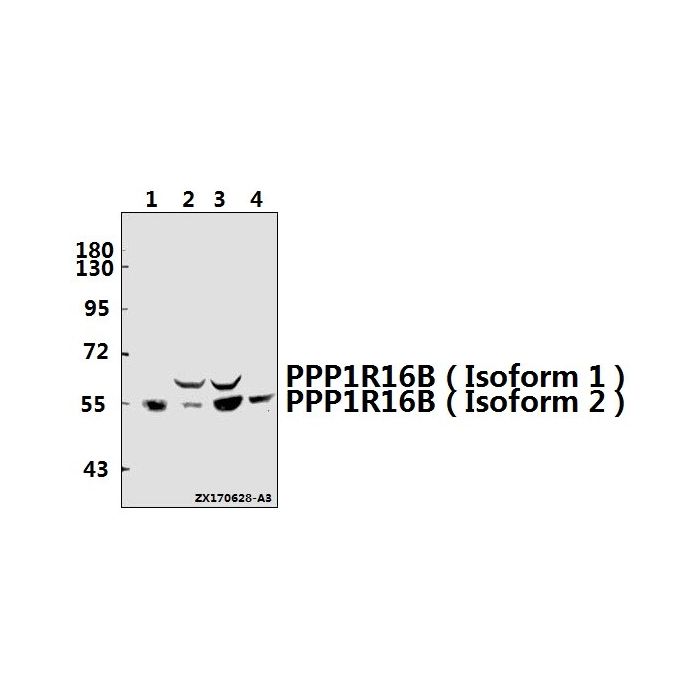
PPP1R16B polyclonal, anti-human, mouse, rat
€305.00
In stock
SKU
BS61720
Background:
Protein phosphatase 1 regulatory inhibitor subunit 16B, regulator of protein phosphatase 1 (PP1) that acts as a positive regulator of pulmonary endothelial cell (EC) barrier function (PubMed:18586956). Involved in the regulation of the PI3K/AKT signaling pathway, angiogenesis and endothelial cell proliferation (PubMed:25007873). Regulates angiogenesis and endothelial cell proliferation through the control of ECE1 dephosphorylation, trafficking and activity (By similarity). Protects the endothelial barrier from lipopolysaccharide (LPS)-induced vascular leakage (By similarity). Involved in the regulation of endothelial cell filopodia extension (By similarity). May be a downstream target for TGF-beta1 signaling cascade in endothelial cells (PubMed:16263087, PubMed:18586956). Involved in PKA-mediated moesin dephosphorylation which is important in EC barrier protection against thrombin stimulation (PubMed:18586956). Promotes the interaction of PPP1CA with RPSA/LAMR1 and in turn facilitates the dephosphorylation of RPSA/LAMR1 (PubMed:16263087). Involved in the dephosphorylation of EEF1A1 (PubMed:26497934).
Alternative Name:
Protein phosphatase 1 regulatory inhibitor subunit 16B, Ankyrin repeat domain-containing protein 4, CAAX box protein TIMAP, TGF-beta-inhibited membrane-associated protein, hTIMAP, PPP1R16B, ANKRD4, KIAA0823
Application Dilution: WB: 1:500~1:1000
Specificity: PPP1R16B polyclonal antibody detects endogenous levels of PPP1R16B protein.
Immunogen:
Synthetic peptide, corresponding to amino acids 350-400 of Human PPP1R16B.
MW: ~ 63, 60 kDa
Swis Prot.: Q96T49
Purification & Purity:
The antibody was affinity-purified from rabbit antiserum by affinity-chromatography using epitope-specific immunogen and the purity is > 95% (by SDS-PAGE).
Format:
1 mg/ml in Phosphate buffered saline (PBS) with 0.05% sodium azide, approx. pH 7.3.
Storage:
Store at 4°C short term. Aliquot and store at -20°C long term. Avoid freeze-thaw cycles.
For research use only, not for use in diagnostic procedure.
Protein phosphatase 1 regulatory inhibitor subunit 16B, regulator of protein phosphatase 1 (PP1) that acts as a positive regulator of pulmonary endothelial cell (EC) barrier function (PubMed:18586956). Involved in the regulation of the PI3K/AKT signaling pathway, angiogenesis and endothelial cell proliferation (PubMed:25007873). Regulates angiogenesis and endothelial cell proliferation through the control of ECE1 dephosphorylation, trafficking and activity (By similarity). Protects the endothelial barrier from lipopolysaccharide (LPS)-induced vascular leakage (By similarity). Involved in the regulation of endothelial cell filopodia extension (By similarity). May be a downstream target for TGF-beta1 signaling cascade in endothelial cells (PubMed:16263087, PubMed:18586956). Involved in PKA-mediated moesin dephosphorylation which is important in EC barrier protection against thrombin stimulation (PubMed:18586956). Promotes the interaction of PPP1CA with RPSA/LAMR1 and in turn facilitates the dephosphorylation of RPSA/LAMR1 (PubMed:16263087). Involved in the dephosphorylation of EEF1A1 (PubMed:26497934).
Alternative Name:
Protein phosphatase 1 regulatory inhibitor subunit 16B, Ankyrin repeat domain-containing protein 4, CAAX box protein TIMAP, TGF-beta-inhibited membrane-associated protein, hTIMAP, PPP1R16B, ANKRD4, KIAA0823
Application Dilution: WB: 1:500~1:1000
Specificity: PPP1R16B polyclonal antibody detects endogenous levels of PPP1R16B protein.
Immunogen:
Synthetic peptide, corresponding to amino acids 350-400 of Human PPP1R16B.
MW: ~ 63, 60 kDa
Swis Prot.: Q96T49
Purification & Purity:
The antibody was affinity-purified from rabbit antiserum by affinity-chromatography using epitope-specific immunogen and the purity is > 95% (by SDS-PAGE).
Format:
1 mg/ml in Phosphate buffered saline (PBS) with 0.05% sodium azide, approx. pH 7.3.
Storage:
Store at 4°C short term. Aliquot and store at -20°C long term. Avoid freeze-thaw cycles.
For research use only, not for use in diagnostic procedure.
| Is Featured? | No |
|---|
Write Your Own Review