
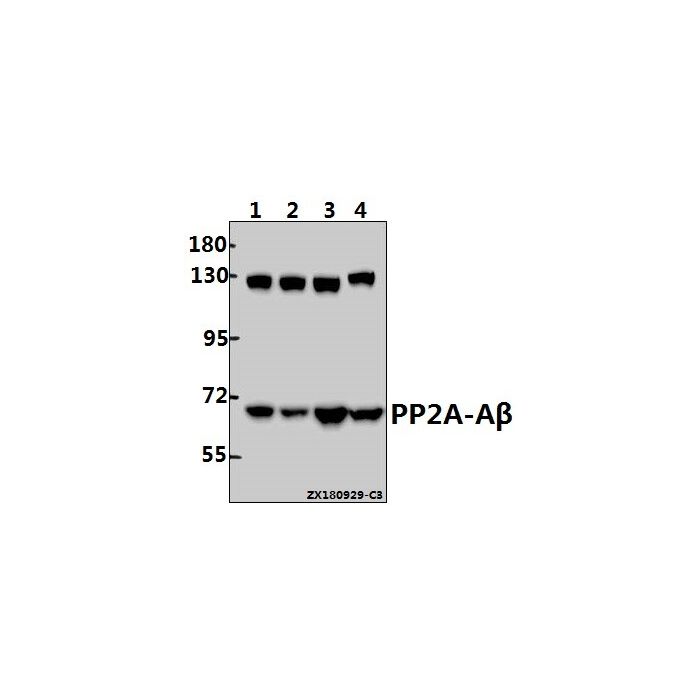
PPP2R1B polyclonal, anti-human, mouse, rat
€305.00
In stock
SKU
BS5862
Background:
In eukaryotes, the phosphorylation and dephosphorylation of proteins on serine and threonine residues is an essential means of regulating a broad range of cellular functions, including division, homeostasis and apoptosis. A group of proteins that are intimately involved in this process are the protein phosphatases. In general, the protein phosphatase (PP) holoenzyme is a trimeric complex composed of a regulatory subunit, a variable subunit and a catalytic subunit. Four major families of protein phosphatase catalytic subunits have been identified, designated PP1, PP2A, PP2B (calcineurin) and PP2C. An additional protein phosphatase catalytic subunit, PPX (also known as PP4), is a putative member of a novel PP family. The PP2A family comprises subfamily members PP2Aα and PP2Aβ. The PP2A catalytic subunit associates with a variety of regulatory subunits. Regulatory subunits include PP2A-Aα and -Aβ, PP2A-Bα and -Bβ, PP2A-Cα and -Cβ, and PP2A-B56α and -B56β.
Alternative Name:
Serine/threonine-protein phosphatase 2A 65 kDa regulatory subunit A beta isoform, PP2A subunit A isoform PR65-beta, PP2A subunit A isoform R1-beta, PP2A-Aβ, PP2AAβ, PP2A Aβ, PP2A-APR65β, PP2A -AR1β,
Application Dilution: WB: 1:500~1:1000, IHC: 1:50~1:200, ICC: 1:50~1:200
Specificity: PPP2R1B polyclonal antibody detects endogenous levels of PPP2R1B protein.
Immunogen:
Synthetic peptide, corresponding to amino acids 556-601 of Human PPP2R1B.
MW: ~ 66 kDa
Swis Prot.: P30154
Purification & Purity:
The antibody was affinity-purified from rabbit antiserum by affinity-chromatography using epitope-specific immunogen and the purity is > 95% (by SDS-PAGE).
Format:
1 mg/ml in Phosphate buffered saline (PBS) with 0.05% sodium azide, approx. pH 7.2.
Storage:
Store at 4°C short term. Aliquot and store at -20°C long term. Avoid freeze-thaw cycles.
For research use only, not for use in diagnostic procedure.
In eukaryotes, the phosphorylation and dephosphorylation of proteins on serine and threonine residues is an essential means of regulating a broad range of cellular functions, including division, homeostasis and apoptosis. A group of proteins that are intimately involved in this process are the protein phosphatases. In general, the protein phosphatase (PP) holoenzyme is a trimeric complex composed of a regulatory subunit, a variable subunit and a catalytic subunit. Four major families of protein phosphatase catalytic subunits have been identified, designated PP1, PP2A, PP2B (calcineurin) and PP2C. An additional protein phosphatase catalytic subunit, PPX (also known as PP4), is a putative member of a novel PP family. The PP2A family comprises subfamily members PP2Aα and PP2Aβ. The PP2A catalytic subunit associates with a variety of regulatory subunits. Regulatory subunits include PP2A-Aα and -Aβ, PP2A-Bα and -Bβ, PP2A-Cα and -Cβ, and PP2A-B56α and -B56β.
Alternative Name:
Serine/threonine-protein phosphatase 2A 65 kDa regulatory subunit A beta isoform, PP2A subunit A isoform PR65-beta, PP2A subunit A isoform R1-beta, PP2A-Aβ, PP2AAβ, PP2A Aβ, PP2A-APR65β, PP2A -AR1β,
Application Dilution: WB: 1:500~1:1000, IHC: 1:50~1:200, ICC: 1:50~1:200
Specificity: PPP2R1B polyclonal antibody detects endogenous levels of PPP2R1B protein.
Immunogen:
Synthetic peptide, corresponding to amino acids 556-601 of Human PPP2R1B.
MW: ~ 66 kDa
Swis Prot.: P30154
Purification & Purity:
The antibody was affinity-purified from rabbit antiserum by affinity-chromatography using epitope-specific immunogen and the purity is > 95% (by SDS-PAGE).
Format:
1 mg/ml in Phosphate buffered saline (PBS) with 0.05% sodium azide, approx. pH 7.2.
Storage:
Store at 4°C short term. Aliquot and store at -20°C long term. Avoid freeze-thaw cycles.
For research use only, not for use in diagnostic procedure.
| Is Featured? | No |
|---|
Write Your Own Review