
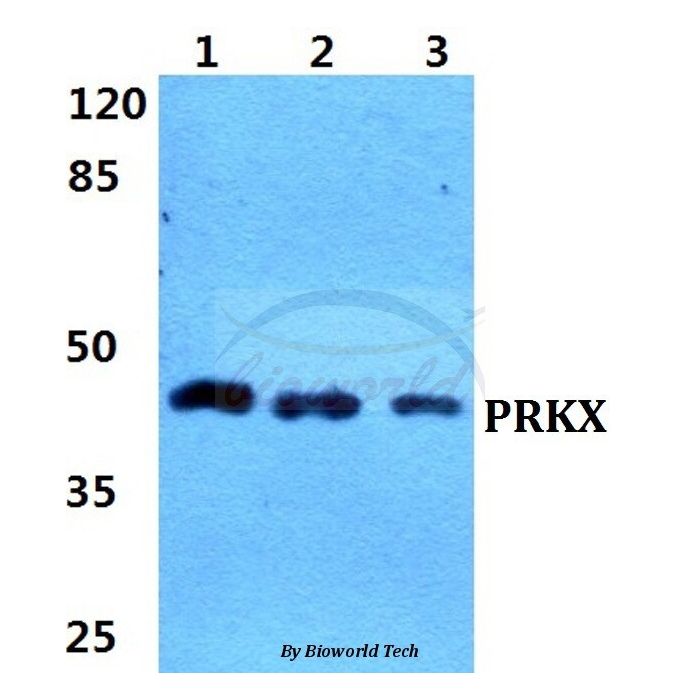
PRKX polyclonal, anti-human, mouse, rat
€305.00
In stock
SKU
BS5865
Background:
The phosphorylation and dephosphorylation of proteins on serine and threonine residues is an essential means of regulating a broad range of cellular functions in eukaryotes, including cell division, homeostasis and apoptosis. A group of proteins that are intimately involved in this process are the serine/threonine (Ser/Thr) protein kinases. PRKY (protein kinase, Y-linked) and PRKX (protein kinase, X-linked) are members of the Ser/Thr protein kinase family, both of which belong to the subfamily of cAMP-dependent kinases. Encoded by a gene that is located near the pseudoautosomal region on chromosome Y, PRKY contains one protein kinase domain through which it catalyzes the ATP-dependent phosphorylation of target proteins. Functioning in a similar manner to PRXY, PRKX contains one protein kinase domain and is essential for macrophage differentiation and renal epithelial cell migration. Defects in the genes encoding PRKY and PRXX are associated with sex reversal disorder, namely XX in males and XY in females.
Alternative Name:
cAMP-dependent protein kinase catalytic subunit PRKX, PrKX, Protein kinase X, Protein kinase X-linked, Serine/threonine-protein kinase PRKX, Protein kinase PKX1, PKX1
Application Dilution: WB: 1:500~1:1000, IHC: 1:50~1:200
Specificity: PRKX polyclonal antibody detects endogenous levels of PRKX protein.
Immunogen:
Synthetic peptide, corresponding to amino acids 308-353 of Human PRKX.
MW: ~ 41 kDa
Swis Prot.: P51817
Purification & Purity:
The antibody was affinity-purified from rabbit antiserum by affinity-chromatography using epitope-specific immunogen and the purity is > 95% (by SDS-PAGE).
Format:
1 mg/ml in Phosphate buffered saline (PBS) with 0.05% sodium azide, approx. pH 7.2.
Storage:
Store at 4°C short term. Aliquot and store at -20°C long term. Avoid freeze-thaw cycles.
For research use only, not for use in diagnostic procedure.
The phosphorylation and dephosphorylation of proteins on serine and threonine residues is an essential means of regulating a broad range of cellular functions in eukaryotes, including cell division, homeostasis and apoptosis. A group of proteins that are intimately involved in this process are the serine/threonine (Ser/Thr) protein kinases. PRKY (protein kinase, Y-linked) and PRKX (protein kinase, X-linked) are members of the Ser/Thr protein kinase family, both of which belong to the subfamily of cAMP-dependent kinases. Encoded by a gene that is located near the pseudoautosomal region on chromosome Y, PRKY contains one protein kinase domain through which it catalyzes the ATP-dependent phosphorylation of target proteins. Functioning in a similar manner to PRXY, PRKX contains one protein kinase domain and is essential for macrophage differentiation and renal epithelial cell migration. Defects in the genes encoding PRKY and PRXX are associated with sex reversal disorder, namely XX in males and XY in females.
Alternative Name:
cAMP-dependent protein kinase catalytic subunit PRKX, PrKX, Protein kinase X, Protein kinase X-linked, Serine/threonine-protein kinase PRKX, Protein kinase PKX1, PKX1
Application Dilution: WB: 1:500~1:1000, IHC: 1:50~1:200
Specificity: PRKX polyclonal antibody detects endogenous levels of PRKX protein.
Immunogen:
Synthetic peptide, corresponding to amino acids 308-353 of Human PRKX.
MW: ~ 41 kDa
Swis Prot.: P51817
Purification & Purity:
The antibody was affinity-purified from rabbit antiserum by affinity-chromatography using epitope-specific immunogen and the purity is > 95% (by SDS-PAGE).
Format:
1 mg/ml in Phosphate buffered saline (PBS) with 0.05% sodium azide, approx. pH 7.2.
Storage:
Store at 4°C short term. Aliquot and store at -20°C long term. Avoid freeze-thaw cycles.
For research use only, not for use in diagnostic procedure.
| Is Featured? | No |
|---|
Write Your Own Review