
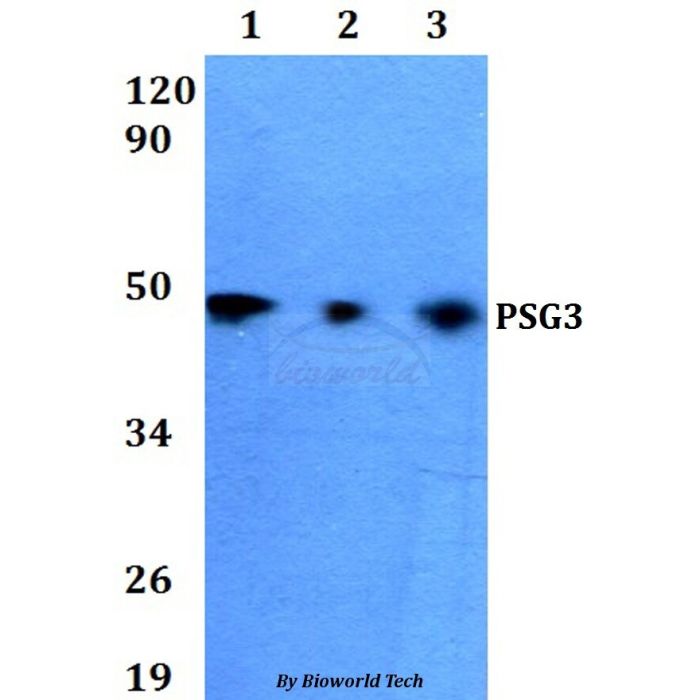
PSG3 polyclonal, anti-human, mouse, rat
€305.00
In stock
SKU
BS60638
Background:
The pregnancy-specific glycoproteins (PSGs) are a group of closely related secreted glycoproteins that are highly expressed in fetal placental syncytiotrophoblast cells. Members of the PSG protein family share a characteristic N-terminal domain that is homologous to the immunoglobulin variable region. PSGs become detectable in serum during the first two to three weeks of pregnancy and increase as the pregnancy progresses, eventually representing the most abundant fetal protein in the maternal blood at term. PSGs function to stimulate secretion of TH2-type cytokines from monocytes, and they may also modulate the maternal immune system during pregnancy, thereby protecting the semi-allotypic fetus from rejection. Eleven human PSG proteins (PSG1-PSG11) have been described.
Alternative Name:
Pregnancy-specific beta-1-glycoprotein 3, PS-beta-G-3, PSBG-3, Pregnancy-specific glycoprotein 3, Carcinoembryonic antigen SG5
Application Dilution: WB: 1:500~1:1000
Specificity: PSG3 polyclonal antibody detects endogenous levels of PSG3 protein.
Immunogen:
A synthetic peptide corresponding to residues in Human PSG3
MW: ~ 48 kDa
Swis Prot.: Q16557
Purification & Purity:
The antibody was affinity-purified from rabbit antiserum by affinity-chromatography using epitope-specific immunogen and the purity is > 95% (by SDS-PAGE).
Format:
1 mg/ml in Phosphate buffered saline (PBS) with 15 mM sodium azide, approx. pH 7.2.
Storage:
Store at 4°C short term. Aliquot and store at -20°C long term. Avoid freeze-thaw cycles.
For research use only, not for use in diagnostic procedure.
The pregnancy-specific glycoproteins (PSGs) are a group of closely related secreted glycoproteins that are highly expressed in fetal placental syncytiotrophoblast cells. Members of the PSG protein family share a characteristic N-terminal domain that is homologous to the immunoglobulin variable region. PSGs become detectable in serum during the first two to three weeks of pregnancy and increase as the pregnancy progresses, eventually representing the most abundant fetal protein in the maternal blood at term. PSGs function to stimulate secretion of TH2-type cytokines from monocytes, and they may also modulate the maternal immune system during pregnancy, thereby protecting the semi-allotypic fetus from rejection. Eleven human PSG proteins (PSG1-PSG11) have been described.
Alternative Name:
Pregnancy-specific beta-1-glycoprotein 3, PS-beta-G-3, PSBG-3, Pregnancy-specific glycoprotein 3, Carcinoembryonic antigen SG5
Application Dilution: WB: 1:500~1:1000
Specificity: PSG3 polyclonal antibody detects endogenous levels of PSG3 protein.
Immunogen:
A synthetic peptide corresponding to residues in Human PSG3
MW: ~ 48 kDa
Swis Prot.: Q16557
Purification & Purity:
The antibody was affinity-purified from rabbit antiserum by affinity-chromatography using epitope-specific immunogen and the purity is > 95% (by SDS-PAGE).
Format:
1 mg/ml in Phosphate buffered saline (PBS) with 15 mM sodium azide, approx. pH 7.2.
Storage:
Store at 4°C short term. Aliquot and store at -20°C long term. Avoid freeze-thaw cycles.
For research use only, not for use in diagnostic procedure.
| Is Featured? | No |
|---|
Write Your Own Review