
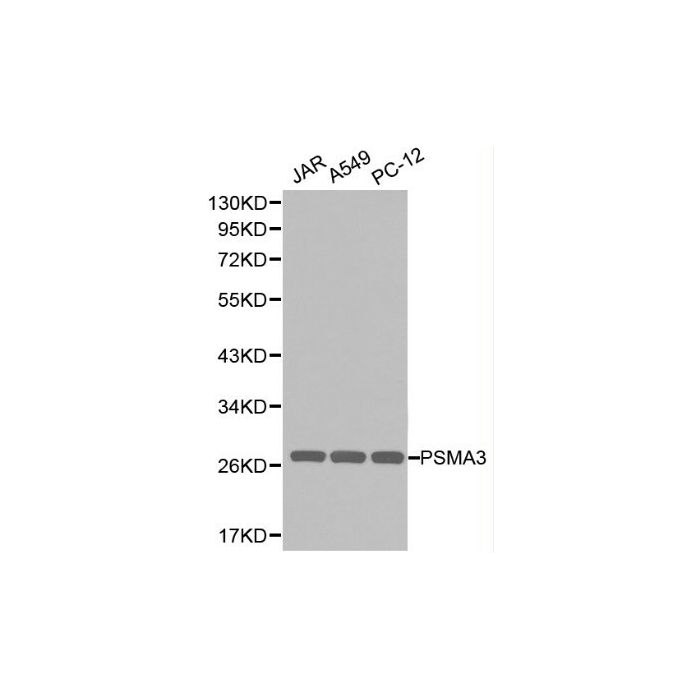
PSMA3 polyclonal, anti-human, mouse
€388.00
In stock
SKU
BS6287
Background:
The 20S proteasome is the major proteolytic enzyme complex involved in intracellular protein degradation. It consists of four stacked rings, each with seven distinct subunits. The two outer layers are identical rings composed of α subunits (called PSMAs), and the two inner layers are identical rings composed of β subunits. While the catalytic sites are located on the β rings, the α subunits are important for assembly and as binding sites for regulatory proteins. Seven different α and ten different β proteasome genes have been identified in mammals. PA700, PA28, and PA200 are three major protein complexes that function as activators of the 20S proteasome. PA700 binds polyubiquitin with high affinity and associates with the 20S proteasome to form the 26S proteasome, which preferentially degrades poly-ubiquitinated proteins ).
Alternative Name:
HC8, Macropain subunit C8, Multicatalytic endopeptidase complex subunit C8, Proteasome (prosome macropain) subunit alpha type 3, Proteasome alpha 3 subunit, Proteasome component C8, Proteasome subunit alpha type 3, Proteasome subunit alpha type-3, Proteasome subunit C8, PSA3, PSC3, PSMA3,
Application Dilution: WB: 1:500~1:2000, IF: 1:50~1:200, IP 1:50 - 1:100
Specificity: PSMA3 polyclonal antibody detects endogenous levels of PSMA3 protein.
Immunogen:
Recombinant full length Human PSMA3.
MW: ~ 28 kDa
Swis Prot.: P25788
Purification & Purity:
The antibody was affinity-purified from rabbit antiserum by affinity-chromatography using epitope-specific immunogen and the purity is > 95% (by SDS-PAGE).
Format:
1mg/ml in PBS with 0.1% Sodium Azide, 50% Glycerol.
Storage:
Store at 4°C short term. Aliquot and store at -20°C long term. Avoid freeze-thaw cycles.
For research use only, not for use in diagnostic procedure.
The 20S proteasome is the major proteolytic enzyme complex involved in intracellular protein degradation. It consists of four stacked rings, each with seven distinct subunits. The two outer layers are identical rings composed of α subunits (called PSMAs), and the two inner layers are identical rings composed of β subunits. While the catalytic sites are located on the β rings, the α subunits are important for assembly and as binding sites for regulatory proteins. Seven different α and ten different β proteasome genes have been identified in mammals. PA700, PA28, and PA200 are three major protein complexes that function as activators of the 20S proteasome. PA700 binds polyubiquitin with high affinity and associates with the 20S proteasome to form the 26S proteasome, which preferentially degrades poly-ubiquitinated proteins ).
Alternative Name:
HC8, Macropain subunit C8, Multicatalytic endopeptidase complex subunit C8, Proteasome (prosome macropain) subunit alpha type 3, Proteasome alpha 3 subunit, Proteasome component C8, Proteasome subunit alpha type 3, Proteasome subunit alpha type-3, Proteasome subunit C8, PSA3, PSC3, PSMA3,
Application Dilution: WB: 1:500~1:2000, IF: 1:50~1:200, IP 1:50 - 1:100
Specificity: PSMA3 polyclonal antibody detects endogenous levels of PSMA3 protein.
Immunogen:
Recombinant full length Human PSMA3.
MW: ~ 28 kDa
Swis Prot.: P25788
Purification & Purity:
The antibody was affinity-purified from rabbit antiserum by affinity-chromatography using epitope-specific immunogen and the purity is > 95% (by SDS-PAGE).
Format:
1mg/ml in PBS with 0.1% Sodium Azide, 50% Glycerol.
Storage:
Store at 4°C short term. Aliquot and store at -20°C long term. Avoid freeze-thaw cycles.
For research use only, not for use in diagnostic procedure.
| Is Featured? | No |
|---|
Write Your Own Review