
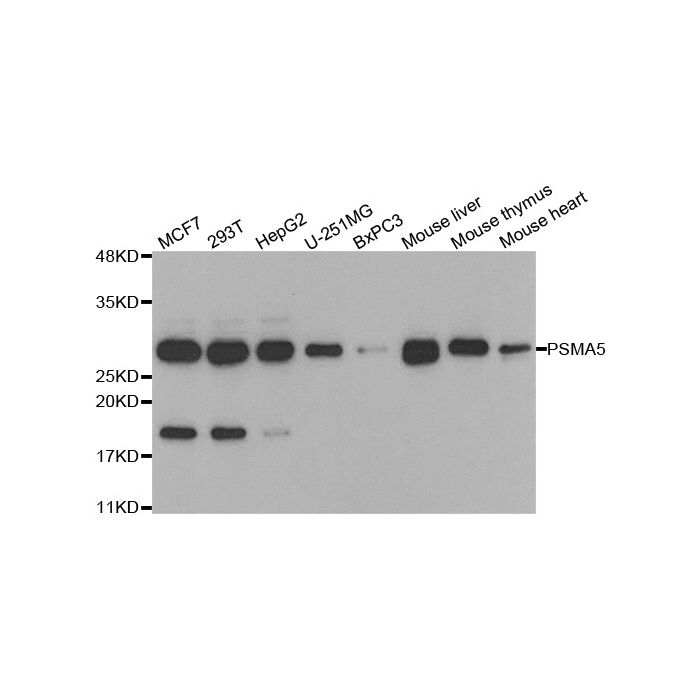
PSMA5 polyclonal, anti-human, mouse, rat
€388.00
In stock
SKU
BS7836
Background:
The proteasome represents a large protein complex that exists inside all eukaryotes and archaea, and in some bacteria. The main function of proteasomes is to degrade unnecessary or damaged proteins by proteolysis. The most common form of the proteasome, known as the 26S Proteasome, contains one 20S Proteasome core particle structure and two 19S regulatory caps. The 20S Proteasome core is hollow and forms an enclosed cavity, where proteins are degraded, as well as openings at the two ends to allow the target protein to enter. The 20S Proteasome core particle contains many subunits, depending on the organism. All of the subunits fall into one of two types: α subunits, which are structural, serve as docking domains for the regulatory particles and exterior gates blocking unregulated access to the interior cavity; or β subunits, which are predominantly catalytic. The outer two rings in the proteasome consist of seven α subunits each, and the inner two rings each consist of seven β subunits.
Alternative Name:
Macropain zeta chain, Multicatalytic endopeptidase complex zeta chain, Proteasome (prosome macropain) subunit alpha type 5, Proteasome alpha5 subunit, Proteasome component 5, Proteasome subunit alpha type 5, Proteasome subunit alpha type-5, Proteasome subunit zeta, Proteasome zeta chain, PSA5_HUMAN, PSC5, PSMA5, ZETA,
Application Dilution: WB: 1:500~1:2000, IHC: 1:50~1:200
Specificity: PSMA5 polyclonal antibody detects endogenous levels of PSMA5 protein.
Immunogen:
Recombinant full length Human PSMA5.
MW: ~ 26 kDa
Swis Prot.: P28066
Purification & Purity:
The antibody was affinity-purified from rabbit antiserum by affinity-chromatography using epitope-specific immunogen and the purity is > 95% (by SDS-PAGE).
Format:
1mg/ml in PBS with 0.1% Sodium Azide, 50% Glycerol.
Storage:
Store at 4°C short term. Aliquot and store at -20°C long term. Avoid freeze-thaw cycles.
For research use only, not for use in diagnostic procedure.
The proteasome represents a large protein complex that exists inside all eukaryotes and archaea, and in some bacteria. The main function of proteasomes is to degrade unnecessary or damaged proteins by proteolysis. The most common form of the proteasome, known as the 26S Proteasome, contains one 20S Proteasome core particle structure and two 19S regulatory caps. The 20S Proteasome core is hollow and forms an enclosed cavity, where proteins are degraded, as well as openings at the two ends to allow the target protein to enter. The 20S Proteasome core particle contains many subunits, depending on the organism. All of the subunits fall into one of two types: α subunits, which are structural, serve as docking domains for the regulatory particles and exterior gates blocking unregulated access to the interior cavity; or β subunits, which are predominantly catalytic. The outer two rings in the proteasome consist of seven α subunits each, and the inner two rings each consist of seven β subunits.
Alternative Name:
Macropain zeta chain, Multicatalytic endopeptidase complex zeta chain, Proteasome (prosome macropain) subunit alpha type 5, Proteasome alpha5 subunit, Proteasome component 5, Proteasome subunit alpha type 5, Proteasome subunit alpha type-5, Proteasome subunit zeta, Proteasome zeta chain, PSA5_HUMAN, PSC5, PSMA5, ZETA,
Application Dilution: WB: 1:500~1:2000, IHC: 1:50~1:200
Specificity: PSMA5 polyclonal antibody detects endogenous levels of PSMA5 protein.
Immunogen:
Recombinant full length Human PSMA5.
MW: ~ 26 kDa
Swis Prot.: P28066
Purification & Purity:
The antibody was affinity-purified from rabbit antiserum by affinity-chromatography using epitope-specific immunogen and the purity is > 95% (by SDS-PAGE).
Format:
1mg/ml in PBS with 0.1% Sodium Azide, 50% Glycerol.
Storage:
Store at 4°C short term. Aliquot and store at -20°C long term. Avoid freeze-thaw cycles.
For research use only, not for use in diagnostic procedure.
| Is Featured? | No |
|---|
Write Your Own Review