
PSMD13 polyclonal, anti-human, mouse, rat
€388.00
In stock
SKU
BS8611
Background:
The 26S proteasome is a multicatalytic proteinase complex with a highly ordered structure composed of 2 complexes, a 20S core and a 19S regulator. The 20S core is composed of 4 rings of 28 non-identical subunits; 2 rings are composed of 7 alpha subunits and 2 rings are composed of 7 beta subunits. The 19S regulator is composed of a base, which contains 6 ATPase subunits and 2 non-ATPase subunits, and a lid, which contains up to 10 non-ATPase subunits. Proteasomes are distributed throughout eukaryotic cells at a high concentration and cleave peptides in an ATP/ubiquitin-dependent process in a non-lysosomal pathway. An essential function of a modified proteasome, the immunoproteasome, is the processing of class I MHC peptides. This gene encodes a non-ATPase subunit of the 19S regulator. Two transcripts encoding different isoforms have been described.
Alternative Name:
26S proteasome non-ATPase regulatory subunit 13, 26S proteasome regulatory subunit RPN9, 26S proteasome regulatory subunit S11, 26S proteasome regulatory subunit p40.5, PSMD13
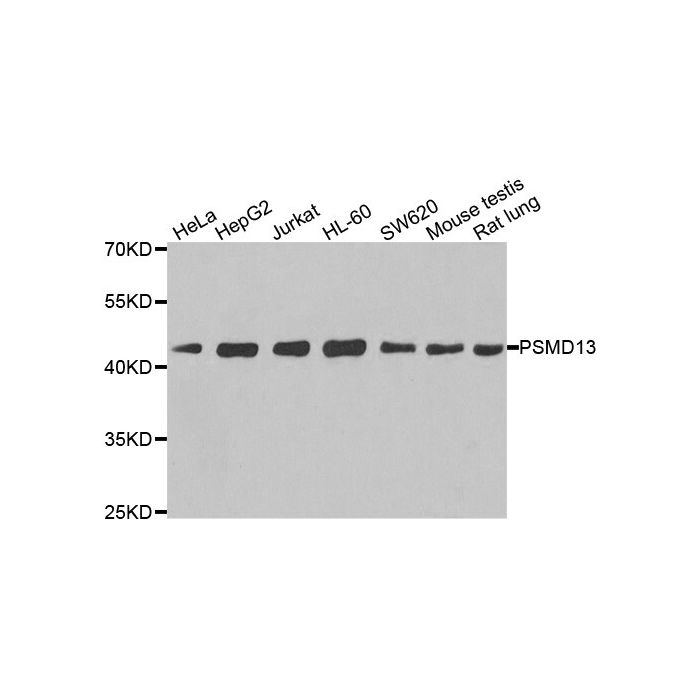
Application Dilution: WB: 1:500~1:2000, IHC: 1:50~1:200, IF: 1:50~1:200
Specificity: PSMD13 polyclonal antibody detects endogenous levels of PSMD13 protein.
Immunogen:
Recombinant full length Human PSMD13.
MW: ~ 43kDa
Swis Prot.: Q9UNM6
Purification & Purity:
The antibody was affinity-purified from rabbit antiserum by affinity-chromatography using epitope-specific immunogen and the purity is > 95% (by SDS-PAGE).
Format:
1mg/ml in PBS with 0.1% Sodium Azide, 50% Glycerol.
Storage:
Store at 4°C short term. Aliquot and store at -20°C long term. Avoid freeze-thaw cycles.
For research use only, not for use in diagnostic procedure.
The 26S proteasome is a multicatalytic proteinase complex with a highly ordered structure composed of 2 complexes, a 20S core and a 19S regulator. The 20S core is composed of 4 rings of 28 non-identical subunits; 2 rings are composed of 7 alpha subunits and 2 rings are composed of 7 beta subunits. The 19S regulator is composed of a base, which contains 6 ATPase subunits and 2 non-ATPase subunits, and a lid, which contains up to 10 non-ATPase subunits. Proteasomes are distributed throughout eukaryotic cells at a high concentration and cleave peptides in an ATP/ubiquitin-dependent process in a non-lysosomal pathway. An essential function of a modified proteasome, the immunoproteasome, is the processing of class I MHC peptides. This gene encodes a non-ATPase subunit of the 19S regulator. Two transcripts encoding different isoforms have been described.
Alternative Name:
26S proteasome non-ATPase regulatory subunit 13, 26S proteasome regulatory subunit RPN9, 26S proteasome regulatory subunit S11, 26S proteasome regulatory subunit p40.5, PSMD13
Application Dilution: WB: 1:500~1:2000, IHC: 1:50~1:200, IF: 1:50~1:200
Specificity: PSMD13 polyclonal antibody detects endogenous levels of PSMD13 protein.
Immunogen:
Recombinant full length Human PSMD13.
MW: ~ 43kDa
Swis Prot.: Q9UNM6
Purification & Purity:
The antibody was affinity-purified from rabbit antiserum by affinity-chromatography using epitope-specific immunogen and the purity is > 95% (by SDS-PAGE).
Format:
1mg/ml in PBS with 0.1% Sodium Azide, 50% Glycerol.
Storage:
Store at 4°C short term. Aliquot and store at -20°C long term. Avoid freeze-thaw cycles.
For research use only, not for use in diagnostic procedure.
| Is Featured? | No |
|---|
Write Your Own Review