
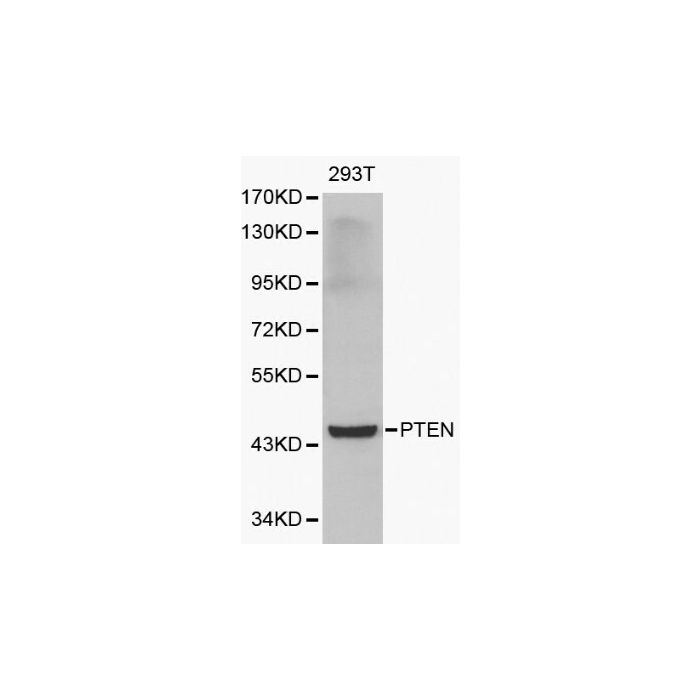
PTEN polyclonal, anti-human, mouse
€388.00
In stock
SKU
BS6493
Background:
As human tumors progress to advanced stages, one genetic alteration that occurs at high frequency is a loss of heterozygosity (LOH) at chromosome 10q23. Mapping of homozygous deletions on this chromosome led to the isolation of the PTEN gene, also designated MMAC1 (for mutated in multiple advanced cancers) and TEP1. This candidate tumor suppressor gene exhibits a high frequency of mutations in human glioblastomas and is also mutated in other cancers, including sporadic brain, breast, kidney and prostate cancers. PTEN has been associated with Cowden disease, an autosomal dominant cancer predisposition syndrome. The PTEN gene product is a putative protein tyrosine phosphatase that is localized to the cytoplasm, and it shares extensive homology with the cytoskeletal proteins tensin and auxilin. Gene transfer studies have indicated that the phosphatase domain of PTEN is essential for growth suppression of glioma cells.
Alternative Name:
Phosphatidylinositol 3,4,5-trisphosphate 3-phosphatase and dual-specificity protein phosphatase PTEN, Mutated in multiple advanced cancers 1, Phosphatase and tensin homolog, PTEN, MMAC1, TEP1
Application Dilution: WB: 1:500~1:2000, IHC: 1:50~1:200
Specificity: PTEN polyclonal antibody detects endogenous levels of PTEN protein.
Immunogen:
Recombinant full length Human PTEN.
MW: ~ 47, 54 kDa
Swis Prot.: P60484
Purification & Purity:
The antibody was affinity-purified from rabbit antiserum by affinity-chromatography using epitope-specific immunogen and the purity is > 95% (by SDS-PAGE).
Format:
1mg/ml in PBS with 0.1% Sodium Azide, 50% Glycerol.
Storage:
Store at 4°C short term. Aliquot and store at -20°C long term. Avoid freeze-thaw cycles.
For research use only, not for use in diagnostic procedure.
As human tumors progress to advanced stages, one genetic alteration that occurs at high frequency is a loss of heterozygosity (LOH) at chromosome 10q23. Mapping of homozygous deletions on this chromosome led to the isolation of the PTEN gene, also designated MMAC1 (for mutated in multiple advanced cancers) and TEP1. This candidate tumor suppressor gene exhibits a high frequency of mutations in human glioblastomas and is also mutated in other cancers, including sporadic brain, breast, kidney and prostate cancers. PTEN has been associated with Cowden disease, an autosomal dominant cancer predisposition syndrome. The PTEN gene product is a putative protein tyrosine phosphatase that is localized to the cytoplasm, and it shares extensive homology with the cytoskeletal proteins tensin and auxilin. Gene transfer studies have indicated that the phosphatase domain of PTEN is essential for growth suppression of glioma cells.
Alternative Name:
Phosphatidylinositol 3,4,5-trisphosphate 3-phosphatase and dual-specificity protein phosphatase PTEN, Mutated in multiple advanced cancers 1, Phosphatase and tensin homolog, PTEN, MMAC1, TEP1
Application Dilution: WB: 1:500~1:2000, IHC: 1:50~1:200
Specificity: PTEN polyclonal antibody detects endogenous levels of PTEN protein.
Immunogen:
Recombinant full length Human PTEN.
MW: ~ 47, 54 kDa
Swis Prot.: P60484
Purification & Purity:
The antibody was affinity-purified from rabbit antiserum by affinity-chromatography using epitope-specific immunogen and the purity is > 95% (by SDS-PAGE).
Format:
1mg/ml in PBS with 0.1% Sodium Azide, 50% Glycerol.
Storage:
Store at 4°C short term. Aliquot and store at -20°C long term. Avoid freeze-thaw cycles.
For research use only, not for use in diagnostic procedure.
| Is Featured? | No |
|---|
Write Your Own Review