
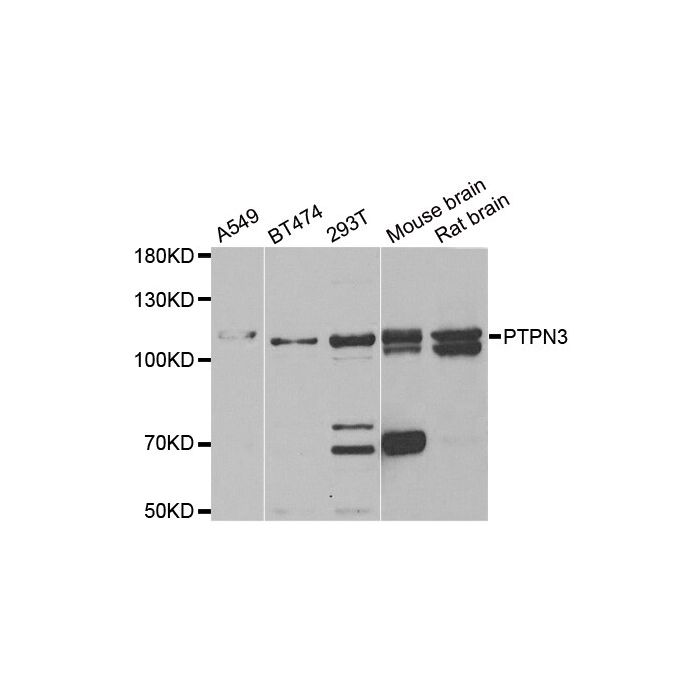
PTPN3 polyclonal, anti-human, mouse, rat
€388.00
In stock
SKU
BS8188
Background:
The phosphorylation of proteins at tyrosine residues has long been recognized as an important regulatory component of signal transduction. This is a reversible process, involving both enzymes that phosphorylate proteins on tyrosine residues as well as a rapidly expanding family of protein tyrosine phosphatases. These latter enzymes bear little resemblance to either the protein serine and protein threonine phosphatases or to the acid and alkaline phosphatases. In most tissues, the major PTPase is a vanadate- and molybdate-sensitive protein. PTP-H1 shares homology with the cytoskeletal-associated proteins band 4.1, ezrin, and talin and has been shown to contain a PDZ and band 4.1 domain. These domains are responsible for targeting proteins to the cytoskeleton-membrane interface, as well as mediating protein-protein interactions, recognizing C-terminal valine residues and binding to other PDZ domains. Overexpression of PTP-H1 may reverse transformation induced by oncogenic protein-tyrosine kinases, such as the members of the src family.
Alternative Name:
Tyrosine-protein phosphatase non-receptor type 3, Protein-tyrosine phosphatase H1, PTP-H1, PTPN3, PTPH1
Application Dilution: WB: 1:500~1:2000, IHC: 1:50~1:200
Specificity: PTPN3 polyclonal antibody detects endogenous levels of PTPN3 protein.
Immunogen:
Recombinant full length Human PTPN3.
MW: ~ 104 kDa
Swis Prot.: P26045
Purification & Purity:
The antibody was affinity-purified from rabbit antiserum by affinity-chromatography using epitope-specific immunogen and the purity is > 95% (by SDS-PAGE).
Format:
1mg/ml in PBS with 0.1% Sodium Azide, 50% Glycerol.
Storage:
Store at 4°C short term. Aliquot and store at -20°C long term. Avoid freeze-thaw cycles.
For research use only, not for use in diagnostic procedure.
The phosphorylation of proteins at tyrosine residues has long been recognized as an important regulatory component of signal transduction. This is a reversible process, involving both enzymes that phosphorylate proteins on tyrosine residues as well as a rapidly expanding family of protein tyrosine phosphatases. These latter enzymes bear little resemblance to either the protein serine and protein threonine phosphatases or to the acid and alkaline phosphatases. In most tissues, the major PTPase is a vanadate- and molybdate-sensitive protein. PTP-H1 shares homology with the cytoskeletal-associated proteins band 4.1, ezrin, and talin and has been shown to contain a PDZ and band 4.1 domain. These domains are responsible for targeting proteins to the cytoskeleton-membrane interface, as well as mediating protein-protein interactions, recognizing C-terminal valine residues and binding to other PDZ domains. Overexpression of PTP-H1 may reverse transformation induced by oncogenic protein-tyrosine kinases, such as the members of the src family.
Alternative Name:
Tyrosine-protein phosphatase non-receptor type 3, Protein-tyrosine phosphatase H1, PTP-H1, PTPN3, PTPH1
Application Dilution: WB: 1:500~1:2000, IHC: 1:50~1:200
Specificity: PTPN3 polyclonal antibody detects endogenous levels of PTPN3 protein.
Immunogen:
Recombinant full length Human PTPN3.
MW: ~ 104 kDa
Swis Prot.: P26045
Purification & Purity:
The antibody was affinity-purified from rabbit antiserum by affinity-chromatography using epitope-specific immunogen and the purity is > 95% (by SDS-PAGE).
Format:
1mg/ml in PBS with 0.1% Sodium Azide, 50% Glycerol.
Storage:
Store at 4°C short term. Aliquot and store at -20°C long term. Avoid freeze-thaw cycles.
For research use only, not for use in diagnostic procedure.
| Is Featured? | No |
|---|
Write Your Own Review