
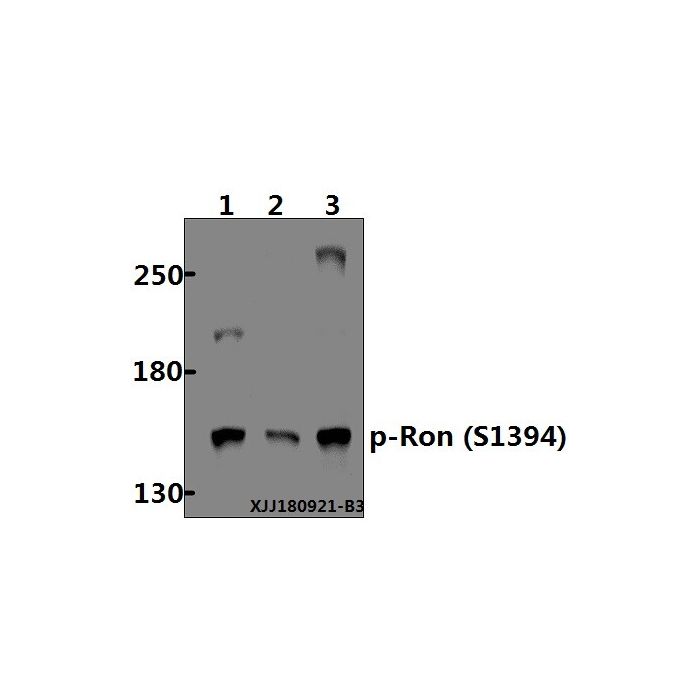
Ron (phospho-S1394) polyclonal, anti-human
€328.00
In stock
SKU
BS4382
Catalog Number: BS4382
Size: 100 µl
Other Size: 50 µl
Isotype: rabbit IgG
Applications: WB
Questions? Contact us!
Size: 100 µl
Other Size: 50 µl
Isotype: rabbit IgG
Applications: WB
Questions? Contact us!
Background:
Ron is a member of the Met protooncogene family of receptor tyrosine kinases, which also includes Stk, c-Met, and c-Sea. The functional Ron is a heterodimer composed of a 40 kDa α chain and a 150 kDa β chain. Ron is initially synthesized in the cells as a single-chain, pro-Ron precursor that is cleaved into the two active chains. The α chain is completely extracellular, whereas the β chain traverses the cell membrane and contains the intracellular tyrosine kinase and regulatory elements. Ron mediates multiple signaling cascades that involve cell motility, adhesion, proliferation, and apoptosis. The signaling pathways activated downstream of Ron include the ras/mitogen-activated protein kinase (MAPK), phosphatidyl inositol-3 kinase (PI3K)/Akt, and focal adhesion kinase (FAK) pathways. Ron activation can also significantly increase c-Src activity, a signaling intermediate involved in cell cycle progression, motility, angiogenesis and survival. The function of Ron has been shown to be important for embryological development as well as implicated in the progression and metastasis of tumors.
Alternative Name:
Macrophage-stimulating protein receptor, MSP receptor, CDw136, Protein-tyrosine kinase 8, p185-Ron, CD_antigen, CD136, MST1R, PTK8, RON
Application Dilution:
WB: 1:500~1:1000
Specificity: Ron (phospho-S1394) polyclonal antibody detects endogenous levels of Ron protein only when phosphorylated at Ser1394.
Immunogen:
Synthetic phosphopeptide derived from human Ron around the phosphorylation site of Serine 1394
MW: ~ 145, 150 kDa
Swiss-Prot: Q04912
Purification & Purity:
The antibody was affinity-purified from rabbit antiserum by affinity-chromatography using epitope-specific immunogen and the purity is > 95% (by SDS-PAGE).
Format:
Rabbit IgG, 1mg/ml in PBS with 0.02% sodium azide, 50% glycerol, pH7.2
Storage:
Store at 4°C short term. Aliquot and store at -20°C long term. Avoid freeze-thaw cycles.
For research use only, not for use in diagnostic procedure.
Ron is a member of the Met protooncogene family of receptor tyrosine kinases, which also includes Stk, c-Met, and c-Sea. The functional Ron is a heterodimer composed of a 40 kDa α chain and a 150 kDa β chain. Ron is initially synthesized in the cells as a single-chain, pro-Ron precursor that is cleaved into the two active chains. The α chain is completely extracellular, whereas the β chain traverses the cell membrane and contains the intracellular tyrosine kinase and regulatory elements. Ron mediates multiple signaling cascades that involve cell motility, adhesion, proliferation, and apoptosis. The signaling pathways activated downstream of Ron include the ras/mitogen-activated protein kinase (MAPK), phosphatidyl inositol-3 kinase (PI3K)/Akt, and focal adhesion kinase (FAK) pathways. Ron activation can also significantly increase c-Src activity, a signaling intermediate involved in cell cycle progression, motility, angiogenesis and survival. The function of Ron has been shown to be important for embryological development as well as implicated in the progression and metastasis of tumors.
Alternative Name:
Macrophage-stimulating protein receptor, MSP receptor, CDw136, Protein-tyrosine kinase 8, p185-Ron, CD_antigen, CD136, MST1R, PTK8, RON
Application Dilution:
WB: 1:500~1:1000
Specificity: Ron (phospho-S1394) polyclonal antibody detects endogenous levels of Ron protein only when phosphorylated at Ser1394.
Immunogen:
Synthetic phosphopeptide derived from human Ron around the phosphorylation site of Serine 1394
MW: ~ 145, 150 kDa
Swiss-Prot: Q04912
Purification & Purity:
The antibody was affinity-purified from rabbit antiserum by affinity-chromatography using epitope-specific immunogen and the purity is > 95% (by SDS-PAGE).
Format:
Rabbit IgG, 1mg/ml in PBS with 0.02% sodium azide, 50% glycerol, pH7.2
Storage:
Store at 4°C short term. Aliquot and store at -20°C long term. Avoid freeze-thaw cycles.
For research use only, not for use in diagnostic procedure.
| Is Featured? | No |
|---|
Write Your Own Review