
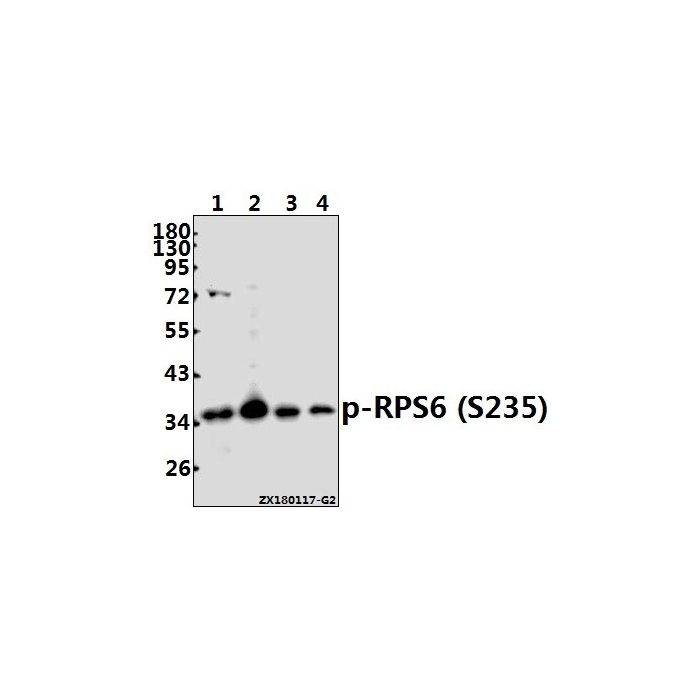
RPS6 (phospho-S235) polyclonal, anti-human, mouse, rat
€328.00
In stock
SKU
BS4745
Background:
Ribosomal protein S6 is a component of the small 40S ribosomeal subunit and belongs to the S6E family of ribosomal proteins. It is the major substrate of protein kinases in the ribosome, with subsets of five C-terminal serine residues phosphorylated by different protein kinases. Phosphorylation is induced by a wide range of stimuli, including growth factors, tumor-promoting agents, and mitogens. Dephosphorylation occurs at growth arrest. The protein may contribute to the control of cell growth and proliferation through the selective translation of particular classes of mRNA. As is typical for genes encoding ribosomal proteins, there are multiple processed pseudogenes of this gene dispersed through the genome.
Alternative Name:
40S ribosomal protein S6, Phosphoprotein NP33, RPS6, OK/SW-cl.2
Application Dilution: WB: 1:500~1:1000, IF: 1:200
Specificity: p-Ribosomal Protein S6 (S235) polyclonal antibody detects endogenous levels of Ribosomal Protein S6 protein only when phosphorylated at Ser235.
Immunogen:
Synthetic phosphopeptide derived from human Ribosomal Protein S6 around the phosphorylation site of Serine 235.
MW: ~ 29 kDa
Swis Prot.: P62753
Purification & Purity:
The antibody was affinity-purified from rabbit antiserum by affinity-chromatography using epitope-specific immunogen and the purity is > 95% (by SDS-PAGE).
Format:
1 mg/ml in Phosphate buffered saline (PBS) with 0.05% sodium azide, approx. pH 7.2.
Storage:
Store at 4°C short term. Aliquot and store at -20°C long term. Avoid freeze-thaw cycles.
For research use only, not for use in diagnostic procedure.
Ribosomal protein S6 is a component of the small 40S ribosomeal subunit and belongs to the S6E family of ribosomal proteins. It is the major substrate of protein kinases in the ribosome, with subsets of five C-terminal serine residues phosphorylated by different protein kinases. Phosphorylation is induced by a wide range of stimuli, including growth factors, tumor-promoting agents, and mitogens. Dephosphorylation occurs at growth arrest. The protein may contribute to the control of cell growth and proliferation through the selective translation of particular classes of mRNA. As is typical for genes encoding ribosomal proteins, there are multiple processed pseudogenes of this gene dispersed through the genome.
Alternative Name:
40S ribosomal protein S6, Phosphoprotein NP33, RPS6, OK/SW-cl.2
Application Dilution: WB: 1:500~1:1000, IF: 1:200
Specificity: p-Ribosomal Protein S6 (S235) polyclonal antibody detects endogenous levels of Ribosomal Protein S6 protein only when phosphorylated at Ser235.
Immunogen:
Synthetic phosphopeptide derived from human Ribosomal Protein S6 around the phosphorylation site of Serine 235.
MW: ~ 29 kDa
Swis Prot.: P62753
Purification & Purity:
The antibody was affinity-purified from rabbit antiserum by affinity-chromatography using epitope-specific immunogen and the purity is > 95% (by SDS-PAGE).
Format:
1 mg/ml in Phosphate buffered saline (PBS) with 0.05% sodium azide, approx. pH 7.2.
Storage:
Store at 4°C short term. Aliquot and store at -20°C long term. Avoid freeze-thaw cycles.
For research use only, not for use in diagnostic procedure.
| Is Featured? | No |
|---|
Write Your Own Review