
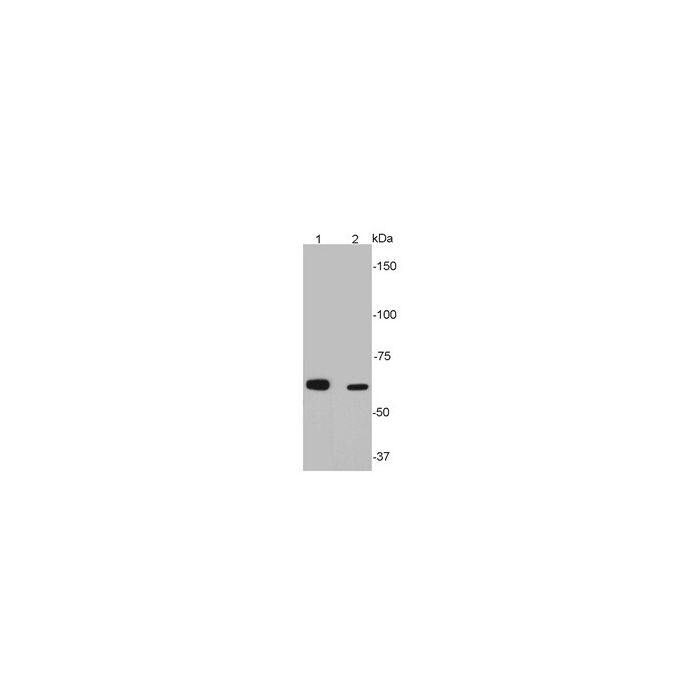
SQSTM1 (clone ) , anti-human, mouse, rat
€428.00
In stock
SKU
MB9009
Background:
Sequestosome 1 (SQSTM1, p62) is a ubiquitin binding protein involved in cell signaling, oxidative stress and autophagy. It was first identified as a protein that binds to the SH2 domain of p56Lck and independently found to interact with PKCζ. SQSTM1 was subsequently found to interact with ubiquitin, providing a scaffold for several signaling proteins and triggering degradation of proteins through the proteasome or lysosome. Interaction between SQSTM1 and TRAF6 leads to the K63-linked polyubiquitination of TRAF6 and subsequent activation of the NF-κB pathway. It may play a role in titin/TTN downstream signaling in muscle cells and regulate signaling cascades through ubiquitination. P62 may be involved in cell differentiation, apoptosis, immune response and regulation of K+ channels.
Alternative Name:
Sequestosome-1, EBI3-associated protein of 60 kDa, EBIAP, p60, Phosphotyrosine-independent ligand for the Lck SH2 domain of 62 kDa, Ubiquitin-binding protein p62, SQSTM1, ORCA, OSIL
Application Dilution: WB: 1:500-1:1000, ICC: 1:200, IHC: 1:200, FC: 1:50-1:100
Specificity: This antibody detects endogenous levels of SQSTM1 and does not cross-react with related proteins.
Immunogen:
This antibody is produced by immunizing mice with a synthetic peptide (KLH-coupled) corresponding to internal SQSTM1.
MW: ~ 62 kDa
Swis Prot.: Q13501
Purification & Purity:
Protein A affinity purified
Format:
Mouse IgG1. 1*TBS (pH7.4), 1%BSA, 40%Glycerol. Preservative: 0.05% Sodium Azide.
Storage:
Store at 4°C short term. Aliquot and store at -20°C long term. Avoid freeze-thaw cycles.
For research use only, not for use in diagnostic procedure.
Sequestosome 1 (SQSTM1, p62) is a ubiquitin binding protein involved in cell signaling, oxidative stress and autophagy. It was first identified as a protein that binds to the SH2 domain of p56Lck and independently found to interact with PKCζ. SQSTM1 was subsequently found to interact with ubiquitin, providing a scaffold for several signaling proteins and triggering degradation of proteins through the proteasome or lysosome. Interaction between SQSTM1 and TRAF6 leads to the K63-linked polyubiquitination of TRAF6 and subsequent activation of the NF-κB pathway. It may play a role in titin/TTN downstream signaling in muscle cells and regulate signaling cascades through ubiquitination. P62 may be involved in cell differentiation, apoptosis, immune response and regulation of K+ channels.
Alternative Name:
Sequestosome-1, EBI3-associated protein of 60 kDa, EBIAP, p60, Phosphotyrosine-independent ligand for the Lck SH2 domain of 62 kDa, Ubiquitin-binding protein p62, SQSTM1, ORCA, OSIL
Application Dilution: WB: 1:500-1:1000, ICC: 1:200, IHC: 1:200, FC: 1:50-1:100
Specificity: This antibody detects endogenous levels of SQSTM1 and does not cross-react with related proteins.
Immunogen:
This antibody is produced by immunizing mice with a synthetic peptide (KLH-coupled) corresponding to internal SQSTM1.
MW: ~ 62 kDa
Swis Prot.: Q13501
Purification & Purity:
Protein A affinity purified
Format:
Mouse IgG1. 1*TBS (pH7.4), 1%BSA, 40%Glycerol. Preservative: 0.05% Sodium Azide.
Storage:
Store at 4°C short term. Aliquot and store at -20°C long term. Avoid freeze-thaw cycles.
For research use only, not for use in diagnostic procedure.
| Is Featured? | No |
|---|
Write Your Own Review