
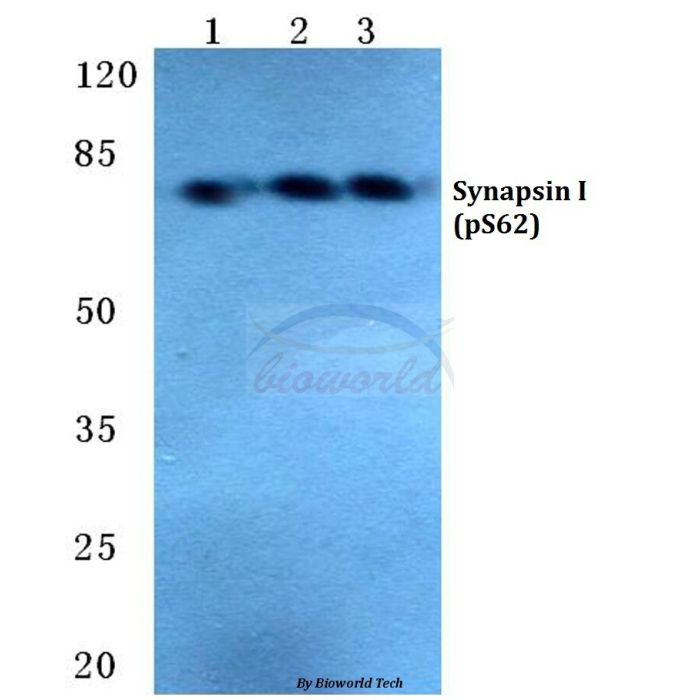
Synapsin I (phospho-S62) polyclonal, anti-human, mouse, rat
€328.00
In stock
SKU
BS4879
Background:
Synapsin I is a member of the synapsin family. Synapsins are neuronal phosphoproteins which associate with the cytoplasmic surface of synaptic vesicles. Family members are characterized by common protein domains, and they are implicated in synaptogenesis and the modulation of neurotransmitter release, suggesting a potential role in several neuropsychiatric diseases. This member of the synapsin family plays a role in regulation of axonogenesis and synaptogenesis. The protein serves as a substrate for several different protein kinases and phosphorylation may function in the regulation of this protein in the nerve terminal. Mutations of the Synapsin I gene may be associated with X linked disorders with primary neuronal degeneration such as Rett syndrome.
Alternative Name:
Synapsin-1, Synapsin 1, Synapsin1, Brain protein 4.1, Synapsin I, SYN1
Application Dilution: WB: 1:500~1:1000
Specificity: p-Synapsin I (S62) polyclonal antibody detects endogenous levels of Synapsin I protein when phosphorylated at Ser62.
Immunogen:
Synthetic phosphopeptide derived from human Synapsin I around the phosphorylation site of Serine 62.
MW: ~ 80 kDa
Swis Prot.: P17600
Purification & Purity:
The antibody was affinity-purified from rabbit antiserum by affinity-chromatography using epitope-specific immunogen and the purity is > 95% (by SDS-PAGE).
Format:
1 mg/ml in Phosphate buffered saline (PBS) with 15 mM sodium azide, approx. pH 7.2.
Storage:
Store at 4°C short term. Aliquot and store at -20°C long term. Avoid freeze-thaw cycles.
For research use only, not for use in diagnostic procedure.
Synapsin I is a member of the synapsin family. Synapsins are neuronal phosphoproteins which associate with the cytoplasmic surface of synaptic vesicles. Family members are characterized by common protein domains, and they are implicated in synaptogenesis and the modulation of neurotransmitter release, suggesting a potential role in several neuropsychiatric diseases. This member of the synapsin family plays a role in regulation of axonogenesis and synaptogenesis. The protein serves as a substrate for several different protein kinases and phosphorylation may function in the regulation of this protein in the nerve terminal. Mutations of the Synapsin I gene may be associated with X linked disorders with primary neuronal degeneration such as Rett syndrome.
Alternative Name:
Synapsin-1, Synapsin 1, Synapsin1, Brain protein 4.1, Synapsin I, SYN1
Application Dilution: WB: 1:500~1:1000
Specificity: p-Synapsin I (S62) polyclonal antibody detects endogenous levels of Synapsin I protein when phosphorylated at Ser62.
Immunogen:
Synthetic phosphopeptide derived from human Synapsin I around the phosphorylation site of Serine 62.
MW: ~ 80 kDa
Swis Prot.: P17600
Purification & Purity:
The antibody was affinity-purified from rabbit antiserum by affinity-chromatography using epitope-specific immunogen and the purity is > 95% (by SDS-PAGE).
Format:
1 mg/ml in Phosphate buffered saline (PBS) with 15 mM sodium azide, approx. pH 7.2.
Storage:
Store at 4°C short term. Aliquot and store at -20°C long term. Avoid freeze-thaw cycles.
For research use only, not for use in diagnostic procedure.
| Is Featured? | No |
|---|
Write Your Own Review