
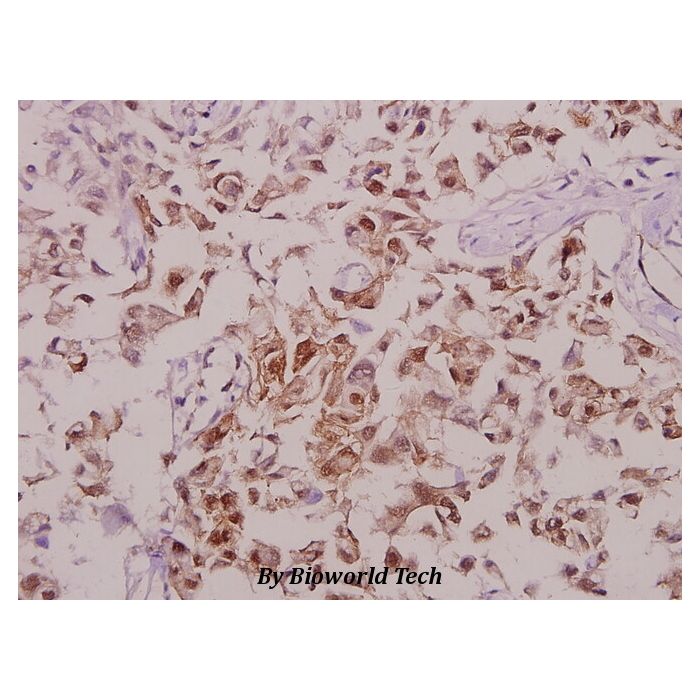
TH (phospho-S71) polyclonal, anti-human, mouse, rat
€328.00
In stock
SKU
BS4203
Background:
The enzyme tyrosine hydroxylase (TH), also designated tyrosine 3-monooxygenase (TY3H), catalyzes the conversion of tyrosine to L-dopa, which is the rate limiting step in the biosynthesis of catecholamines such as dopamine, adrenalin and noradrenalin. TH is thought to play a role in the pathogenesis of Parkinson’s disease, which is associated with reduced dopamine levels. Two transcription factor binding sites in the proximal region of the TH gene, the TPA-responsive element (TRE) and the c-AMP responsive element (CRE), have been implicated in the complex regulation of the TH gene. TH is also known to be upregulated by the glia maturation factor (GMF), a Cdc 10/SWI6 motif-containing protein called V-1, and a variety of additional compounds
Alternative Name:
Tyrosine 3-monooxygenase, Tyrosine 3-hydroxylase, TH, TYH
Application Dilution: IHC: 1:50~1:200
Specificity: p-TH (S71) polyclonal antibody detects endogenous levels of TH protein only when phosphorylated at Ser71.
Immunogen:
Synthetic phosphopeptide derived from human TH around the phosphorylation site of Serine 71.
MW: ~ 58 kDa
Swis Prot.: P07101
Purification & Purity:
The antibody was affinity-purified from rabbit antiserum by affinity-chromatography using epitope-specific immunogen and the purity is > 95% (by SDS-PAGE).
Format:
1 mg/ml in Phosphate buffered saline (PBS) with 0.05% sodium azide, approx. pH 7.2.
Storage:
Store at 4°C short term. Aliquot and store at -20°C long term. Avoid freeze-thaw cycles.
For research use only, not for use in diagnostic procedure.
The enzyme tyrosine hydroxylase (TH), also designated tyrosine 3-monooxygenase (TY3H), catalyzes the conversion of tyrosine to L-dopa, which is the rate limiting step in the biosynthesis of catecholamines such as dopamine, adrenalin and noradrenalin. TH is thought to play a role in the pathogenesis of Parkinson’s disease, which is associated with reduced dopamine levels. Two transcription factor binding sites in the proximal region of the TH gene, the TPA-responsive element (TRE) and the c-AMP responsive element (CRE), have been implicated in the complex regulation of the TH gene. TH is also known to be upregulated by the glia maturation factor (GMF), a Cdc 10/SWI6 motif-containing protein called V-1, and a variety of additional compounds
Alternative Name:
Tyrosine 3-monooxygenase, Tyrosine 3-hydroxylase, TH, TYH
Application Dilution: IHC: 1:50~1:200
Specificity: p-TH (S71) polyclonal antibody detects endogenous levels of TH protein only when phosphorylated at Ser71.
Immunogen:
Synthetic phosphopeptide derived from human TH around the phosphorylation site of Serine 71.
MW: ~ 58 kDa
Swis Prot.: P07101
Purification & Purity:
The antibody was affinity-purified from rabbit antiserum by affinity-chromatography using epitope-specific immunogen and the purity is > 95% (by SDS-PAGE).
Format:
1 mg/ml in Phosphate buffered saline (PBS) with 0.05% sodium azide, approx. pH 7.2.
Storage:
Store at 4°C short term. Aliquot and store at -20°C long term. Avoid freeze-thaw cycles.
For research use only, not for use in diagnostic procedure.
| Is Featured? | No |
|---|
Write Your Own Review