
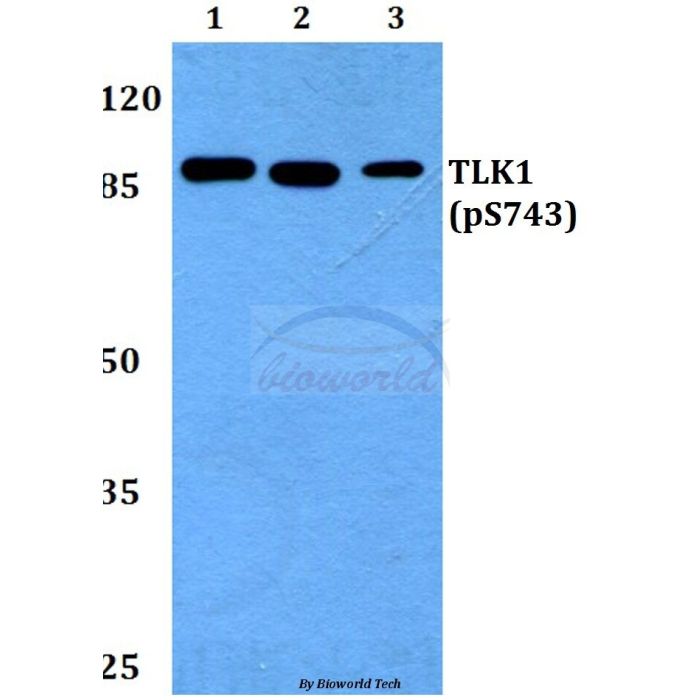
TLK1 (phospho-S743) polyclonal, anti-human, mouse, rat
€328.00
In stock
SKU
BS64008
Background:
The Tousled-like kinases (TLK1 and TLK2, also designated PKU-β and PKU-α, respectively) are the human homologs of the Tousled gene from Arabidopsis thaliana, which encodes a Serine/Threonine kinase that is necessary for proper organ morphogenesis. Both TLKs contain a nuclear localization signal and a predicted coiled-coil region in the N-terminal domain. TLK is ubiquitously expressed, and is prevalent in mouse testis, especially in pachytene spermatocytes and round spermatids. It displays a propensity to dimerize through an interaction between its coiled-coil structure and is able to autophosphorylate, as well as phosphorylate exogenous substrates. TLK1 and TLK2 are regulated by the cell cycle, showing maximum activity during S phase. Subsequently, they are thought to regulate the development of multicellular organisms, including playing a key role in spermatogenesis, through a series of phosphorylations.
Alternative Name:
Serine/threonine-protein kinase tousled-like 1, PKU-beta, Tousled-like kinase 1, TLK-1, KIAA0137, PKU-β, PKU β, PKUβ
Application Dilution: WB: 1:500~1:1000
Specificity: p-TLK1 (S743) polyclonal antibody detects endogenous levels of TLK1 protein only when phosphorylated at Ser743.
Immunogen:
Synthetic phosphopeptide derived from human TLK1 around the phosphorylation site of Serine 743.
MW: ~ 86 kDa
Swis Prot.: Q9UKI8
Purification & Purity:
The antibody was affinity-purified from rabbit antiserum by affinity-chromatography using epitope-specific immunogen and the purity is > 95% (by SDS-PAGE).
Format:
1mg/ml in PBS with 0.1% Sodium Azide, 50% Glycerol.
Storage:
Store at 4°C short term. Aliquot and store at -20°C long term. Avoid freeze-thaw cycles.
For research use only, not for use in diagnostic procedure.
The Tousled-like kinases (TLK1 and TLK2, also designated PKU-β and PKU-α, respectively) are the human homologs of the Tousled gene from Arabidopsis thaliana, which encodes a Serine/Threonine kinase that is necessary for proper organ morphogenesis. Both TLKs contain a nuclear localization signal and a predicted coiled-coil region in the N-terminal domain. TLK is ubiquitously expressed, and is prevalent in mouse testis, especially in pachytene spermatocytes and round spermatids. It displays a propensity to dimerize through an interaction between its coiled-coil structure and is able to autophosphorylate, as well as phosphorylate exogenous substrates. TLK1 and TLK2 are regulated by the cell cycle, showing maximum activity during S phase. Subsequently, they are thought to regulate the development of multicellular organisms, including playing a key role in spermatogenesis, through a series of phosphorylations.
Alternative Name:
Serine/threonine-protein kinase tousled-like 1, PKU-beta, Tousled-like kinase 1, TLK-1, KIAA0137, PKU-β, PKU β, PKUβ
Application Dilution: WB: 1:500~1:1000
Specificity: p-TLK1 (S743) polyclonal antibody detects endogenous levels of TLK1 protein only when phosphorylated at Ser743.
Immunogen:
Synthetic phosphopeptide derived from human TLK1 around the phosphorylation site of Serine 743.
MW: ~ 86 kDa
Swis Prot.: Q9UKI8
Purification & Purity:
The antibody was affinity-purified from rabbit antiserum by affinity-chromatography using epitope-specific immunogen and the purity is > 95% (by SDS-PAGE).
Format:
1mg/ml in PBS with 0.1% Sodium Azide, 50% Glycerol.
Storage:
Store at 4°C short term. Aliquot and store at -20°C long term. Avoid freeze-thaw cycles.
For research use only, not for use in diagnostic procedure.
| Is Featured? | No |
|---|
Write Your Own Review