
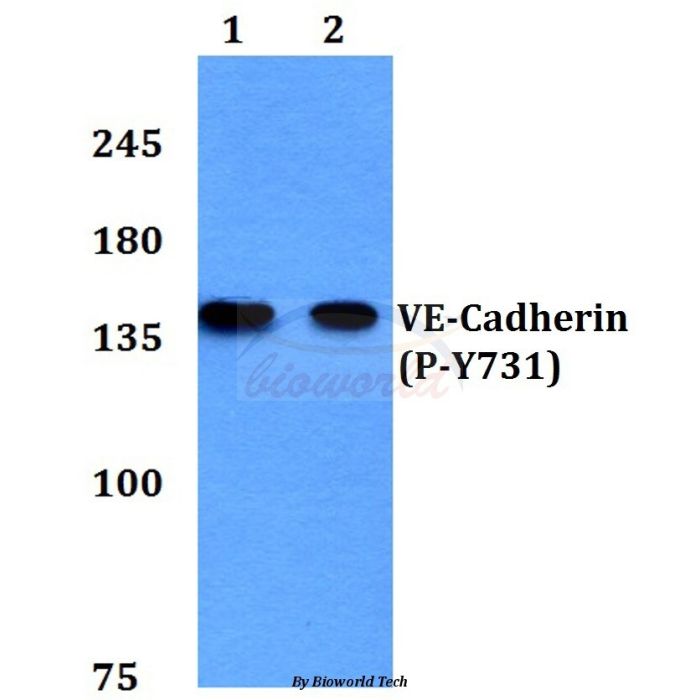
VE-Cadherin (phospho-Y731) polyclonal, anti-human, mouse, rat
€328.00
In stock
SKU
BS4242
Background:
The cadherins are a family of Ca 2+-dependent adhesion molecules that function to mediate cell-cell binding critical to the maintenance of tissue structure and morphogenesis. Cadherins each contain a large extracellular domain at the amino-terminus, which is characterized by a series of five homologous repeats, the most distal of which is thought to be responsible for binding specificity. The relatively short carboxy-terminal, intracellular domain interacts with a variety of cytoplasmic proteins, including β-catenin, to regulate cadherin function. VE-cadherin (for vascular endothelial cadherin, also designated cadherin-5) is localized at intercellular junctions of endothelial cells, where it is thought to play a role in the cohesion and organization of intercellular junctions.
Alternative Name:
Cadherin-5, 7B4 antigen, Vascular endothelial cadherin, VE-cadherin, CD144, CDH5, Cadherin 5
Application Dilution: WB: 1:500~1:1000, IHC: 1:50~1:200
Specificity: p-VE-Cadherin (Y731) polyclonal antibody detects endogenous levels of VE-Cadherin protein only when phosphorylated at Tyr731
Immunogen:
Synthetic phosphopeptide derived from human VE-Cadherin around the phosphorylation site of Tyrosine 731.
MW: ~ 130 kDa
Swis Prot.: P33151
Purification & Purity:
The antibody was affinity-purified from rabbit antiserum by affinity-chromatography using epitope-specific immunogen and the purity is > 95% (by SDS-PAGE).
Format:
1 mg/ml in Phosphate buffered saline (PBS) with 0.05% sodium azide, approx. pH 7.2.
Storage:
Store at 4°C short term. Aliquot and store at -20°C long term. Avoid freeze-thaw cycles.
For research use only, not for use in diagnostic procedure.
The cadherins are a family of Ca 2+-dependent adhesion molecules that function to mediate cell-cell binding critical to the maintenance of tissue structure and morphogenesis. Cadherins each contain a large extracellular domain at the amino-terminus, which is characterized by a series of five homologous repeats, the most distal of which is thought to be responsible for binding specificity. The relatively short carboxy-terminal, intracellular domain interacts with a variety of cytoplasmic proteins, including β-catenin, to regulate cadherin function. VE-cadherin (for vascular endothelial cadherin, also designated cadherin-5) is localized at intercellular junctions of endothelial cells, where it is thought to play a role in the cohesion and organization of intercellular junctions.
Alternative Name:
Cadherin-5, 7B4 antigen, Vascular endothelial cadherin, VE-cadherin, CD144, CDH5, Cadherin 5
Application Dilution: WB: 1:500~1:1000, IHC: 1:50~1:200
Specificity: p-VE-Cadherin (Y731) polyclonal antibody detects endogenous levels of VE-Cadherin protein only when phosphorylated at Tyr731
Immunogen:
Synthetic phosphopeptide derived from human VE-Cadherin around the phosphorylation site of Tyrosine 731.
MW: ~ 130 kDa
Swis Prot.: P33151
Purification & Purity:
The antibody was affinity-purified from rabbit antiserum by affinity-chromatography using epitope-specific immunogen and the purity is > 95% (by SDS-PAGE).
Format:
1 mg/ml in Phosphate buffered saline (PBS) with 0.05% sodium azide, approx. pH 7.2.
Storage:
Store at 4°C short term. Aliquot and store at -20°C long term. Avoid freeze-thaw cycles.
For research use only, not for use in diagnostic procedure.
| Is Featured? | No |
|---|
Write Your Own Review