
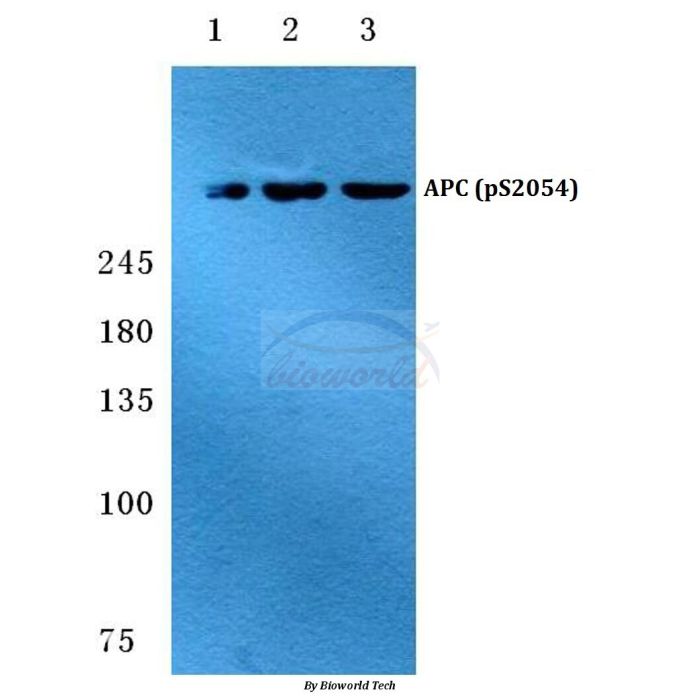
APC (phospho-S2054) polyclonal, anti-human, mouse, rat
€328.00
In stock
SKU
BS4649
Background:
Adenomatous polyposis coli (APC) is a protein that plays a critical role in several cellular processes. APC is a tumor suppressor, regulates cell division, helps ensure that the number of chromosomes in a cell is correct following cell division and associates with other proteins involved in cell attachment and signaling. APC regulates ß-catenin levels through Wnt-signaling and is involved in actin cytoskeletal integrity, cell-cell adhesion and cell migration. Defects in this gene cause familial adenomatous polyposis (FAP), an autosomal dominant pre-malignant disease that usually progresses to malignancy. Disease-associated mutations tend to be clustered in a small region designated the mutation cluster region (MCR) and result in a truncated protein product.
Alternative Name:
Adenomatous polyposis coli protein, Protein APC, Deleted in polyposis 2.5, APC, DP2.5
Application Dilution: WB: 1:500~1:1000, IHC: 1:50~1:200
Specificity: p-APC (S2054) polyclonal antibody detects endogenous levels of APC protein when phosphorylated at Ser2054.
Immunogen:
Synthetic phosphopeptide derived from human APC around the phosphorylation site of Serine 2054.
MW: ~ 310 kDa
Swis Prot.: P25054
Purification & Purity:
The antibody was affinity-purified from rabbit antiserum by affinity-chromatography using epitope-specific immunogen and the purity is > 95% (by SDS-PAGE).
Format:
1 mg/ml in Phosphate buffered saline (PBS) with 0.05% sodium azide, approx. pH 7.2.
Storage:
Store at 4°C short term. Aliquot and store at -20°C long term. Avoid freeze-thaw cycles.
For research use only, not for use in diagnostic procedure.
Adenomatous polyposis coli (APC) is a protein that plays a critical role in several cellular processes. APC is a tumor suppressor, regulates cell division, helps ensure that the number of chromosomes in a cell is correct following cell division and associates with other proteins involved in cell attachment and signaling. APC regulates ß-catenin levels through Wnt-signaling and is involved in actin cytoskeletal integrity, cell-cell adhesion and cell migration. Defects in this gene cause familial adenomatous polyposis (FAP), an autosomal dominant pre-malignant disease that usually progresses to malignancy. Disease-associated mutations tend to be clustered in a small region designated the mutation cluster region (MCR) and result in a truncated protein product.
Alternative Name:
Adenomatous polyposis coli protein, Protein APC, Deleted in polyposis 2.5, APC, DP2.5
Application Dilution: WB: 1:500~1:1000, IHC: 1:50~1:200
Specificity: p-APC (S2054) polyclonal antibody detects endogenous levels of APC protein when phosphorylated at Ser2054.
Immunogen:
Synthetic phosphopeptide derived from human APC around the phosphorylation site of Serine 2054.
MW: ~ 310 kDa
Swis Prot.: P25054
Purification & Purity:
The antibody was affinity-purified from rabbit antiserum by affinity-chromatography using epitope-specific immunogen and the purity is > 95% (by SDS-PAGE).
Format:
1 mg/ml in Phosphate buffered saline (PBS) with 0.05% sodium azide, approx. pH 7.2.
Storage:
Store at 4°C short term. Aliquot and store at -20°C long term. Avoid freeze-thaw cycles.
For research use only, not for use in diagnostic procedure.
| Is Featured? | No |
|---|
Write Your Own Review