
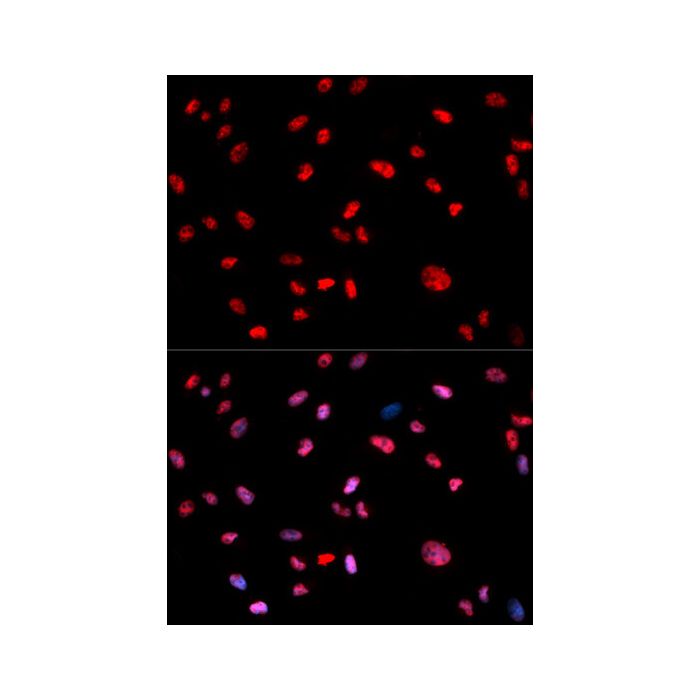
c-Jun (phospho-T239) polyclonal, anti-human
€428.00
In stock
SKU
BS6375
Background:
The c-Jun proto-oncogene was first identified as the cellular homolog of the avian sarcoma virus v-Jun oncogene. The c-Jun protein, along with c-Fos, is a component of the AP-1 transcriptional complex. c-Jun can form either Jun/Jun homodimers or Jun/Fos heterodimers via the leucine repeats in both proteins. Homo- and heterodimers bind to the TGACTCA consensus sequence present in numerous promoters and initially identified as the phorbol ester tumor promoter response element (TRE). Two additional genes, Jun B and Jun D, have been shown to be almost identical to c-Jun in their C-terminal regions, which are involved in dimerization and DNA binding, whereas their N-terminal domains, which are involved in transcriptional activation, diverge. All three form heterodimers among themselves and with c-Fos and other members of the Fos gene family.
Alternative Name:
JUN, p39, V-jun avian sarcoma virus 17 oncogene homolog, Proto-oncogene c-Jun, AP1, Activator protein 1, Transcription factor AP-1
Application Dilution: WB: 1:500~1:2000, IF: 1:50~1:200
Specificity: p-c-Jun (T239) polyclonal antibody detects endogenous levels of c-Jun protein only when phosphorylated at Thr239.
Immunogen:
Synthetic phosphopeptide derived from human c-Jun around the phosphorylation site of Threonine 239.
MW: ~ 43, 48 kDa
Swis Prot.: P05412
Purification & Purity:
The antibody was affinity-purified from rabbit antiserum by affinity-chromatography using epitope-specific immunogen and the purity is > 95% (by SDS-PAGE).
Format:
1mg/ml in PBS with 0.1% Sodium Azide, 50% Glycerol.
Storage:
Store at 4°C short term. Aliquot and store at -20°C long term. Avoid freeze-thaw cycles.
For research use only, not for use in diagnostic procedure.
The c-Jun proto-oncogene was first identified as the cellular homolog of the avian sarcoma virus v-Jun oncogene. The c-Jun protein, along with c-Fos, is a component of the AP-1 transcriptional complex. c-Jun can form either Jun/Jun homodimers or Jun/Fos heterodimers via the leucine repeats in both proteins. Homo- and heterodimers bind to the TGACTCA consensus sequence present in numerous promoters and initially identified as the phorbol ester tumor promoter response element (TRE). Two additional genes, Jun B and Jun D, have been shown to be almost identical to c-Jun in their C-terminal regions, which are involved in dimerization and DNA binding, whereas their N-terminal domains, which are involved in transcriptional activation, diverge. All three form heterodimers among themselves and with c-Fos and other members of the Fos gene family.
Alternative Name:
JUN, p39, V-jun avian sarcoma virus 17 oncogene homolog, Proto-oncogene c-Jun, AP1, Activator protein 1, Transcription factor AP-1
Application Dilution: WB: 1:500~1:2000, IF: 1:50~1:200
Specificity: p-c-Jun (T239) polyclonal antibody detects endogenous levels of c-Jun protein only when phosphorylated at Thr239.
Immunogen:
Synthetic phosphopeptide derived from human c-Jun around the phosphorylation site of Threonine 239.
MW: ~ 43, 48 kDa
Swis Prot.: P05412
Purification & Purity:
The antibody was affinity-purified from rabbit antiserum by affinity-chromatography using epitope-specific immunogen and the purity is > 95% (by SDS-PAGE).
Format:
1mg/ml in PBS with 0.1% Sodium Azide, 50% Glycerol.
Storage:
Store at 4°C short term. Aliquot and store at -20°C long term. Avoid freeze-thaw cycles.
For research use only, not for use in diagnostic procedure.
| Is Featured? | No |
|---|
Write Your Own Review