
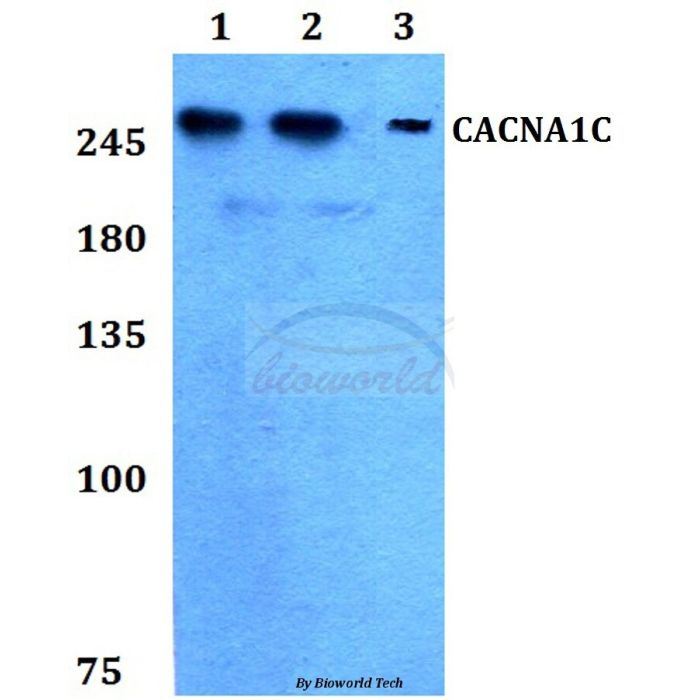
CACNA1C polyclonal, anti-human, mouse, rat
€305.00
In stock
SKU
BS60266
Background:
Voltage-dependent Ca++ channels mediate Ca++ entryinto excitable cellsin response to membrane depolarization, and they are involved in a variety of Ca++-dependent processes, includingmuscle contraction, hormone or neurotransmitter release and gene expression. Calciumchannels are highly diverse,multimericcomplexescomposed of anα-1 subunit, an intracellular β-subunit, a disulfide linkedα-2/δ subunit and a transmembrane γ-subunit. Ca++ currents are characterized on the basis of their biophysical and pharmacologic properties and include L-, N-, T-, P-, Q-, and R- types.L-type Ca++ currentsinitiate muscle contraction, endocrine secretion, and gene transcription, and can be regulated through second-messenger activated protein phosphorylation pathways.L-type calcium channels may form macromolecular signaling complexeswith G protein-coupled receptors, thereby enhancing the selectivity of regulating specifictargets.
Alternative Name:
Voltage-dependent L-type calcium channel subunit alpha-1C, Calcium channel, L type, alpha-1 polypeptide, isoform 1, cardiac muscle, Voltage-gated calcium channel subunit alpha Cav1.2, CACNA1C, CACH2, CACN2, CACNL1A1, CCHL1A1
Application Dilution: WB: 1:500~1:1000
Specificity: CACNA1C polyclonal antibody detects endogenous levels of CACNA1C protein.
Immunogen:
A synthetic peptide corresponding to residues in Human CACNA1C.
MW: ~ 249 kDa
Swis Prot.: Q13936
Purification & Purity:
The antibody was affinity-purified from rabbit antiserum by affinity-chromatography using epitope-specific immunogen and the purity is > 95% (by SDS-PAGE).
Format:
1 mg/ml in Phosphate buffered saline (PBS) with 0.05% sodium azide, approx. pH 7.2.
Storage:
Store at 4°C short term. Aliquot and store at -20°C long term. Avoid freeze-thaw cycles.
For research use only, not for use in diagnostic procedure.
Voltage-dependent Ca++ channels mediate Ca++ entryinto excitable cellsin response to membrane depolarization, and they are involved in a variety of Ca++-dependent processes, includingmuscle contraction, hormone or neurotransmitter release and gene expression. Calciumchannels are highly diverse,multimericcomplexescomposed of anα-1 subunit, an intracellular β-subunit, a disulfide linkedα-2/δ subunit and a transmembrane γ-subunit. Ca++ currents are characterized on the basis of their biophysical and pharmacologic properties and include L-, N-, T-, P-, Q-, and R- types.L-type Ca++ currentsinitiate muscle contraction, endocrine secretion, and gene transcription, and can be regulated through second-messenger activated protein phosphorylation pathways.L-type calcium channels may form macromolecular signaling complexeswith G protein-coupled receptors, thereby enhancing the selectivity of regulating specifictargets.
Alternative Name:
Voltage-dependent L-type calcium channel subunit alpha-1C, Calcium channel, L type, alpha-1 polypeptide, isoform 1, cardiac muscle, Voltage-gated calcium channel subunit alpha Cav1.2, CACNA1C, CACH2, CACN2, CACNL1A1, CCHL1A1
Application Dilution: WB: 1:500~1:1000
Specificity: CACNA1C polyclonal antibody detects endogenous levels of CACNA1C protein.
Immunogen:
A synthetic peptide corresponding to residues in Human CACNA1C.
MW: ~ 249 kDa
Swis Prot.: Q13936
Purification & Purity:
The antibody was affinity-purified from rabbit antiserum by affinity-chromatography using epitope-specific immunogen and the purity is > 95% (by SDS-PAGE).
Format:
1 mg/ml in Phosphate buffered saline (PBS) with 0.05% sodium azide, approx. pH 7.2.
Storage:
Store at 4°C short term. Aliquot and store at -20°C long term. Avoid freeze-thaw cycles.
For research use only, not for use in diagnostic procedure.
| Is Featured? | No |
|---|
Write Your Own Review