
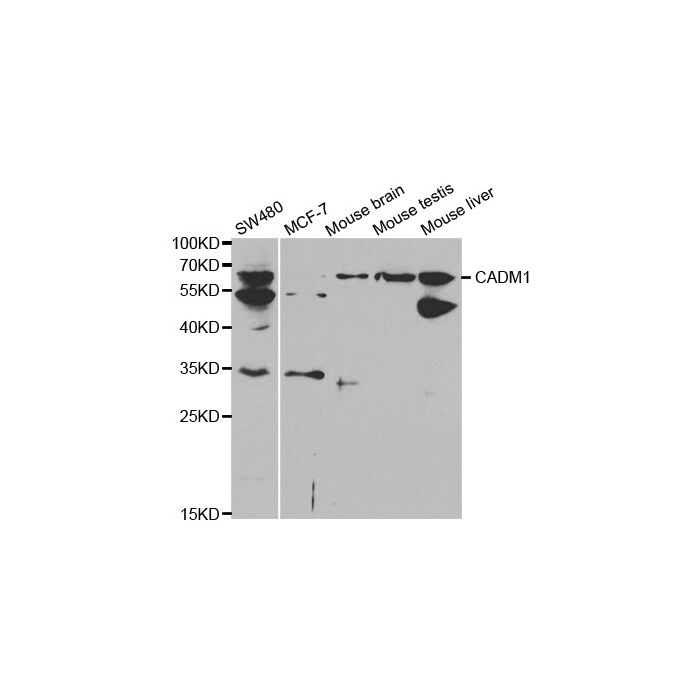
CADM1 polyclonal, anti-human, mouse
€388.00
In stock
SKU
BS6792
Background:
Cell adhesion molecules are a family of closely related cell surface glycoproteins involved in cell-cell interactions during growth and are thought to play an important role in embryogenesis and development. Neuronal cell adhesion molecule (NCAM) expression is observed in a variety of human tumors including neuroblastomas, rhabdomyosarcomas, Wilms’ tumors, Ewing’s sarcomas and some primitive myeloid malignancies. The intracellular adhesion molecule-1 (ICAM-1), also referred to as CD54, is an integral membrane protein of the immunoglobulin superfamily and recognizes the β2/α1 and β2/αM integrins. PECAM-1 (platelet/endothelial cell adhesion molecule-1), also referred to as CD31, is a glycoprotein expressed on the cell surfaces of monocytes, neutrophils, platelets and a subpopulation of T cells. VCAM-1 (vascular cell adhesion molecule-1) was first identified as an adhesion molecule induced on human endothelial cells by inflammatory cytokines such as IL-1, tumor necrosis factor (TNF) and lipopolysaccharide (LPS). The KALIG gene encodes a nerve cell adhesion molecule (NCAM)-like protein and is deleted in 66% of patients with Kallmann’s syndrome, anosmia with secondary hypogonadism.
Alternative Name:
Cell adhesion molecule 1, Immunoglobulin superfamily member 4, IgSF4, Nectin-like protein 2, NECL-2, Spermatogenic immunoglobulin superfamily, SgIgSF, Synaptic cell adhesion molecule, SynCAM, Tumor suppressor in lung cancer 1, TSLC-1, CADM1, IGSF4, IGSF4A, NECL2, SYNCAM, TSLC1
Application Dilution: WB: 1:500 - 1:2000
Specificity: CADM1 polyclonal antibody detects endogenous levels of CADM1 protein.
Immunogen:
Recombinant full length Human CADM1.
MW: ~ 48 kDa
Swis Prot.: Q9BY67
Purification & Purity:
The antibody was affinity-purified from rabbit antiserum by affinity-chromatography using epitope-specific immunogen and the purity is > 95% (by SDS-PAGE).
Format:
1mg/ml in PBS with 0.1% Sodium Azide, 50% Glycerol.
Storage:
Store at 4°C short term. Aliquot and store at -20°C long term. Avoid freeze-thaw cycles.
For research use only, not for use in diagnostic procedure.
Cell adhesion molecules are a family of closely related cell surface glycoproteins involved in cell-cell interactions during growth and are thought to play an important role in embryogenesis and development. Neuronal cell adhesion molecule (NCAM) expression is observed in a variety of human tumors including neuroblastomas, rhabdomyosarcomas, Wilms’ tumors, Ewing’s sarcomas and some primitive myeloid malignancies. The intracellular adhesion molecule-1 (ICAM-1), also referred to as CD54, is an integral membrane protein of the immunoglobulin superfamily and recognizes the β2/α1 and β2/αM integrins. PECAM-1 (platelet/endothelial cell adhesion molecule-1), also referred to as CD31, is a glycoprotein expressed on the cell surfaces of monocytes, neutrophils, platelets and a subpopulation of T cells. VCAM-1 (vascular cell adhesion molecule-1) was first identified as an adhesion molecule induced on human endothelial cells by inflammatory cytokines such as IL-1, tumor necrosis factor (TNF) and lipopolysaccharide (LPS). The KALIG gene encodes a nerve cell adhesion molecule (NCAM)-like protein and is deleted in 66% of patients with Kallmann’s syndrome, anosmia with secondary hypogonadism.
Alternative Name:
Cell adhesion molecule 1, Immunoglobulin superfamily member 4, IgSF4, Nectin-like protein 2, NECL-2, Spermatogenic immunoglobulin superfamily, SgIgSF, Synaptic cell adhesion molecule, SynCAM, Tumor suppressor in lung cancer 1, TSLC-1, CADM1, IGSF4, IGSF4A, NECL2, SYNCAM, TSLC1
Application Dilution: WB: 1:500 - 1:2000
Specificity: CADM1 polyclonal antibody detects endogenous levels of CADM1 protein.
Immunogen:
Recombinant full length Human CADM1.
MW: ~ 48 kDa
Swis Prot.: Q9BY67
Purification & Purity:
The antibody was affinity-purified from rabbit antiserum by affinity-chromatography using epitope-specific immunogen and the purity is > 95% (by SDS-PAGE).
Format:
1mg/ml in PBS with 0.1% Sodium Azide, 50% Glycerol.
Storage:
Store at 4°C short term. Aliquot and store at -20°C long term. Avoid freeze-thaw cycles.
For research use only, not for use in diagnostic procedure.
| Is Featured? | No |
|---|
Write Your Own Review