
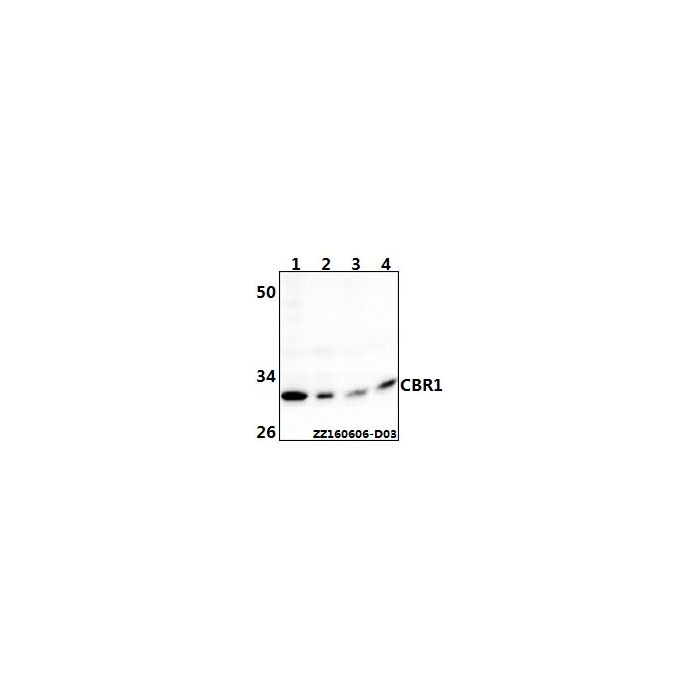
CBR1 polyclonal, anti-human, mouse, rat
€305.00
In stock
SKU
BS61606
Background:
Carbonyl reductase is one of several monomeric,NADPH-dependent oxidoreductases having wide specificity for carbonyl compounds.This enzyme is widely distributed in human tissues. Another carbonyl reductase gene,CRB3,lies close to this gene on chromosome 21q. NADPH-dependent reductase with broad substrate specificity.Catalyzes the reduction of a wide variety of carbonyl compounds including quinones,prostaglandins, menadione,plus various xenobiotics.Catalyzes the reduction of the antitumor anthracyclines doxorubicin and daunorubicin to the cardiotoxic compounds doxorubicinol and daunorubicinol. Can convert prostaglandin E2 to prostaglandin F2-alpha.Can bind glutathione,which explains its higher affinity for glutathione-conjugated substrates.Catalyzes the reduction of S-nitrosoglutathione.
Alternative Name:
15 hydroxyprostaglandin dehydrogenase [NADP+], 15-hydroxyprostaglandin dehydrogenase [NADP+], Carbonyl reductase [NADPH] 1, Carbonyl Reductase 1, CBR 1, CBR1, CBR1_HUMAN, CRN, NADPH dependent carbonyl reductase 1, NADPH-dependent carbonyl reductase 1
Application Dilution: WB: 1:500~1:1000
Specificity: CBR1 polyclonal antibody detects endogenous levels of CBR1 protein.
Immunogen:
Synthetic peptide, corresponding to amino acids 187-231 of Human CBR1.
MW: ~ 30 kDa
Swis Prot.: P16152
Purification & Purity:
The antibody was affinity-purified from rabbit antiserum by affinity-chromatography using epitope-specific immunogen and the purity is > 96% (by SDS-PAGE).
Format:
1 mg/ml in Phosphate buffered saline (PBS) with 0.05% sodium azide, approx. pH 7.3.
Storage:
Store at 4°C short term. Aliquot and store at -20°C long term. Avoid freeze-thaw cycles.
For research use only, not for use in diagnostic procedure.
Carbonyl reductase is one of several monomeric,NADPH-dependent oxidoreductases having wide specificity for carbonyl compounds.This enzyme is widely distributed in human tissues. Another carbonyl reductase gene,CRB3,lies close to this gene on chromosome 21q. NADPH-dependent reductase with broad substrate specificity.Catalyzes the reduction of a wide variety of carbonyl compounds including quinones,prostaglandins, menadione,plus various xenobiotics.Catalyzes the reduction of the antitumor anthracyclines doxorubicin and daunorubicin to the cardiotoxic compounds doxorubicinol and daunorubicinol. Can convert prostaglandin E2 to prostaglandin F2-alpha.Can bind glutathione,which explains its higher affinity for glutathione-conjugated substrates.Catalyzes the reduction of S-nitrosoglutathione.
Alternative Name:
15 hydroxyprostaglandin dehydrogenase [NADP+], 15-hydroxyprostaglandin dehydrogenase [NADP+], Carbonyl reductase [NADPH] 1, Carbonyl Reductase 1, CBR 1, CBR1, CBR1_HUMAN, CRN, NADPH dependent carbonyl reductase 1, NADPH-dependent carbonyl reductase 1
Application Dilution: WB: 1:500~1:1000
Specificity: CBR1 polyclonal antibody detects endogenous levels of CBR1 protein.
Immunogen:
Synthetic peptide, corresponding to amino acids 187-231 of Human CBR1.
MW: ~ 30 kDa
Swis Prot.: P16152
Purification & Purity:
The antibody was affinity-purified from rabbit antiserum by affinity-chromatography using epitope-specific immunogen and the purity is > 96% (by SDS-PAGE).
Format:
1 mg/ml in Phosphate buffered saline (PBS) with 0.05% sodium azide, approx. pH 7.3.
Storage:
Store at 4°C short term. Aliquot and store at -20°C long term. Avoid freeze-thaw cycles.
For research use only, not for use in diagnostic procedure.
| Is Featured? | No |
|---|
Write Your Own Review