
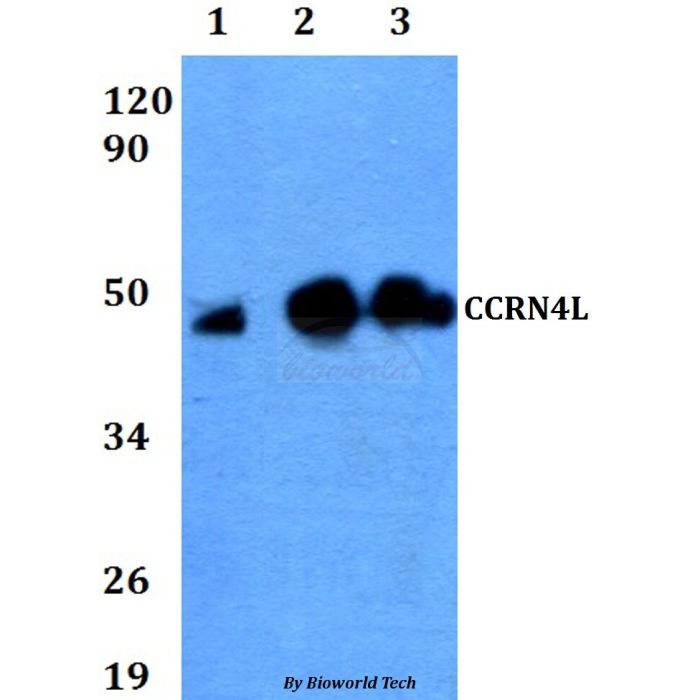
CCRN4L polyclonal, anti-human, rat
€305.00
In stock
SKU
BS60637
Background:
Nocturnin, also known as CCRN4L or NOC, is a 431 amino acid circadian deadenylase protein that is expressed in a broad range of tissues with greatest abundance in the liver, kidney and testis. Nocturnin plays a role in circadian regulation as well as diet-induced obesity. The mRNA abundance of Nocturnin exhibits circadian rhythmicity, peaking after dusk in photoreceptors, spleen, heart, kidney and liver. Nocturnin is thought to be responisble for turning off genes that are involved in circadian regulation. In Xenopus retinal photoreceptor cells, the rhythmic regulation of Nocturnin is thought to be controlled by phosphorylated CREB. Mice lacking Nocturnin remain lean on high fat diets with a reduction in visceral fat, which suggests that this protein may also be responsible for lipid metabolism and fat storage.
Alternative Name:
Nocturnin, Carbon catabolite repression 4-like protein, Circadian deadenylase NOC, CCRN4L, CCR4, NOC
Application Dilution: WB: 1:500~1:1000
Specificity: CCRN4L polyclonal antibody detects endogenous levels of CCRN4L protein.
Immunogen:
A synthetic peptide corresponding to residues in Human CCRN4L
MW: ~ 48 kDa
Swis Prot.: Q9UK39
Purification & Purity:
The antibody was affinity-purified from rabbit antiserum by affinity-chromatography using epitope-specific immunogen and the purity is > 95% (by SDS-PAGE).
Format:
1 mg/ml in Phosphate buffered saline (PBS) with 15 mM sodium azide, approx. pH 7.2.
Storage:
Store at 4°C short term. Aliquot and store at -20°C long term. Avoid freeze-thaw cycles.
For research use only, not for use in diagnostic procedure.
Nocturnin, also known as CCRN4L or NOC, is a 431 amino acid circadian deadenylase protein that is expressed in a broad range of tissues with greatest abundance in the liver, kidney and testis. Nocturnin plays a role in circadian regulation as well as diet-induced obesity. The mRNA abundance of Nocturnin exhibits circadian rhythmicity, peaking after dusk in photoreceptors, spleen, heart, kidney and liver. Nocturnin is thought to be responisble for turning off genes that are involved in circadian regulation. In Xenopus retinal photoreceptor cells, the rhythmic regulation of Nocturnin is thought to be controlled by phosphorylated CREB. Mice lacking Nocturnin remain lean on high fat diets with a reduction in visceral fat, which suggests that this protein may also be responsible for lipid metabolism and fat storage.
Alternative Name:
Nocturnin, Carbon catabolite repression 4-like protein, Circadian deadenylase NOC, CCRN4L, CCR4, NOC
Application Dilution: WB: 1:500~1:1000
Specificity: CCRN4L polyclonal antibody detects endogenous levels of CCRN4L protein.
Immunogen:
A synthetic peptide corresponding to residues in Human CCRN4L
MW: ~ 48 kDa
Swis Prot.: Q9UK39
Purification & Purity:
The antibody was affinity-purified from rabbit antiserum by affinity-chromatography using epitope-specific immunogen and the purity is > 95% (by SDS-PAGE).
Format:
1 mg/ml in Phosphate buffered saline (PBS) with 15 mM sodium azide, approx. pH 7.2.
Storage:
Store at 4°C short term. Aliquot and store at -20°C long term. Avoid freeze-thaw cycles.
For research use only, not for use in diagnostic procedure.
| Is Featured? | No |
|---|
Write Your Own Review