
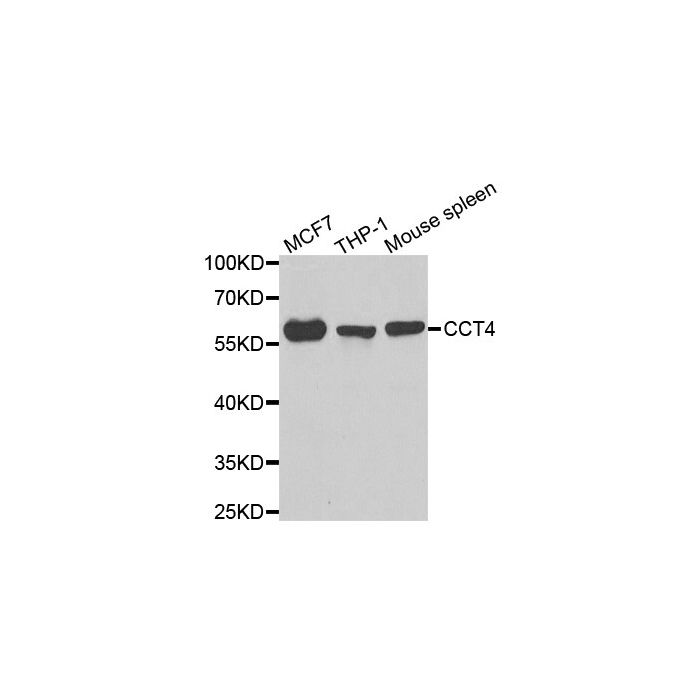
CCT4 polyclonal, anti-human, mouse, rat
€388.00
In stock
SKU
BS6841
Background:
The protein TCP-1 (t complex polypeptide 1) is a subunit of the hetero-oligomeric complex CCT (chaperonin containing TCP-1) present in the eukaryotic cytosol. The CCT of eukaryotic cytosol is composed of eight different subunit species, TCP-1 alpha, beta, gamma, delta, epsilon, zeta, eta and theta, each encoded by a different gene. Two zeta subunits have been described: TCP-1 zeta (also designated TCP-1 zeta1) and TCP-1 zeta2. TCP-1 subunits are proposed to have independent functions in folding its in vivo substrates, the actins and tubulins. TCP-1 was first identified in the mouse as relevant for tail-less and embryonic lethal phenotypes. Sequences homologous to TCP-1 have been isolated in several other species, and the yeast TCP-1 has been shown to encode a molecular chaperone for Actin and Tubulin. TCP-1 found in mammalian cells and yeast plays an important role in the folding of cytosolic proteins.
Alternative Name:
T-complex protein 1 subunit delta, TCP-1-delta, CCT-delta, Stimulator of TAR RNA-binding, CCT4, CCTD, SRB
Application Dilution: WB: 1:500 - 1:2000, IHC: 1:50 - 1:200, IF: 1:50 - 1:200
Specificity: CCT4 polyclonal antibody detects endogenous levels of CCT4 protein.
Immunogen:
Recombinant full length Human CCT4.
MW: ~ 58 kDa
Swis Prot.: P50991
Purification & Purity:
The antibody was affinity-purified from rabbit antiserum by affinity-chromatography using epitope-specific immunogen and the purity is > 95% (by SDS-PAGE).
Format:
1mg/ml in PBS with 0.1% Sodium Azide, 50% Glycerol.
Storage:
Store at 4°C short term. Aliquot and store at -20°C long term. Avoid freeze-thaw cycles.
For research use only, not for use in diagnostic procedure.
The protein TCP-1 (t complex polypeptide 1) is a subunit of the hetero-oligomeric complex CCT (chaperonin containing TCP-1) present in the eukaryotic cytosol. The CCT of eukaryotic cytosol is composed of eight different subunit species, TCP-1 alpha, beta, gamma, delta, epsilon, zeta, eta and theta, each encoded by a different gene. Two zeta subunits have been described: TCP-1 zeta (also designated TCP-1 zeta1) and TCP-1 zeta2. TCP-1 subunits are proposed to have independent functions in folding its in vivo substrates, the actins and tubulins. TCP-1 was first identified in the mouse as relevant for tail-less and embryonic lethal phenotypes. Sequences homologous to TCP-1 have been isolated in several other species, and the yeast TCP-1 has been shown to encode a molecular chaperone for Actin and Tubulin. TCP-1 found in mammalian cells and yeast plays an important role in the folding of cytosolic proteins.
Alternative Name:
T-complex protein 1 subunit delta, TCP-1-delta, CCT-delta, Stimulator of TAR RNA-binding, CCT4, CCTD, SRB
Application Dilution: WB: 1:500 - 1:2000, IHC: 1:50 - 1:200, IF: 1:50 - 1:200
Specificity: CCT4 polyclonal antibody detects endogenous levels of CCT4 protein.
Immunogen:
Recombinant full length Human CCT4.
MW: ~ 58 kDa
Swis Prot.: P50991
Purification & Purity:
The antibody was affinity-purified from rabbit antiserum by affinity-chromatography using epitope-specific immunogen and the purity is > 95% (by SDS-PAGE).
Format:
1mg/ml in PBS with 0.1% Sodium Azide, 50% Glycerol.
Storage:
Store at 4°C short term. Aliquot and store at -20°C long term. Avoid freeze-thaw cycles.
For research use only, not for use in diagnostic procedure.
| Is Featured? | No |
|---|
Write Your Own Review