
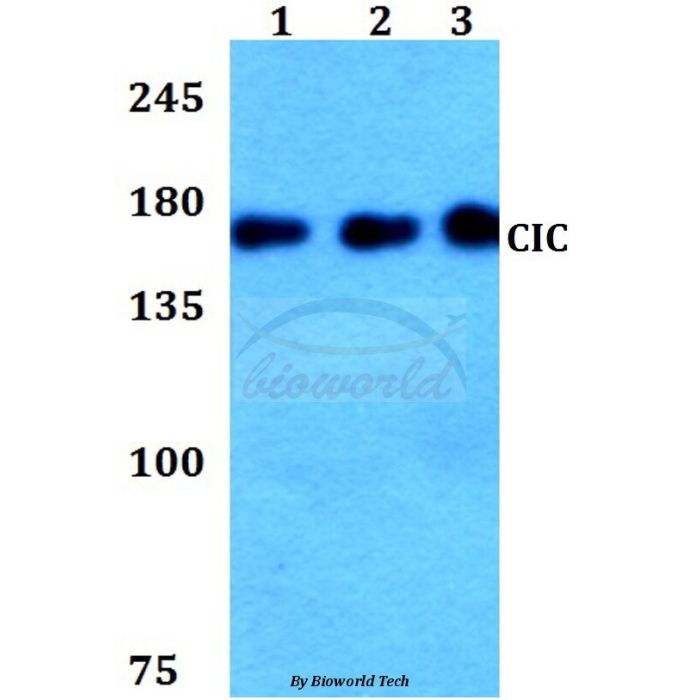
CIC polyclonal, anti-human, mouse, rat
€305.00
In stock
SKU
BS60283
Background:
Capicua, also referred to as CIC, is the mammalian ortholog of the drosophilia Cic gene and is part of the HMG-box protein superfamily. Expressed primarily in the fetal brain, Capicua functions as a transciptional repressor and is involved in the development of the nervous system through interaction with the ATXN1 protein. When ATXN1 assembles into stable complexes, it directly binds Capicua, thereby mediating both the activity and expression of Capicua. When Capicua is active, it is able to interact with other developmental proteins to restrict the growth of granule cells and regulate normal neuronal development. Disruptions in the the association of Capicua with proteins such as ATXN1 are thought to cause medulloblastoma, the most common form of perdiatric brain tumor arising from irregular growth of granule cells.
Alternative Name:
Protein capicua homolog, CIC, KIAA0306
Application Dilution: WB: 1:500~1:1000
Specificity: CIC polyclonal antibody detects endogenous levels of CIC protein.
Immunogen:
A synthetic peptide corresponding to residues in Human CIC.
MW: ~ 164 kDa
Swis Prot.: Q96RK0
Purification & Purity:
The antibody was affinity-purified from rabbit antiserum by affinity-chromatography using epitope-specific immunogen and the purity is > 95% (by SDS-PAGE).
Format:
1 mg/ml in Phosphate buffered saline (PBS) with 0.05% sodium azide, approx. pH 7.2.
Storage:
Store at 4°C short term. Aliquot and store at -20°C long term. Avoid freeze-thaw cycles.
For research use only, not for use in diagnostic procedure.
Capicua, also referred to as CIC, is the mammalian ortholog of the drosophilia Cic gene and is part of the HMG-box protein superfamily. Expressed primarily in the fetal brain, Capicua functions as a transciptional repressor and is involved in the development of the nervous system through interaction with the ATXN1 protein. When ATXN1 assembles into stable complexes, it directly binds Capicua, thereby mediating both the activity and expression of Capicua. When Capicua is active, it is able to interact with other developmental proteins to restrict the growth of granule cells and regulate normal neuronal development. Disruptions in the the association of Capicua with proteins such as ATXN1 are thought to cause medulloblastoma, the most common form of perdiatric brain tumor arising from irregular growth of granule cells.
Alternative Name:
Protein capicua homolog, CIC, KIAA0306
Application Dilution: WB: 1:500~1:1000
Specificity: CIC polyclonal antibody detects endogenous levels of CIC protein.
Immunogen:
A synthetic peptide corresponding to residues in Human CIC.
MW: ~ 164 kDa
Swis Prot.: Q96RK0
Purification & Purity:
The antibody was affinity-purified from rabbit antiserum by affinity-chromatography using epitope-specific immunogen and the purity is > 95% (by SDS-PAGE).
Format:
1 mg/ml in Phosphate buffered saline (PBS) with 0.05% sodium azide, approx. pH 7.2.
Storage:
Store at 4°C short term. Aliquot and store at -20°C long term. Avoid freeze-thaw cycles.
For research use only, not for use in diagnostic procedure.
| Is Featured? | No |
|---|
Write Your Own Review