
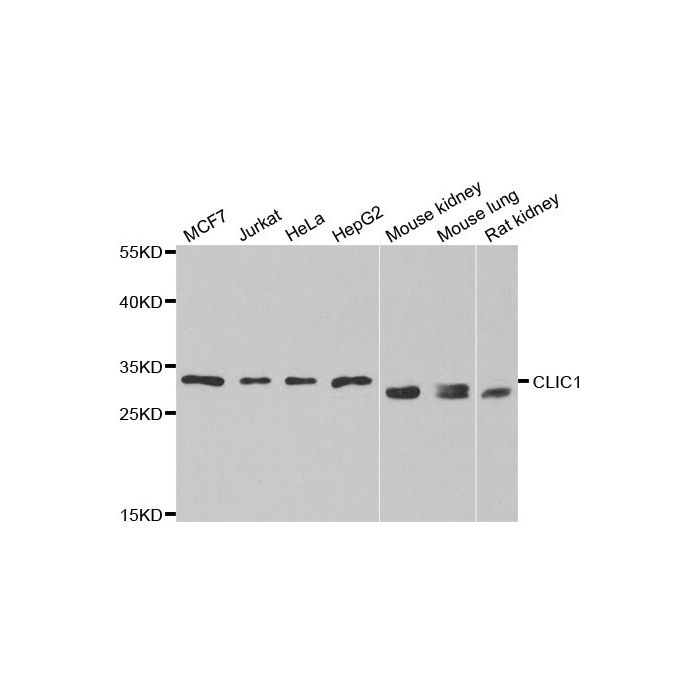
CLIC1 polyclonal, anti-human, mouse, rat
€388.00
In stock
SKU
BS8158
Background:
Chloride intracellular channel 1 (CLIC1), also referred to as NCC27, is a member of the highly conserved family of chloride ion channels that function in both soluble and integral membrane forms. CLIC1 is a monomeric protein that contains a redox-active site similar to glutaredoxin; it functions as a anionselective channel. CLIC1 forms a dimer when oxidized and is then able to form chloride ion channels in bilayers and vesicles, whereas a reducing environment prevents this from occurring. Insulin concentration also plays a role in CLIC1 regulation, and the hormone may cause a subnuclear relocalization of CLIC1. CLIC1 is associated with macrophage activation; a downregulation of CLIC1 function prevents TNFα release induced by β-Amyloid protein (A-β) stimulation. This suggests a role for CLIC1 in several neurodegenerative processes, such as Alzheimer’s disease, a syndrome characterized by an accumulation of A-β.
Alternative Name:
Chloride intracellular channel protein 1, Chloride channel ABP, Nuclear chloride ion channel 27, NCC27, Regulatory nuclear chloride ion channel protein, hRNCC, CLIC1, G6, NCC27
Application Dilution: WB: 1:500 - 1:2000, IHC: 1:50 - 1:200, IF: 1:10 - 1:100
Specificity: CLIC1 polyclonal antibody detects endogenous levels of CLIC1 protein.
Immunogen:
Recombinant full length Human CLIC1.
MW: ~ 27 kDa
Swis Prot.: O00299
Purification & Purity:
The antibody was affinity-purified from rabbit antiserum by affinity-chromatography using epitope-specific immunogen and the purity is > 95% (by SDS-PAGE).
Format:
1mg/ml in PBS with 0.1% Sodium Azide, 50% Glycerol.
Storage:
Store at 4°C short term. Aliquot and store at -20°C long term. Avoid freeze-thaw cycles.
For research use only, not for use in diagnostic procedure.
Chloride intracellular channel 1 (CLIC1), also referred to as NCC27, is a member of the highly conserved family of chloride ion channels that function in both soluble and integral membrane forms. CLIC1 is a monomeric protein that contains a redox-active site similar to glutaredoxin; it functions as a anionselective channel. CLIC1 forms a dimer when oxidized and is then able to form chloride ion channels in bilayers and vesicles, whereas a reducing environment prevents this from occurring. Insulin concentration also plays a role in CLIC1 regulation, and the hormone may cause a subnuclear relocalization of CLIC1. CLIC1 is associated with macrophage activation; a downregulation of CLIC1 function prevents TNFα release induced by β-Amyloid protein (A-β) stimulation. This suggests a role for CLIC1 in several neurodegenerative processes, such as Alzheimer’s disease, a syndrome characterized by an accumulation of A-β.
Alternative Name:
Chloride intracellular channel protein 1, Chloride channel ABP, Nuclear chloride ion channel 27, NCC27, Regulatory nuclear chloride ion channel protein, hRNCC, CLIC1, G6, NCC27
Application Dilution: WB: 1:500 - 1:2000, IHC: 1:50 - 1:200, IF: 1:10 - 1:100
Specificity: CLIC1 polyclonal antibody detects endogenous levels of CLIC1 protein.
Immunogen:
Recombinant full length Human CLIC1.
MW: ~ 27 kDa
Swis Prot.: O00299
Purification & Purity:
The antibody was affinity-purified from rabbit antiserum by affinity-chromatography using epitope-specific immunogen and the purity is > 95% (by SDS-PAGE).
Format:
1mg/ml in PBS with 0.1% Sodium Azide, 50% Glycerol.
Storage:
Store at 4°C short term. Aliquot and store at -20°C long term. Avoid freeze-thaw cycles.
For research use only, not for use in diagnostic procedure.
| Is Featured? | No |
|---|
Write Your Own Review