
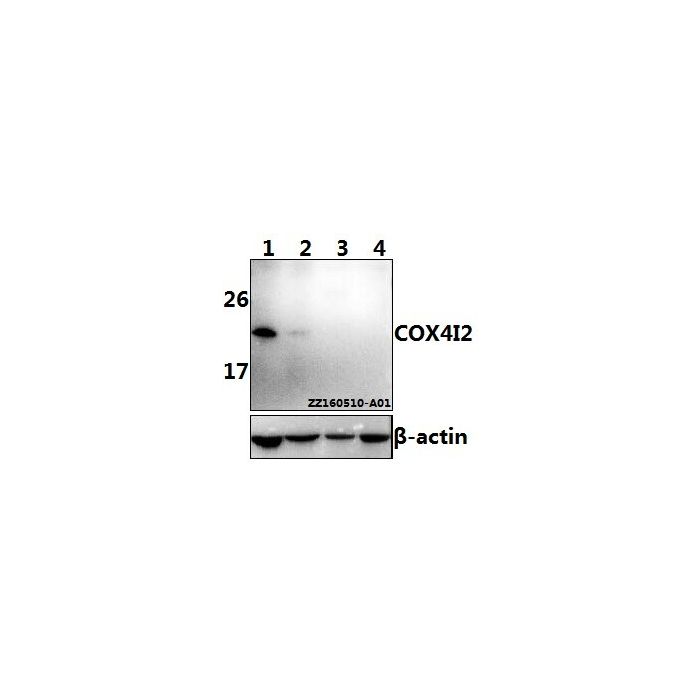
COX4I2 polyclonal, anti-human
€305.00
In stock
SKU
BS61592
Background:
The cytochrome c oxidase (COX) family of proteins function as the final electron donor in the respiratory chain to drive a proton gradient across the inner mitochondrial membrane, ultimately resulting in the production of water. The mammalian COX apoenzyme is a dimer, with each monomer consisting of 13 subunits, some of which are mitochondrial and some of which are nuclear. Cytochrome c oxidase IV (COX4) is a nuclear-encoded subunit of COX that may play a role in regulating COX activity. COX4 is expressed ubiquitously in adult human tissue with the strongest levels of expression in the pancreas and moderate expression levels in heart, skeletal muscle and placenta. Two isoforms exist for COX4, namely COX4I1 and COX4I2, and they are encoded by two different genes. COX4I2 (Cytochrome c oxidase subunit 4 isoform 2), also known as COX4B, COX4-2, COX4L2 or COXIV-2, is the less common isoform and is incorporated into the COX apoenzyme under hypoxic conditions to optimize COX activity.
Alternative Name:
Cytochrome c oxidase subunit 4 isoform 2, mitochondrial, Cytochrome c oxidase subunit IV isoform 2, COX IV-2
Application Dilution: WB: 1:500~1:1000
Specificity: COX4I2 polyclonal antibody detects endogenous levels of COX4I2 protein.
Immunogen:
Synthetic peptide, corresponding to amino acids 77-121 of Human COX4I2.
MW: ~ 20 kDa
Swis Prot.: Q96KJ9
Purification & Purity:
The antibody was affinity-purified from rabbit antiserum by affinity-chromatography using epitope-specific immunogen and the purity is > 97% (by SDS-PAGE).
Format:
1 mg/ml in Phosphate buffered saline (PBS) with 0.05% sodium azide, approx. pH 7.3.
Storage:
Store at 4°C short term. Aliquot and store at -20°C long term. Avoid freeze-thaw cycles.
For research use only, not for use in diagnostic procedure.
The cytochrome c oxidase (COX) family of proteins function as the final electron donor in the respiratory chain to drive a proton gradient across the inner mitochondrial membrane, ultimately resulting in the production of water. The mammalian COX apoenzyme is a dimer, with each monomer consisting of 13 subunits, some of which are mitochondrial and some of which are nuclear. Cytochrome c oxidase IV (COX4) is a nuclear-encoded subunit of COX that may play a role in regulating COX activity. COX4 is expressed ubiquitously in adult human tissue with the strongest levels of expression in the pancreas and moderate expression levels in heart, skeletal muscle and placenta. Two isoforms exist for COX4, namely COX4I1 and COX4I2, and they are encoded by two different genes. COX4I2 (Cytochrome c oxidase subunit 4 isoform 2), also known as COX4B, COX4-2, COX4L2 or COXIV-2, is the less common isoform and is incorporated into the COX apoenzyme under hypoxic conditions to optimize COX activity.
Alternative Name:
Cytochrome c oxidase subunit 4 isoform 2, mitochondrial, Cytochrome c oxidase subunit IV isoform 2, COX IV-2
Application Dilution: WB: 1:500~1:1000
Specificity: COX4I2 polyclonal antibody detects endogenous levels of COX4I2 protein.
Immunogen:
Synthetic peptide, corresponding to amino acids 77-121 of Human COX4I2.
MW: ~ 20 kDa
Swis Prot.: Q96KJ9
Purification & Purity:
The antibody was affinity-purified from rabbit antiserum by affinity-chromatography using epitope-specific immunogen and the purity is > 97% (by SDS-PAGE).
Format:
1 mg/ml in Phosphate buffered saline (PBS) with 0.05% sodium azide, approx. pH 7.3.
Storage:
Store at 4°C short term. Aliquot and store at -20°C long term. Avoid freeze-thaw cycles.
For research use only, not for use in diagnostic procedure.
| Is Featured? | No |
|---|
Write Your Own Review