
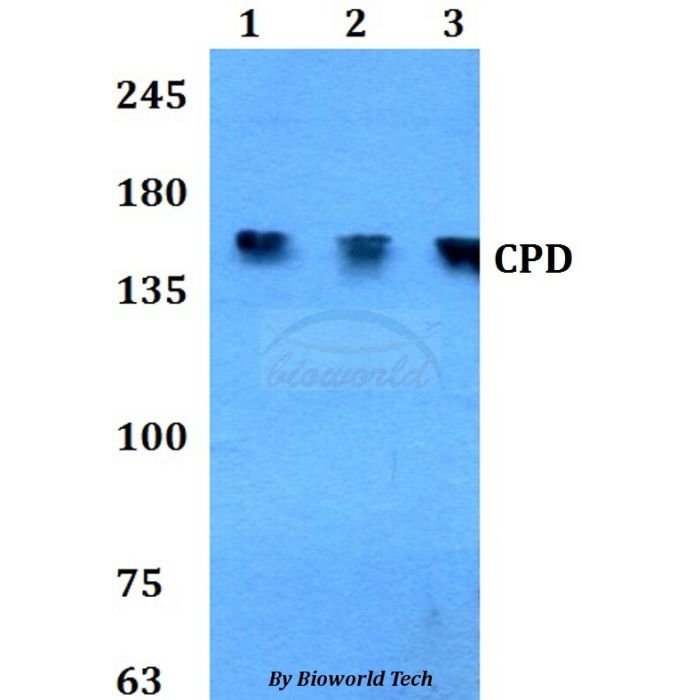
CPD polyclonal, anti-human, mouse, rat
€305.00
In stock
SKU
BS60812
Background:
Members of the M14 metallocarboxypeptidase protein family serve many diverse functions and are divided into three subfamilies based on structure, function and amino acid sequence similarity. CPD (carboxypeptidase D), also known as GP180 or metallocarboxypeptidase D, is a 1,380 amino acid single-pass type I membrane protein that belongs to the peptidase M14 family. CPD binds two zinc ions per subunit and contains three carboxypeptidase-like domains. CPD causes the release of C-terminal arganine and lysine from polypeptides. Highest expression of CPD is found in pancreas, hepatoma cells and placenta, with lower levels in heart, skeletal muscle and colon carcinoma. Mammalian CPD is a homolog of the duck hepatitis B virus-binding protein gp180.
Alternative Name:
Carboxypeptidase D, Metallocarboxypeptidase D, gp180, CPD
Application Dilution: WB: 1:500~1:1000
Specificity: CABIN1 polyclonal antibody detects endogenous levels of CABIN1 protein.
Immunogen:
A synthetic peptide corresponding to residues in Human CPD.
MW: ~ 153 kDa
Swis Prot.: O75976
Purification & Purity:
The antibody was affinity-purified from rabbit antiserum by affinity-chromatography using epitope-specific immunogen and the purity is > 95% (by SDS-PAGE).
Format:
1 mg/ml in Phosphate buffered saline (PBS) with 15 mM sodium azide, approx. pH 7.2.
Storage:
Store at 4°C short term. Aliquot and store at -20°C long term. Avoid freeze-thaw cycles.
For research use only, not for use in diagnostic procedure.
Members of the M14 metallocarboxypeptidase protein family serve many diverse functions and are divided into three subfamilies based on structure, function and amino acid sequence similarity. CPD (carboxypeptidase D), also known as GP180 or metallocarboxypeptidase D, is a 1,380 amino acid single-pass type I membrane protein that belongs to the peptidase M14 family. CPD binds two zinc ions per subunit and contains three carboxypeptidase-like domains. CPD causes the release of C-terminal arganine and lysine from polypeptides. Highest expression of CPD is found in pancreas, hepatoma cells and placenta, with lower levels in heart, skeletal muscle and colon carcinoma. Mammalian CPD is a homolog of the duck hepatitis B virus-binding protein gp180.
Alternative Name:
Carboxypeptidase D, Metallocarboxypeptidase D, gp180, CPD
Application Dilution: WB: 1:500~1:1000
Specificity: CABIN1 polyclonal antibody detects endogenous levels of CABIN1 protein.
Immunogen:
A synthetic peptide corresponding to residues in Human CPD.
MW: ~ 153 kDa
Swis Prot.: O75976
Purification & Purity:
The antibody was affinity-purified from rabbit antiserum by affinity-chromatography using epitope-specific immunogen and the purity is > 95% (by SDS-PAGE).
Format:
1 mg/ml in Phosphate buffered saline (PBS) with 15 mM sodium azide, approx. pH 7.2.
Storage:
Store at 4°C short term. Aliquot and store at -20°C long term. Avoid freeze-thaw cycles.
For research use only, not for use in diagnostic procedure.
| Is Featured? | No |
|---|
Write Your Own Review