
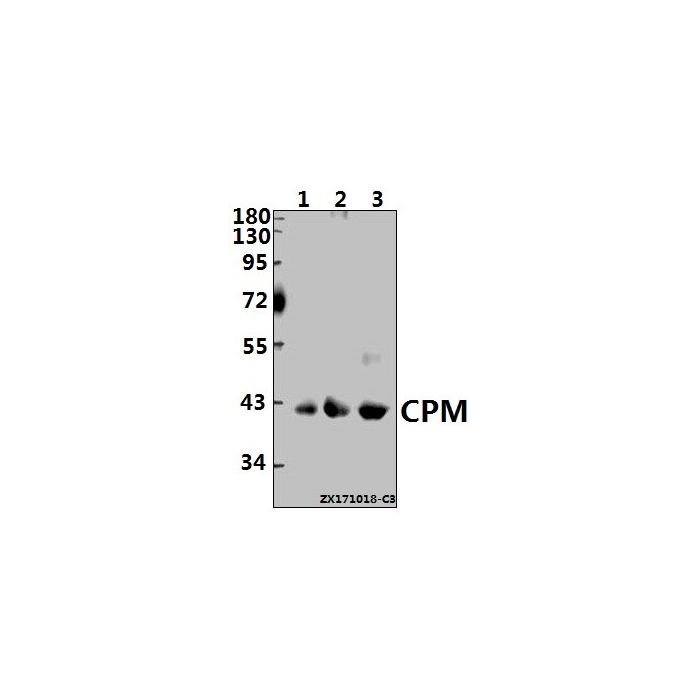
CPM (L113) polyclonal, anti-human, mouse, rat
€305.00
In stock
SKU
BS3827
Background:
Carboxypeptidase M (CPM) is a 443 amino acid protein belonging to the metallo-carboxypeptidase (metallo-CP) family. Localized to the cell membrane, CPM contains hydrophobic regions in the N and C- termini and has six potential asparagine-linked glycosylation sites. Functionally, CPM specifically removes C-terminal basic amino acids (arginine or lysine) from proteins and polypeptides and is believed to play a role in monocyte to macrophage differentiation. CPM is also thought to play an important role in the control of peptide hormone and growth factor activity at the cell surface, as well as in the membrane-localized degradation of extracellular proteins. Three isoforms of this protein exist as a result of alternative splicing events.
Alternative Name:
Carboxypeptidase M, CBPM, CPM, Renal carboxypeptidase, Urinary carboxypeptidase B
Application Dilution: WB: 1:500~1:1000
Specificity: CPM (L113) polyclonal antibody detects endogenous levels of CPM protein.
Immunogen:
Synthetic peptide, corresponding to amino acids 80-130 of Human CPM.
MW: ~ 51 kDa
Swis Prot.: P14384
Purification & Purity:
The antibody was affinity-purified from rabbit antiserum by affinity-chromatography using epitope-specific immunogen and the purity is > 95% (by SDS-PAGE).
Format:
1 mg/ml in Phosphate buffered saline (PBS) with 0.05% sodium azide, approx. pH 7.2.
Storage:
Store at 4°C short term. Aliquot and store at -20°C long term. Avoid freeze-thaw cycles.
For research use only, not for use in diagnostic procedure.
Carboxypeptidase M (CPM) is a 443 amino acid protein belonging to the metallo-carboxypeptidase (metallo-CP) family. Localized to the cell membrane, CPM contains hydrophobic regions in the N and C- termini and has six potential asparagine-linked glycosylation sites. Functionally, CPM specifically removes C-terminal basic amino acids (arginine or lysine) from proteins and polypeptides and is believed to play a role in monocyte to macrophage differentiation. CPM is also thought to play an important role in the control of peptide hormone and growth factor activity at the cell surface, as well as in the membrane-localized degradation of extracellular proteins. Three isoforms of this protein exist as a result of alternative splicing events.
Alternative Name:
Carboxypeptidase M, CBPM, CPM, Renal carboxypeptidase, Urinary carboxypeptidase B
Application Dilution: WB: 1:500~1:1000
Specificity: CPM (L113) polyclonal antibody detects endogenous levels of CPM protein.
Immunogen:
Synthetic peptide, corresponding to amino acids 80-130 of Human CPM.
MW: ~ 51 kDa
Swis Prot.: P14384
Purification & Purity:
The antibody was affinity-purified from rabbit antiserum by affinity-chromatography using epitope-specific immunogen and the purity is > 95% (by SDS-PAGE).
Format:
1 mg/ml in Phosphate buffered saline (PBS) with 0.05% sodium azide, approx. pH 7.2.
Storage:
Store at 4°C short term. Aliquot and store at -20°C long term. Avoid freeze-thaw cycles.
For research use only, not for use in diagnostic procedure.
| Is Featured? | No |
|---|
Write Your Own Review