
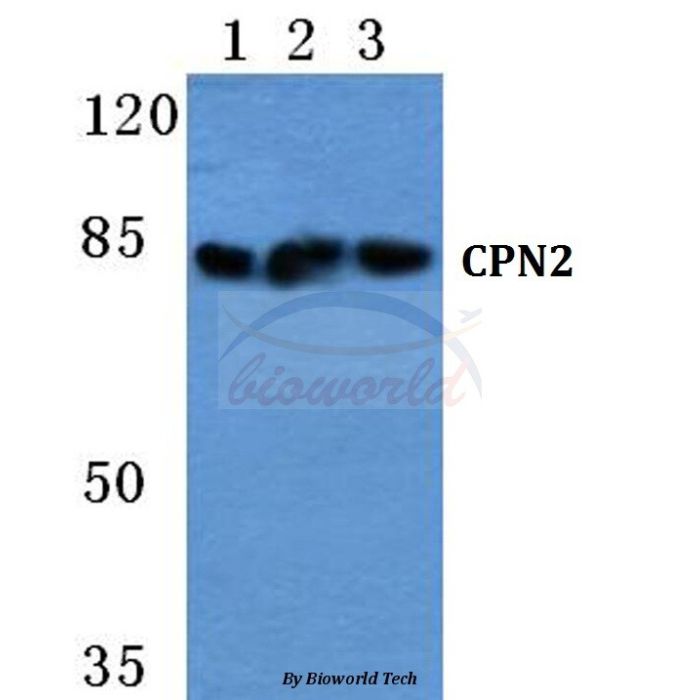
CPN2 polyclonal, anti-human, mouse, rat
€305.00
In stock
SKU
BS5676
Background:
Carboxypeptidase N (arginine carboxypeptidase or CPN) cleaves basic amino acid residues from the carboxy terminal of peptides and proteins. The enzyme plays a central role in regulating the biologic activity of peptides such as kinins and anaphylatoxins, and therefore is also known as kininase-1 and anaphylatoxin inactivator. CPN is a tetrameric complex consisting of two identical regulatory subunits (CPN reg) and two identical catalytic subunits (CPN cat). The two glycosylated CPN reg subunits protect the two CPN cat subunits and keep them in the circulation. CPN reg is a member of the leucinerich repeat family of proteins and the gene which encodes CPN reg maps to human chromosome 8p22-p23. CPN cat is a member of the regulatory B-type carboxypeptidase group and the gene which encodes CPN cat maps to human chromosome 10.
Alternative Name:
Carboxypeptidase N subunit 2, Carboxypeptidase N 83 kDa chain, Carboxypeptidase N large subunit, Carboxypeptidase N polypeptide 2, Carboxypeptidase N regulatory subunit, ACBP, CPN reg, CPN-reg, CPNreg,
Application Dilution: WB: 1:500~1:1000
Specificity: CPN2 polyclonal antibody detects endogenous levels of Carboxypeptidase N regulatory subunit protein.
Immunogen:
Synthetic peptide, corresponding to the 490-535 of Human CPN2.
MW: ~ 61, 83 kDa
Swis Prot.: P22792
Purification & Purity:
The antibody was affinity-purified from rabbit antiserum by affinity-chromatography using epitope-specific immunogen and the purity is > 95% (by SDS-PAGE).
Format:
1 mg/ml in Phosphate buffered saline (PBS) with 0.05% sodium azide, approx. pH 7.2.
Storage:
Store at 4°C short term. Aliquot and store at -20°C long term. Avoid freeze-thaw cycles.
For research use only, not for use in diagnostic procedure.
Carboxypeptidase N (arginine carboxypeptidase or CPN) cleaves basic amino acid residues from the carboxy terminal of peptides and proteins. The enzyme plays a central role in regulating the biologic activity of peptides such as kinins and anaphylatoxins, and therefore is also known as kininase-1 and anaphylatoxin inactivator. CPN is a tetrameric complex consisting of two identical regulatory subunits (CPN reg) and two identical catalytic subunits (CPN cat). The two glycosylated CPN reg subunits protect the two CPN cat subunits and keep them in the circulation. CPN reg is a member of the leucinerich repeat family of proteins and the gene which encodes CPN reg maps to human chromosome 8p22-p23. CPN cat is a member of the regulatory B-type carboxypeptidase group and the gene which encodes CPN cat maps to human chromosome 10.
Alternative Name:
Carboxypeptidase N subunit 2, Carboxypeptidase N 83 kDa chain, Carboxypeptidase N large subunit, Carboxypeptidase N polypeptide 2, Carboxypeptidase N regulatory subunit, ACBP, CPN reg, CPN-reg, CPNreg,
Application Dilution: WB: 1:500~1:1000
Specificity: CPN2 polyclonal antibody detects endogenous levels of Carboxypeptidase N regulatory subunit protein.
Immunogen:
Synthetic peptide, corresponding to the 490-535 of Human CPN2.
MW: ~ 61, 83 kDa
Swis Prot.: P22792
Purification & Purity:
The antibody was affinity-purified from rabbit antiserum by affinity-chromatography using epitope-specific immunogen and the purity is > 95% (by SDS-PAGE).
Format:
1 mg/ml in Phosphate buffered saline (PBS) with 0.05% sodium azide, approx. pH 7.2.
Storage:
Store at 4°C short term. Aliquot and store at -20°C long term. Avoid freeze-thaw cycles.
For research use only, not for use in diagnostic procedure.
| Is Featured? | No |
|---|
Write Your Own Review