
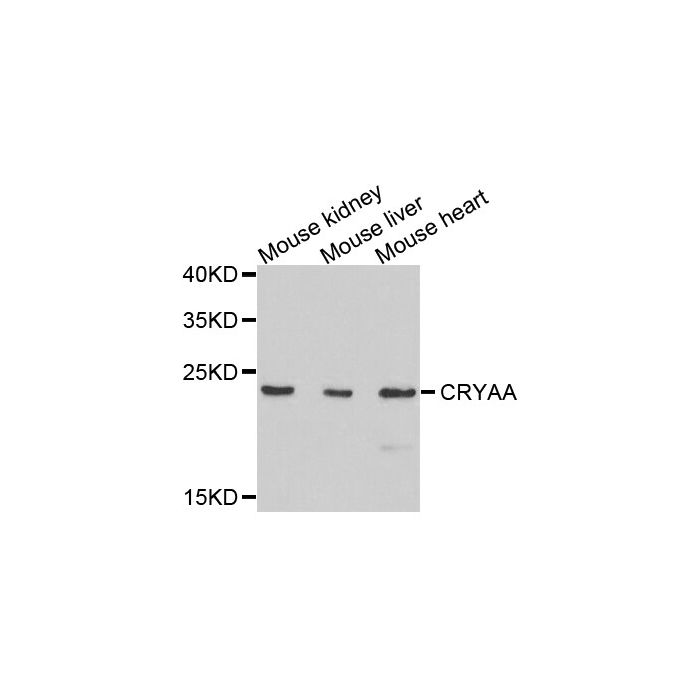
CRYAA polyclonal, anti-human, mouse, rat, zebrafish
€388.00
In stock
SKU
BS7816
Background:
Crystallins are the major proteins of the vertebrate eye lens, where they maintain the transparency and refractive index of the lens. Crystallins are divided into α, β and γ families, and the β- and γ-crystallins also compose a superfamily. Crystallins usually contain seven distinct protein regions, including four homologous motifs, a connecting peptide, and N- and C-terminal extensions. α-crystallins consist of three gene products, αA, αB and αC-crystallin, which are members of the small heat shock protein family (HSP 20). They are induced by heat shock, and act as molecular chaperones by holding denatured proteins in large soluble aggregates. However, unlike other molecular chaperones, α-crystallins do not renature these proteins. Expression of αA-crystallin is restricted to the lens. Defects in this gene cause autosomal dominant congenital cataracts (ADCC). The human αB-crystallin gene product is expressed in many tissues, including lens, heart and skeletal muscle. Elevated expression of αB-crystallin is associated with many neurological diseases, and a missense mutation in this gene has co-segregated in a family with a Desmin-related myopathy.
Alternative Name:
Acry 1, Alpha crystallin A chain, Alpha-crystallin A chain, CRYA 1, CRYA1, CRYAA, CRYAA_HUMAN, Crystallin Alpha 1, Crystallin alpha A, Heat shock protein beta 4, Heat shock protein beta-4, HSPB 4, HspB4, short form, Zonular Central Nuclear Cataract,
Application Dilution: WB: 1:500~1:2000, IHC/IF: 1:50~1:200
Specificity: CRYAA polyclonal antibody detects endogenous levels of CRYAA protein.
Immunogen:
Recombinant full length Human CRYAA.
MW: ~ 20 kDa
Swis Prot.: P02489
Purification & Purity:
The antibody was affinity-purified from rabbit antiserum by affinity-chromatography using epitope-specific immunogen and the purity is > 95% (by SDS-PAGE).
Format:
1mg/ml in PBS with 0.1% Sodium Azide, 50% Glycerol.
Storage:
Store at 4°C short term. Aliquot and store at -20°C long term. Avoid freeze-thaw cycles.
For research use only, not for use in diagnostic procedure.
Crystallins are the major proteins of the vertebrate eye lens, where they maintain the transparency and refractive index of the lens. Crystallins are divided into α, β and γ families, and the β- and γ-crystallins also compose a superfamily. Crystallins usually contain seven distinct protein regions, including four homologous motifs, a connecting peptide, and N- and C-terminal extensions. α-crystallins consist of three gene products, αA, αB and αC-crystallin, which are members of the small heat shock protein family (HSP 20). They are induced by heat shock, and act as molecular chaperones by holding denatured proteins in large soluble aggregates. However, unlike other molecular chaperones, α-crystallins do not renature these proteins. Expression of αA-crystallin is restricted to the lens. Defects in this gene cause autosomal dominant congenital cataracts (ADCC). The human αB-crystallin gene product is expressed in many tissues, including lens, heart and skeletal muscle. Elevated expression of αB-crystallin is associated with many neurological diseases, and a missense mutation in this gene has co-segregated in a family with a Desmin-related myopathy.
Alternative Name:
Acry 1, Alpha crystallin A chain, Alpha-crystallin A chain, CRYA 1, CRYA1, CRYAA, CRYAA_HUMAN, Crystallin Alpha 1, Crystallin alpha A, Heat shock protein beta 4, Heat shock protein beta-4, HSPB 4, HspB4, short form, Zonular Central Nuclear Cataract,
Application Dilution: WB: 1:500~1:2000, IHC/IF: 1:50~1:200
Specificity: CRYAA polyclonal antibody detects endogenous levels of CRYAA protein.
Immunogen:
Recombinant full length Human CRYAA.
MW: ~ 20 kDa
Swis Prot.: P02489
Purification & Purity:
The antibody was affinity-purified from rabbit antiserum by affinity-chromatography using epitope-specific immunogen and the purity is > 95% (by SDS-PAGE).
Format:
1mg/ml in PBS with 0.1% Sodium Azide, 50% Glycerol.
Storage:
Store at 4°C short term. Aliquot and store at -20°C long term. Avoid freeze-thaw cycles.
For research use only, not for use in diagnostic procedure.
| Is Featured? | No |
|---|
Write Your Own Review