
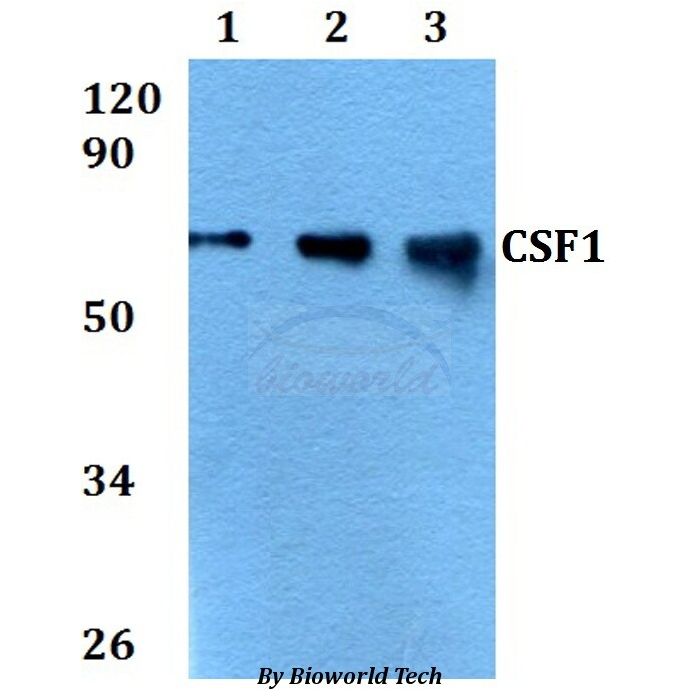
CSF1 polyclonal, anti-human, mouse, rat
€305.00
In stock
SKU
BS60697
Background:
The macrophage colony-stimulating factor (M-CSF), also designated CSF-1, was originally discovered in serum, urine and other biological fluids as a factor that can stimulate the formation of macrophage colonies from bone marrow hematopoietic progenitor cells. M-CSF is a homodimeric cytokine that is produced by fibroblasts, epithelial cells, bone marrow stromal cells, osteoblasts, keratinocytes, macrophages, T cells and B cells. M-CSF is a glycoprotein required for the proliferation and differentiation of mononuclear phagocytes, including osteoclasts. M-CSF has also been identified as an important mediator of the inflammatory response and can regulate the release of proinflammatory cytokines from macrophages. M-CSF exerts its pleiotropic effects by binding to a single type of high affinity cell surface receptor that is encoded by the c-Fms proto-oncogene.
Alternative Name:
Macrophage colony-stimulating factor 1, CSF-1, M-CSF, MCSF, Lanimostim
Application Dilution: WB: 1:500~1:1000
Specificity: CSF1 polyclonal antibody detects endogenous levels of CSF1 protein.
Immunogen:
A synthetic peptide corresponding to residues in Human CSF1
MW: ~ 70 kDa
Swis Prot.: P09603
Purification & Purity:
The antibody was affinity-purified from rabbit antiserum by affinity-chromatography using epitope-specific immunogen and the purity is > 95% (by SDS-PAGE).
Format:
1 mg/ml in Phosphate buffered saline (PBS) with 15 mM sodium azide, approx. pH 7.2.
Storage:
Store at 4°C short term. Aliquot and store at -20°C long term. Avoid freeze-thaw cycles.
For research use only, not for use in diagnostic procedure.
The macrophage colony-stimulating factor (M-CSF), also designated CSF-1, was originally discovered in serum, urine and other biological fluids as a factor that can stimulate the formation of macrophage colonies from bone marrow hematopoietic progenitor cells. M-CSF is a homodimeric cytokine that is produced by fibroblasts, epithelial cells, bone marrow stromal cells, osteoblasts, keratinocytes, macrophages, T cells and B cells. M-CSF is a glycoprotein required for the proliferation and differentiation of mononuclear phagocytes, including osteoclasts. M-CSF has also been identified as an important mediator of the inflammatory response and can regulate the release of proinflammatory cytokines from macrophages. M-CSF exerts its pleiotropic effects by binding to a single type of high affinity cell surface receptor that is encoded by the c-Fms proto-oncogene.
Alternative Name:
Macrophage colony-stimulating factor 1, CSF-1, M-CSF, MCSF, Lanimostim
Application Dilution: WB: 1:500~1:1000
Specificity: CSF1 polyclonal antibody detects endogenous levels of CSF1 protein.
Immunogen:
A synthetic peptide corresponding to residues in Human CSF1
MW: ~ 70 kDa
Swis Prot.: P09603
Purification & Purity:
The antibody was affinity-purified from rabbit antiserum by affinity-chromatography using epitope-specific immunogen and the purity is > 95% (by SDS-PAGE).
Format:
1 mg/ml in Phosphate buffered saline (PBS) with 15 mM sodium azide, approx. pH 7.2.
Storage:
Store at 4°C short term. Aliquot and store at -20°C long term. Avoid freeze-thaw cycles.
For research use only, not for use in diagnostic procedure.
| Is Featured? | No |
|---|
Write Your Own Review