
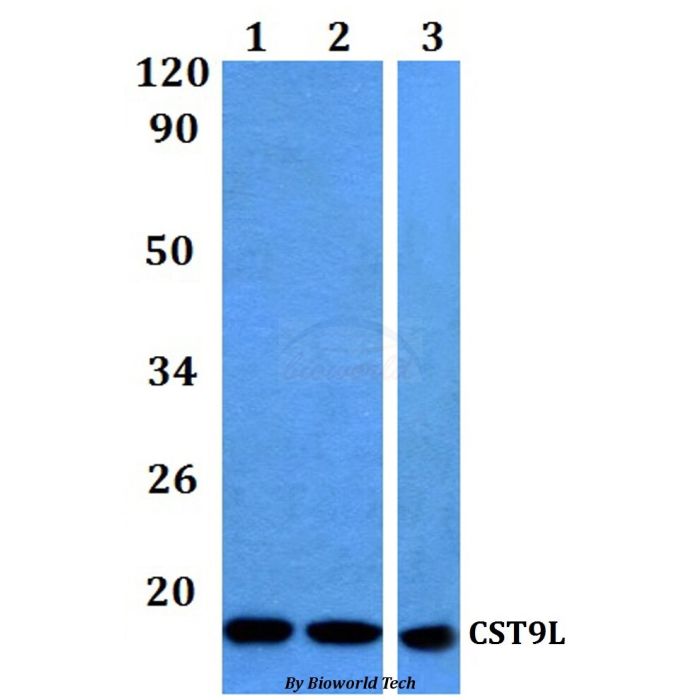
CST9L polyclonal, anti-human, mouse, rat
€305.00
In stock
SKU
BS61165
Background:
The cystatin superfamily is a well-established family of cysteine protease inhibitors. All true cystatins inhibit cysteine peptidases of the papain family, such as cathepsins, while some also inhibit legumain family enzymes. CST9L (Cystatin-9-like) is a 147 amino acid secreted protein that is related to cystatin 9, which is thought to play a role in hematopoietic differentiation or inflammation. The gene encoding CST9L maps to human chromosome 20, which comprises approximately 2% of the human genome and contains nearly 63 million bases that encode over 600 genes, some of which are associated with Creutzfeldt-Jakob disease, amyotrophic lateral sclerosis, spinal muscular atrophy, ring chromosome 20 epilepsy syndrome and Alagille syndrome. Additionally, chromosome 20 contains a region with numerous genes which are thought important for seminal production and may be potential targets for male contraception.
Alternative Name:
Cystatin-9-like, CST9L
Application Dilution: WB: 1:500~1:1000
Specificity: CST9L polyclonal antibody detects endogenous levels of CST9L protein.
Immunogen:
A synthetic peptide corresponding to residues in Human CST9L.
MW: ~ 17 kDa
Swis Prot.: Q9H4G1
Purification & Purity:
The antibody was affinity-purified from rabbit antiserum by affinity-chromatography using epitope-specific immunogen and the purity is > 95% (by SDS-PAGE).
Format:
1 mg/ml in Phosphate buffered saline (PBS) with 0.05% sodium azide, approx. pH 7.3.
Storage:
Store at 4°C short term. Aliquot and store at -20°C long term. Avoid freeze-thaw cycles.
For research use only, not for use in diagnostic procedure.
The cystatin superfamily is a well-established family of cysteine protease inhibitors. All true cystatins inhibit cysteine peptidases of the papain family, such as cathepsins, while some also inhibit legumain family enzymes. CST9L (Cystatin-9-like) is a 147 amino acid secreted protein that is related to cystatin 9, which is thought to play a role in hematopoietic differentiation or inflammation. The gene encoding CST9L maps to human chromosome 20, which comprises approximately 2% of the human genome and contains nearly 63 million bases that encode over 600 genes, some of which are associated with Creutzfeldt-Jakob disease, amyotrophic lateral sclerosis, spinal muscular atrophy, ring chromosome 20 epilepsy syndrome and Alagille syndrome. Additionally, chromosome 20 contains a region with numerous genes which are thought important for seminal production and may be potential targets for male contraception.
Alternative Name:
Cystatin-9-like, CST9L
Application Dilution: WB: 1:500~1:1000
Specificity: CST9L polyclonal antibody detects endogenous levels of CST9L protein.
Immunogen:
A synthetic peptide corresponding to residues in Human CST9L.
MW: ~ 17 kDa
Swis Prot.: Q9H4G1
Purification & Purity:
The antibody was affinity-purified from rabbit antiserum by affinity-chromatography using epitope-specific immunogen and the purity is > 95% (by SDS-PAGE).
Format:
1 mg/ml in Phosphate buffered saline (PBS) with 0.05% sodium azide, approx. pH 7.3.
Storage:
Store at 4°C short term. Aliquot and store at -20°C long term. Avoid freeze-thaw cycles.
For research use only, not for use in diagnostic procedure.
| Is Featured? | No |
|---|
Write Your Own Review