
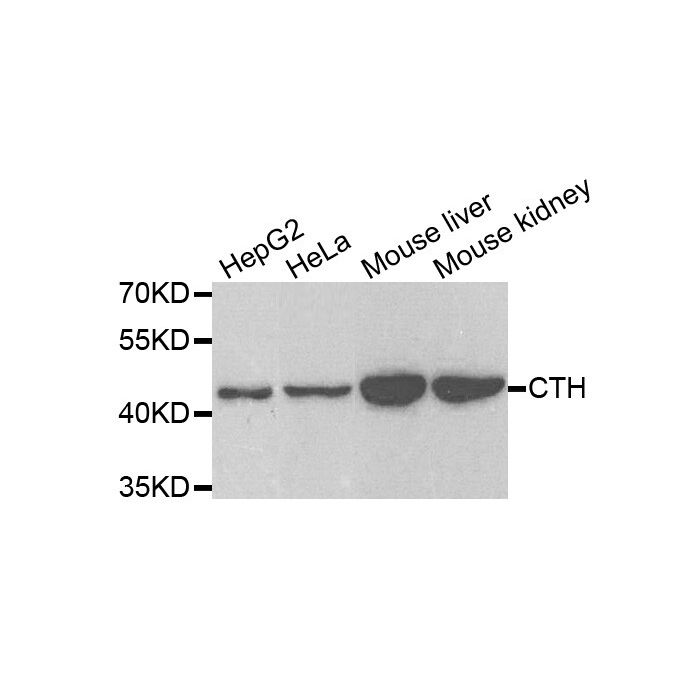
CTH polyclonal, anti-human, mouse
€388.00
In stock
SKU
BS7916
Background:
CTH (cystathionine γ-lyase), also known as CSE or γ-cystathionase, is a member of the trans-sulfuration enzyme family and participates in the trans-sulfuration pathway. CTH is a cytoplasmic enzyme produced in the cytosol and is responsible for catalyzing the pyridoxal phosphate-dependent β-disulfide elimination reaction resulting in ammonium, pyruvate and thiocysteine. The thiocysteine that is produced may then react with other thiols (or cysteine) and form hydrogen sulfide (H2S). Thus, CTH is the major H2S-producing enzyme in kidney, liver, vascular smooth muscle cells and enterocytes. The endogenous production of H2S plays a significant role in the regulation of cellular functions, including cell growth, hyperpolarization of cell membranes, modulation of neuronal excitability and relaxation of smooth muscle cells. Mutations in the gene encoding CTH can result in the autosomal recessive disease cystathioninuria; a disorder characterized by the unusual accumulation of plasma cystathionine causing increased urinary excretion.
Alternative Name:
CGL_HUMAN, CTH, cystathionase (cystathionine gamma-lyase), Cystathionine gamma lyase, Cystathionine gamma-lyase, Cysteine desulfhydrase, Gamma cystathionase, Gamma-cystathionase, Homoserine deaminase, Homoserine dehydratase, MGC9471,
Application Dilution: WB: 1:500~1:2000, IHC: 1:50~1:200
Specificity: CTH polyclonal antibody detects endogenous levels of CTH protein.
Immunogen:
Recombinant full length Human CTH.
MW: ~ 44 kDa
Swis Prot.: P32929
Purification & Purity:
The antibody was affinity-purified from rabbit antiserum by affinity-chromatography using epitope-specific immunogen and the purity is > 95% (by SDS-PAGE).
Format:
1mg/ml in PBS with 0.1% Sodium Azide, 50% Glycerol.
Storage:
Store at 4°C short term. Aliquot and store at -20°C long term. Avoid freeze-thaw cycles.
For research use only, not for use in diagnostic procedure.
CTH (cystathionine γ-lyase), also known as CSE or γ-cystathionase, is a member of the trans-sulfuration enzyme family and participates in the trans-sulfuration pathway. CTH is a cytoplasmic enzyme produced in the cytosol and is responsible for catalyzing the pyridoxal phosphate-dependent β-disulfide elimination reaction resulting in ammonium, pyruvate and thiocysteine. The thiocysteine that is produced may then react with other thiols (or cysteine) and form hydrogen sulfide (H2S). Thus, CTH is the major H2S-producing enzyme in kidney, liver, vascular smooth muscle cells and enterocytes. The endogenous production of H2S plays a significant role in the regulation of cellular functions, including cell growth, hyperpolarization of cell membranes, modulation of neuronal excitability and relaxation of smooth muscle cells. Mutations in the gene encoding CTH can result in the autosomal recessive disease cystathioninuria; a disorder characterized by the unusual accumulation of plasma cystathionine causing increased urinary excretion.
Alternative Name:
CGL_HUMAN, CTH, cystathionase (cystathionine gamma-lyase), Cystathionine gamma lyase, Cystathionine gamma-lyase, Cysteine desulfhydrase, Gamma cystathionase, Gamma-cystathionase, Homoserine deaminase, Homoserine dehydratase, MGC9471,
Application Dilution: WB: 1:500~1:2000, IHC: 1:50~1:200
Specificity: CTH polyclonal antibody detects endogenous levels of CTH protein.
Immunogen:
Recombinant full length Human CTH.
MW: ~ 44 kDa
Swis Prot.: P32929
Purification & Purity:
The antibody was affinity-purified from rabbit antiserum by affinity-chromatography using epitope-specific immunogen and the purity is > 95% (by SDS-PAGE).
Format:
1mg/ml in PBS with 0.1% Sodium Azide, 50% Glycerol.
Storage:
Store at 4°C short term. Aliquot and store at -20°C long term. Avoid freeze-thaw cycles.
For research use only, not for use in diagnostic procedure.
| Is Featured? | No |
|---|
Write Your Own Review