
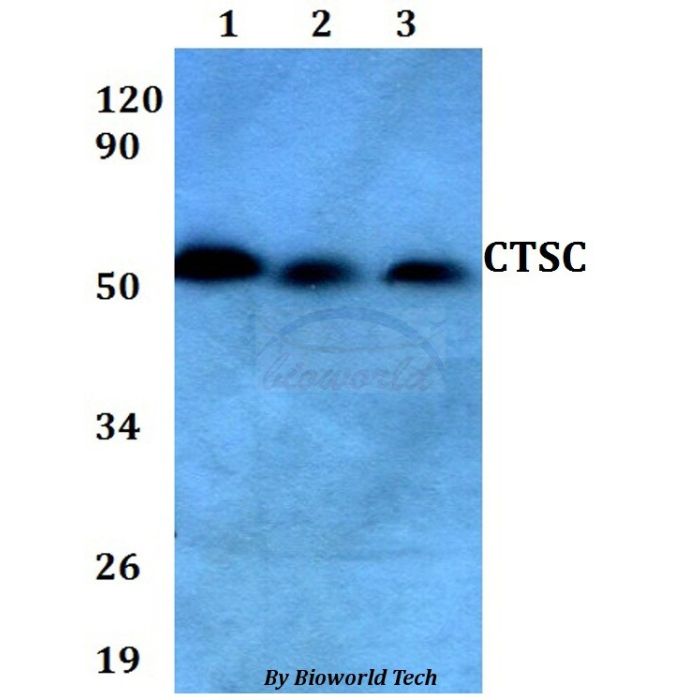
CTSC polyclonal, anti-human, mouse, rat
€305.00
In stock
SKU
BS60650
Background:
Cathepsin C, known also as dipeptidyl aminopeptidase I (DPPI), is a tetrameric lysosomal cysteine peptidase belonging to the papain family . Cathepsin C is involved in intracellular protein degradation and the processing of protein precursors, where it participates in cell growth, neuraminidase activation, and platelet factor XIII activation. Cathepsin C is largely related to other lysosomal cysteine proteinases, including cathepsin B, H and L . Enzymatically, Cathepsin C is capable of sequentially removing dipeptides from the amino terminus, and it requires halide ions, namely chloride ions, and thiols for complete enzymatic activity . Protein levels of Cathepsin C are detected in a variety of tissues, and it is most highly expressed in spleen, kidney, cytotoxic lymphocytes and myeloid cells, where it localizes to the secretory granule compartment . Cathepsin C is initially synthesized as a proenzyme that is rapidly processed to generate two distinct chains that function together as the mature form of the enzyme .
Alternative Name:
Dipeptidyl peptidase 1, Cathepsin C, Cathepsin J, Dipeptidyl peptidase I, DPP-I, DPPI, Dipeptidyl transferase, CTSC, CPPI
Application Dilution: WB: 1:500~1:1000
Specificity: CTSC polyclonal antibody detects endogenous levels of CTSC protein.
Immunogen:
A synthetic peptide corresponding to residues in Human CTSC
MW: ~ 52 kDa
Swis Prot.: P53634
Purification & Purity:
The antibody was affinity-purified from rabbit antiserum by affinity-chromatography using epitope-specific immunogen and the purity is > 95% (by SDS-PAGE).
Format:
1 mg/ml in Phosphate buffered saline (PBS) with 15 mM sodium azide, approx. pH 7.2.
Storage:
Store at 4°C short term. Aliquot and store at -20°C long term. Avoid freeze-thaw cycles.
For research use only, not for use in diagnostic procedure.
Cathepsin C, known also as dipeptidyl aminopeptidase I (DPPI), is a tetrameric lysosomal cysteine peptidase belonging to the papain family . Cathepsin C is involved in intracellular protein degradation and the processing of protein precursors, where it participates in cell growth, neuraminidase activation, and platelet factor XIII activation. Cathepsin C is largely related to other lysosomal cysteine proteinases, including cathepsin B, H and L . Enzymatically, Cathepsin C is capable of sequentially removing dipeptides from the amino terminus, and it requires halide ions, namely chloride ions, and thiols for complete enzymatic activity . Protein levels of Cathepsin C are detected in a variety of tissues, and it is most highly expressed in spleen, kidney, cytotoxic lymphocytes and myeloid cells, where it localizes to the secretory granule compartment . Cathepsin C is initially synthesized as a proenzyme that is rapidly processed to generate two distinct chains that function together as the mature form of the enzyme .
Alternative Name:
Dipeptidyl peptidase 1, Cathepsin C, Cathepsin J, Dipeptidyl peptidase I, DPP-I, DPPI, Dipeptidyl transferase, CTSC, CPPI
Application Dilution: WB: 1:500~1:1000
Specificity: CTSC polyclonal antibody detects endogenous levels of CTSC protein.
Immunogen:
A synthetic peptide corresponding to residues in Human CTSC
MW: ~ 52 kDa
Swis Prot.: P53634
Purification & Purity:
The antibody was affinity-purified from rabbit antiserum by affinity-chromatography using epitope-specific immunogen and the purity is > 95% (by SDS-PAGE).
Format:
1 mg/ml in Phosphate buffered saline (PBS) with 15 mM sodium azide, approx. pH 7.2.
Storage:
Store at 4°C short term. Aliquot and store at -20°C long term. Avoid freeze-thaw cycles.
For research use only, not for use in diagnostic procedure.
| Is Featured? | No |
|---|
Write Your Own Review