
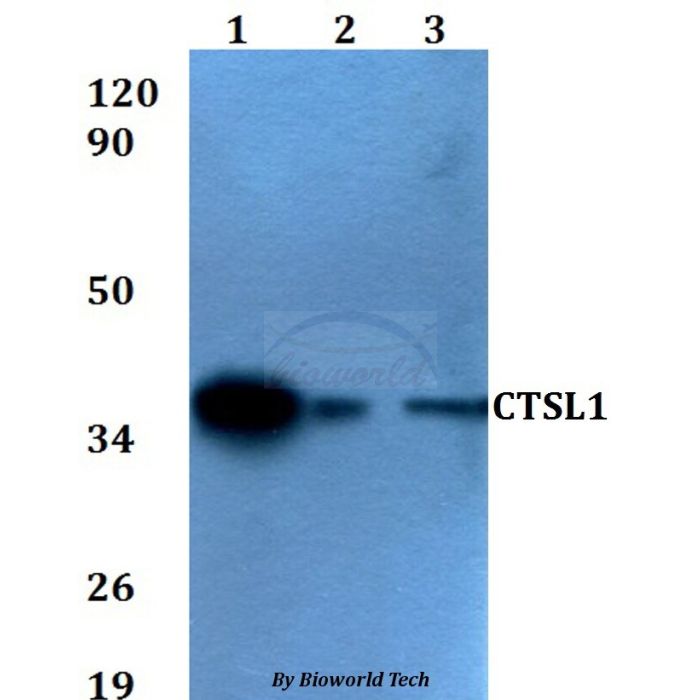
CTSL1 polyclonal, anti-human, mouse, rat
€305.00
In stock
SKU
BS60598
Background:
The cathepsin family of proteolytic enzymes contains several diverse classes of proteases. The cysteine protease class comprises cathepsins B, L, H, K, S, and O. The aspartyl protease class is composed of cathepsins D and E. Cathepsin G is in the serine protease class. Most cathepsins are lysosomal and each is involved in cellular metabolism, participating in various events such as peptide biosynthesis and protein degradation. Cathepsin L (also designated major excreted protein, MEP or CATL) is a member of the peptidase C1 family and has been identified as a protein that is most closely related to cathepsin H. It is a lysosomal cysteine proteinase that mediates intracellular protein catabolism for collagen, elastin and å-1 protease inhibitor. Cathepsin L is a dimer composed of disulfide-linked heavy and light chains, both produced from a single protein precursor. At least two transcript variants encoding the same protein have been found for this gene. Transformed mouse fibroblasts stimulated by growth factors or tumor promoters secrete a form of cathepsin L.
Alternative Name:
Cathepsin L1, Cathepsin L, Major excreted protein, MEP, CTSL, CTSL1
Application Dilution: WB: 1:500~1:1000
Specificity: CTSL1 polyclonal antibody detects endogenous levels of CTSL1 protein.
Immunogen:
A synthetic peptide corresponding to residues in Human CTSL1
MW: ~ 38 kDa
Swis Prot.: P07711
Purification & Purity:
The antibody was affinity-purified from rabbit antiserum by affinity-chromatography using epitope-specific immunogen and the purity is > 95% (by SDS-PAGE).
Format:
1 mg/ml in Phosphate buffered saline (PBS) with 15 mM sodium azide, approx. pH 7.2.
Storage:
Store at 4°C short term. Aliquot and store at -20°C long term. Avoid freeze-thaw cycles.
For research use only, not for use in diagnostic procedure.
The cathepsin family of proteolytic enzymes contains several diverse classes of proteases. The cysteine protease class comprises cathepsins B, L, H, K, S, and O. The aspartyl protease class is composed of cathepsins D and E. Cathepsin G is in the serine protease class. Most cathepsins are lysosomal and each is involved in cellular metabolism, participating in various events such as peptide biosynthesis and protein degradation. Cathepsin L (also designated major excreted protein, MEP or CATL) is a member of the peptidase C1 family and has been identified as a protein that is most closely related to cathepsin H. It is a lysosomal cysteine proteinase that mediates intracellular protein catabolism for collagen, elastin and å-1 protease inhibitor. Cathepsin L is a dimer composed of disulfide-linked heavy and light chains, both produced from a single protein precursor. At least two transcript variants encoding the same protein have been found for this gene. Transformed mouse fibroblasts stimulated by growth factors or tumor promoters secrete a form of cathepsin L.
Alternative Name:
Cathepsin L1, Cathepsin L, Major excreted protein, MEP, CTSL, CTSL1
Application Dilution: WB: 1:500~1:1000
Specificity: CTSL1 polyclonal antibody detects endogenous levels of CTSL1 protein.
Immunogen:
A synthetic peptide corresponding to residues in Human CTSL1
MW: ~ 38 kDa
Swis Prot.: P07711
Purification & Purity:
The antibody was affinity-purified from rabbit antiserum by affinity-chromatography using epitope-specific immunogen and the purity is > 95% (by SDS-PAGE).
Format:
1 mg/ml in Phosphate buffered saline (PBS) with 15 mM sodium azide, approx. pH 7.2.
Storage:
Store at 4°C short term. Aliquot and store at -20°C long term. Avoid freeze-thaw cycles.
For research use only, not for use in diagnostic procedure.
| Is Featured? | No |
|---|
Write Your Own Review