
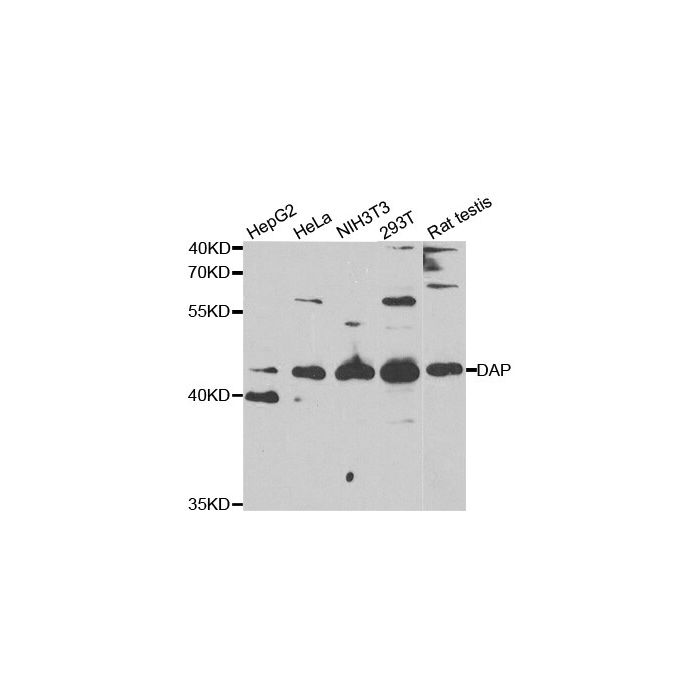
DAP polyclonal, anti-human, mouse, rat
€388.00
In stock
SKU
BS7941
Background:
In contrast to growth factors which promote cell proliferation, FAS ligand (FAS-L) and the tumor necrosis factors (TNFs) rapidly induce apoptosis. Cellular response to FAS-L and TNF is mediated by structurally related receptors containing a conserved cytoplasmic region called the “death domain”. DAP-1 (for death associated protein-1) interacts with the death domain of TNF-R1 and can trigger programmed cell death in a variety of cell lines, as well as suppress NFκB/Rel activity. DAP-3 is a positive mediator of programmed cell death; overexpressed intact full-length protein is required in order to induce apoptosis. During apotosis, the caspase-activated DAP-5 can mediate CAP-independent translation at least from its own internal ribosome entry site, thus resulting in a positive feedback loop responsible for the continuous translation of DAP-5. DAP-5 is also required for cellular differentiation, as it controls specific gene expression pathways.
Alternative Name:
DAP 1, Dap, DAP-1, DAP1_HUMAN, Death Associated Protein 1, Death associated protein, Death-associated protein 1, MGC99796, OTTHUMP00000161670, OTTHUMP00000221331,
Application Dilution: WB: 1:500~1:2000, IHC/IF: 1:50~1:200
Specificity: DAP polyclonal antibody detects endogenous levels of DAP protein.
Immunogen:
Recombinant full length Human DAP.
MW: ~ 11 kDa
Swis Prot.: P51397
Purification & Purity:
The antibody was affinity-purified from rabbit antiserum by affinity-chromatography using epitope-specific immunogen and the purity is > 95% (by SDS-PAGE).
Format:
1mg/ml in PBS with 0.1% Sodium Azide, 50% Glycerol.
Storage:
Store at 4°C short term. Aliquot and store at -20°C long term. Avoid freeze-thaw cycles.
For research use only, not for use in diagnostic procedure.
In contrast to growth factors which promote cell proliferation, FAS ligand (FAS-L) and the tumor necrosis factors (TNFs) rapidly induce apoptosis. Cellular response to FAS-L and TNF is mediated by structurally related receptors containing a conserved cytoplasmic region called the “death domain”. DAP-1 (for death associated protein-1) interacts with the death domain of TNF-R1 and can trigger programmed cell death in a variety of cell lines, as well as suppress NFκB/Rel activity. DAP-3 is a positive mediator of programmed cell death; overexpressed intact full-length protein is required in order to induce apoptosis. During apotosis, the caspase-activated DAP-5 can mediate CAP-independent translation at least from its own internal ribosome entry site, thus resulting in a positive feedback loop responsible for the continuous translation of DAP-5. DAP-5 is also required for cellular differentiation, as it controls specific gene expression pathways.
Alternative Name:
DAP 1, Dap, DAP-1, DAP1_HUMAN, Death Associated Protein 1, Death associated protein, Death-associated protein 1, MGC99796, OTTHUMP00000161670, OTTHUMP00000221331,
Application Dilution: WB: 1:500~1:2000, IHC/IF: 1:50~1:200
Specificity: DAP polyclonal antibody detects endogenous levels of DAP protein.
Immunogen:
Recombinant full length Human DAP.
MW: ~ 11 kDa
Swis Prot.: P51397
Purification & Purity:
The antibody was affinity-purified from rabbit antiserum by affinity-chromatography using epitope-specific immunogen and the purity is > 95% (by SDS-PAGE).
Format:
1mg/ml in PBS with 0.1% Sodium Azide, 50% Glycerol.
Storage:
Store at 4°C short term. Aliquot and store at -20°C long term. Avoid freeze-thaw cycles.
For research use only, not for use in diagnostic procedure.
| Is Featured? | No |
|---|
Write Your Own Review