
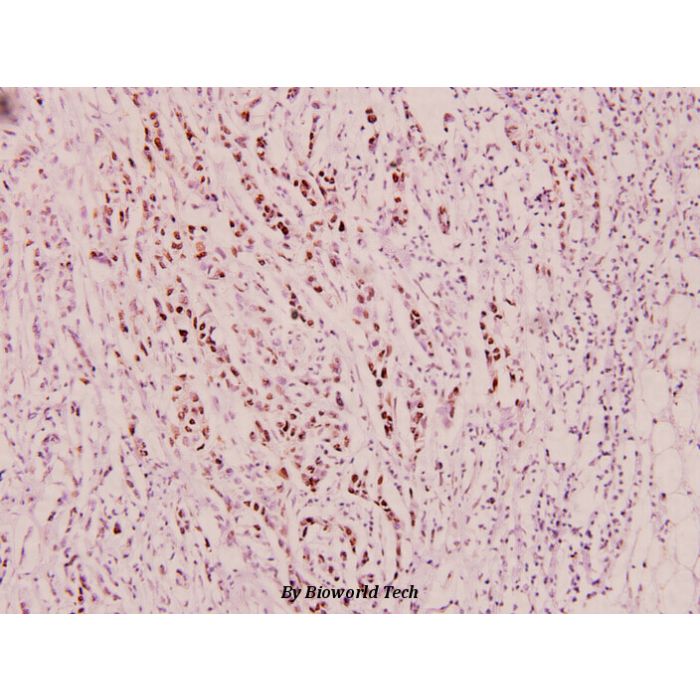
DNA-PK (phospho-Y2609) polyclonal, anti-human
€328.00
In stock
SKU
BS5066
Background:
The phosphatidylinositol kinase (PIK) family members fall into two distinct subgroups. The first subgroup contains proteins such as the PI 3- and PI 4-kinases and the second group comprises the PIK-related kinases. The PIK-related kinases include Atm, DNA-PKCS and FRAP. These proteins have in common a region of homology at their carboxy termini that is not present in the PI 3- and PI 4-kinases. All of the members of the PIK-related kinases are also over 270 kDa. The Atm gene is mutated in the autosomal recessive disorder ataxia telangiectasia (AT) that is characterized by cerebellar degeneration (ataxia) and the appearance of dilated blood vessels (telangiectases) in the conjunctivae of the eyes.
Alternative Name:
DNA-dependent protein kinase catalytic subunit, DNA-PK catalytic subunit, DNA-PKcs, DNPK1, p460, PRKDC, HYRC, HYRC1
Application Dilution: IHC: 1:50~1:200
Specificity: p-DNA-PK (Y2609) polyclonal antibody detects endogenous levels of DNA-PK protein only when phosphorylated at Tyr2609.
Immunogen:
Synthetic phosphopeptide derived from human DNA-PK around the phosphorylation site of Tyrosine 2609.
MW: ~ 450 kDa
Swis Prot.: P78527
Purification & Purity:
The antibody was affinity-purified from rabbit antiserum by affinity-chromatography using epitope-specific immunogen and the purity is > 95% (by SDS-PAGE).
Format:
1 mg/ml in Phosphate buffered saline (PBS) with 0.05% sodium azide, approx. pH 7.2.
Storage:
Store at 4°C short term. Aliquot and store at -20°C long term. Avoid freeze-thaw cycles.
For research use only, not for use in diagnostic procedure.
The phosphatidylinositol kinase (PIK) family members fall into two distinct subgroups. The first subgroup contains proteins such as the PI 3- and PI 4-kinases and the second group comprises the PIK-related kinases. The PIK-related kinases include Atm, DNA-PKCS and FRAP. These proteins have in common a region of homology at their carboxy termini that is not present in the PI 3- and PI 4-kinases. All of the members of the PIK-related kinases are also over 270 kDa. The Atm gene is mutated in the autosomal recessive disorder ataxia telangiectasia (AT) that is characterized by cerebellar degeneration (ataxia) and the appearance of dilated blood vessels (telangiectases) in the conjunctivae of the eyes.
Alternative Name:
DNA-dependent protein kinase catalytic subunit, DNA-PK catalytic subunit, DNA-PKcs, DNPK1, p460, PRKDC, HYRC, HYRC1
Application Dilution: IHC: 1:50~1:200
Specificity: p-DNA-PK (Y2609) polyclonal antibody detects endogenous levels of DNA-PK protein only when phosphorylated at Tyr2609.
Immunogen:
Synthetic phosphopeptide derived from human DNA-PK around the phosphorylation site of Tyrosine 2609.
MW: ~ 450 kDa
Swis Prot.: P78527
Purification & Purity:
The antibody was affinity-purified from rabbit antiserum by affinity-chromatography using epitope-specific immunogen and the purity is > 95% (by SDS-PAGE).
Format:
1 mg/ml in Phosphate buffered saline (PBS) with 0.05% sodium azide, approx. pH 7.2.
Storage:
Store at 4°C short term. Aliquot and store at -20°C long term. Avoid freeze-thaw cycles.
For research use only, not for use in diagnostic procedure.
| Is Featured? | No |
|---|
Write Your Own Review