
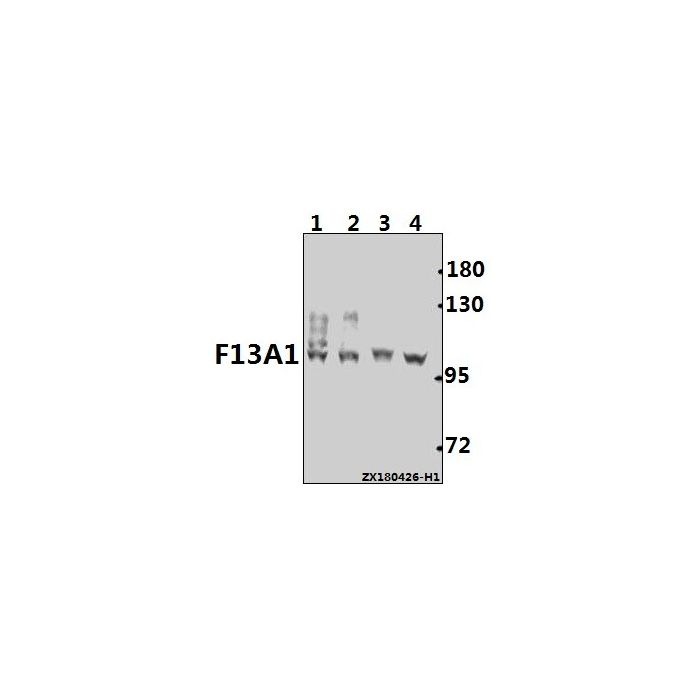
Factor 13 A polyclonal, anti-human, mouse, rat
€305.00
In stock
SKU
BS61807
Background:
Hemostasis following tissue injury involves the deployment of essential plasma procoagulants (Prothrombin, and Factors V, VIII, IX and X), which are involved in a blood coagulation cascade leading to the formation of insoluble fibrin clots and the promotion of platelet aggregation. Coagulation Factor VII (serum prothrombin conversion accelerator, proconvertin, F7, Factor VII) is a 406 amino acid, vitamin K-dependent, single chain serine protease that is synthesized in the liver and circulates as an inactive precursor. Factor IXa, Factor Xa, Factor XIIa, or Thrombin mediated proteolytic cleavage of Factor VII at Arg152-Ile153 generates Factor VIIa, an active serine protease composed of a catalytic heavy chain disulfide linked to a light chain, containing two EGF-like domains. Coagulation Factor XIII is a terminal effector in the blood coagulation cascade. Plasma Factor XIII is a heterotetramer composed of two A subunits and two B subunits. The A subunits have catalytic function, and the noncatalytic B subunits may serve as plasma carrier molecules.
Alternative Name:
Coagulation factor XIII A chain, Coagulation factor XIIIa, Protein-glutamine gamma-glutamyltransferase A chain, Transglutaminase A chain, F13A1, F13A
Application Dilution: WB: 1:500~1:1000
Specificity: F13A1 pAb detects endogenous levels of F13A1 protein.
Immunogen:
Synthetic peptide, corresponding to Human F13A1.
MW: ~ 95 kDa
Swis Prot.: P00488
Purification & Purity:
The antibody was affinity-purified from rabbit antiserum by affinity-chromatography using epitope-specific immunogen and the purity is > 95% (by SDS-PAGE).
Format:
1 mg/ml in Phosphate buffered saline (PBS) with 0.05% sodium azide, approx. pH 7.3.
Storage:
Store at 4°C short term. Aliquot and store at -20°C long term. Avoid freeze-thaw cycles.
For research use only, not for use in diagnostic procedure.
Hemostasis following tissue injury involves the deployment of essential plasma procoagulants (Prothrombin, and Factors V, VIII, IX and X), which are involved in a blood coagulation cascade leading to the formation of insoluble fibrin clots and the promotion of platelet aggregation. Coagulation Factor VII (serum prothrombin conversion accelerator, proconvertin, F7, Factor VII) is a 406 amino acid, vitamin K-dependent, single chain serine protease that is synthesized in the liver and circulates as an inactive precursor. Factor IXa, Factor Xa, Factor XIIa, or Thrombin mediated proteolytic cleavage of Factor VII at Arg152-Ile153 generates Factor VIIa, an active serine protease composed of a catalytic heavy chain disulfide linked to a light chain, containing two EGF-like domains. Coagulation Factor XIII is a terminal effector in the blood coagulation cascade. Plasma Factor XIII is a heterotetramer composed of two A subunits and two B subunits. The A subunits have catalytic function, and the noncatalytic B subunits may serve as plasma carrier molecules.
Alternative Name:
Coagulation factor XIII A chain, Coagulation factor XIIIa, Protein-glutamine gamma-glutamyltransferase A chain, Transglutaminase A chain, F13A1, F13A
Application Dilution: WB: 1:500~1:1000
Specificity: F13A1 pAb detects endogenous levels of F13A1 protein.
Immunogen:
Synthetic peptide, corresponding to Human F13A1.
MW: ~ 95 kDa
Swis Prot.: P00488
Purification & Purity:
The antibody was affinity-purified from rabbit antiserum by affinity-chromatography using epitope-specific immunogen and the purity is > 95% (by SDS-PAGE).
Format:
1 mg/ml in Phosphate buffered saline (PBS) with 0.05% sodium azide, approx. pH 7.3.
Storage:
Store at 4°C short term. Aliquot and store at -20°C long term. Avoid freeze-thaw cycles.
For research use only, not for use in diagnostic procedure.
| Is Featured? | No |
|---|
Write Your Own Review