
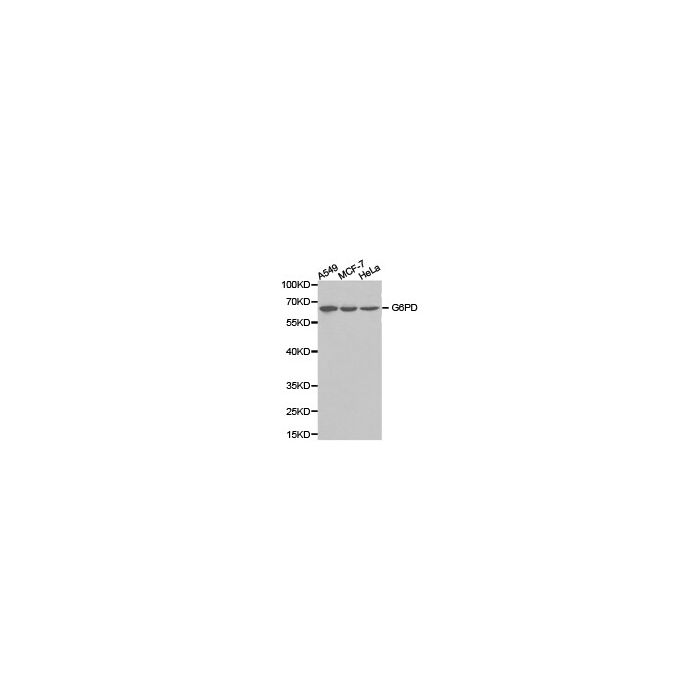
G6PD polyclonal, anti-human, mouse
€388.00
In stock
SKU
BS6611
Background:
Glucose-6-phosphate 1-dehydrogenase (G6PD) plays an important role in the pentose phosphate pathway. It is a member of the glucose-6-phosphate dehydrogenase family of proteins. G6PD is an ubiquitous enzyme that produces pentose sugars for nucleic acid synthesis, but is also involved in carbohydrate degradation, as it is one of the main producers of NADPH reducing power. G6PD has NADP as a co-factor and structural element. It can be found as a homodimer or homotetramer, and is primarily detected in lymphoblasts, granulocytes and sperm. Defects in G6PD can cause chronic non-spherocytic hemolytic anemia (CNSHA), especially in areas in which malaria is an epidemic. Individuals with a high level of G6PD-deficiency are at higher risk of acute hemolytic attacks.
Alternative Name:
Glucose-6-phosphate 1-dehydrogenase, G6PD
Application Dilution: WB: 1:500 - 1:2000
Specificity: G6PD polyclonal antibody detects endogenous levels of G6PD protein.
Immunogen:
Recombinant full length Human G6PD.
MW: ~ 60 kDa
Swis Prot.: P11413
Purification & Purity:
The antibody was affinity-purified from rabbit antiserum by affinity-chromatography using epitope-specific immunogen and the purity is > 95% (by SDS-PAGE).
Format:
1mg/ml in PBS with 0.1% Sodium Azide, 50% Glycerol.
Storage:
Store at 4°C short term. Aliquot and store at -20°C long term. Avoid freeze-thaw cycles.
For research use only, not for use in diagnostic procedure.
Glucose-6-phosphate 1-dehydrogenase (G6PD) plays an important role in the pentose phosphate pathway. It is a member of the glucose-6-phosphate dehydrogenase family of proteins. G6PD is an ubiquitous enzyme that produces pentose sugars for nucleic acid synthesis, but is also involved in carbohydrate degradation, as it is one of the main producers of NADPH reducing power. G6PD has NADP as a co-factor and structural element. It can be found as a homodimer or homotetramer, and is primarily detected in lymphoblasts, granulocytes and sperm. Defects in G6PD can cause chronic non-spherocytic hemolytic anemia (CNSHA), especially in areas in which malaria is an epidemic. Individuals with a high level of G6PD-deficiency are at higher risk of acute hemolytic attacks.
Alternative Name:
Glucose-6-phosphate 1-dehydrogenase, G6PD
Application Dilution: WB: 1:500 - 1:2000
Specificity: G6PD polyclonal antibody detects endogenous levels of G6PD protein.
Immunogen:
Recombinant full length Human G6PD.
MW: ~ 60 kDa
Swis Prot.: P11413
Purification & Purity:
The antibody was affinity-purified from rabbit antiserum by affinity-chromatography using epitope-specific immunogen and the purity is > 95% (by SDS-PAGE).
Format:
1mg/ml in PBS with 0.1% Sodium Azide, 50% Glycerol.
Storage:
Store at 4°C short term. Aliquot and store at -20°C long term. Avoid freeze-thaw cycles.
For research use only, not for use in diagnostic procedure.
| Is Featured? | No |
|---|
Write Your Own Review