
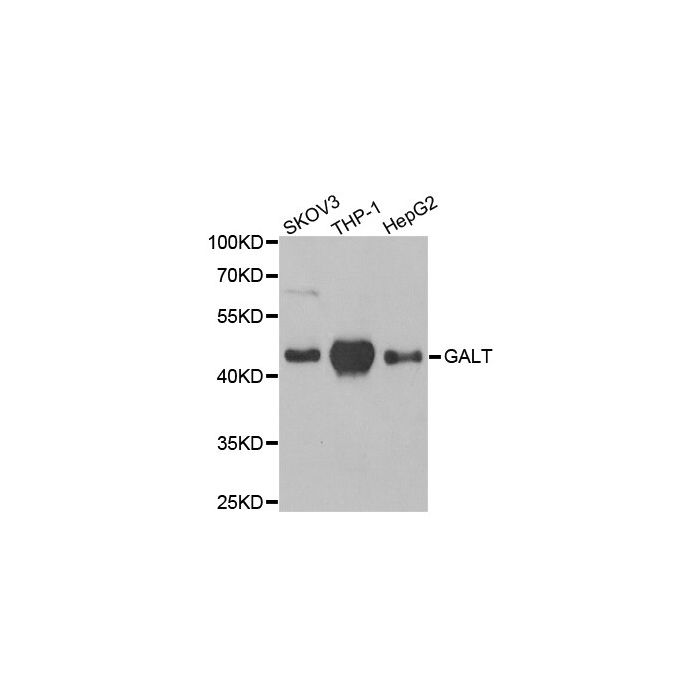
GALT polyclonal, anti-human, mouse, rat
€388.00
In stock
SKU
BS8105
Background:
GALT (galactose-1-phosphate uridylyltransferase) is a 379 amino acid member of the galactose-1-phosphate uridylyltransferase type 1 family of proteins. GALT exists as a homodimer and is believed to play a role in galactose metabolism. More specifically, GALT is responsible for catalyzing the reaction of UDP-glucose with α-D-galactose 1-phosphate to produce α-D-glucose 1-phosphate and UDP-galactose. This is the second step of the Leloir pathway of galactose metabolism. The products of this reaction will either enter the glycolytic pathway to yield energy (α-D-glucose 1-phosphate) or be used as a galactosyl donor in the synthesis of glycoproteins and glycolipids (UDP-galactose). Mutations in the gene encoding GALT can lead to galactosemia, a disorder (occurring from the inability to metabolize galactose) that is characterized by cataracts, mental retardation and jaundice. In newborns, galactosemia can be fatal if lactose is not removed from the diet.
Alternative Name:
Galactose-1-phosphate uridylyltransferase, Gal-1-P uridylyltransferase, UDP-glucose--hexose-1-phosphate uridylyltransferase, GALT
Application Dilution: WB: 1:500~1:2000, IHC: 1:50~1:200
Specificity: GALT polyclonal antibody detects endogenous levels of GALT protein.
Immunogen:
Recombinant full length Human GALT.
MW: ~ 43 kDa
Swis Prot.: P07902
Purification & Purity:
The antibody was affinity-purified from rabbit antiserum by affinity-chromatography using epitope-specific immunogen and the purity is > 95% (by SDS-PAGE).
Format:
1mg/ml in PBS with 0.1% Sodium Azide, 50% Glycerol.
Storage:
Store at 4°C short term. Aliquot and store at -20°C long term. Avoid freeze-thaw cycles.
For research use only, not for use in diagnostic procedure.
GALT (galactose-1-phosphate uridylyltransferase) is a 379 amino acid member of the galactose-1-phosphate uridylyltransferase type 1 family of proteins. GALT exists as a homodimer and is believed to play a role in galactose metabolism. More specifically, GALT is responsible for catalyzing the reaction of UDP-glucose with α-D-galactose 1-phosphate to produce α-D-glucose 1-phosphate and UDP-galactose. This is the second step of the Leloir pathway of galactose metabolism. The products of this reaction will either enter the glycolytic pathway to yield energy (α-D-glucose 1-phosphate) or be used as a galactosyl donor in the synthesis of glycoproteins and glycolipids (UDP-galactose). Mutations in the gene encoding GALT can lead to galactosemia, a disorder (occurring from the inability to metabolize galactose) that is characterized by cataracts, mental retardation and jaundice. In newborns, galactosemia can be fatal if lactose is not removed from the diet.
Alternative Name:
Galactose-1-phosphate uridylyltransferase, Gal-1-P uridylyltransferase, UDP-glucose--hexose-1-phosphate uridylyltransferase, GALT
Application Dilution: WB: 1:500~1:2000, IHC: 1:50~1:200
Specificity: GALT polyclonal antibody detects endogenous levels of GALT protein.
Immunogen:
Recombinant full length Human GALT.
MW: ~ 43 kDa
Swis Prot.: P07902
Purification & Purity:
The antibody was affinity-purified from rabbit antiserum by affinity-chromatography using epitope-specific immunogen and the purity is > 95% (by SDS-PAGE).
Format:
1mg/ml in PBS with 0.1% Sodium Azide, 50% Glycerol.
Storage:
Store at 4°C short term. Aliquot and store at -20°C long term. Avoid freeze-thaw cycles.
For research use only, not for use in diagnostic procedure.
| Is Featured? | No |
|---|
Write Your Own Review