
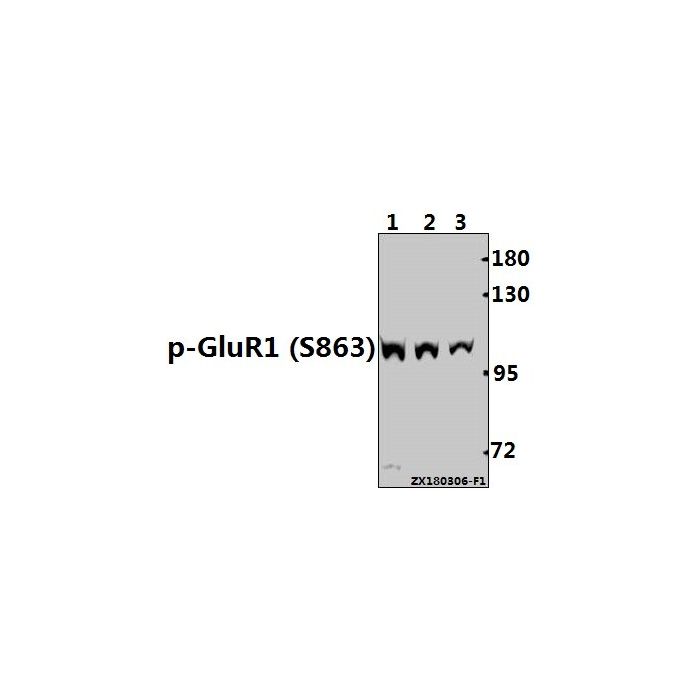
GluR1 (phospho-S863) polyclonal, anti-human
€328.00
In stock
SKU
BS4793
Background:
Glutamate receptors mediate most excitatory neurotransmission in the brain and play an important role in neural plasticity, neural development and neurodegeneration. Ionotropic glutamate receptors are categorized into NMDA receptors and kainate/AMPA receptors, both of which contain glutamate-gated, cation-specific ion channels. Kainate/AMPA receptors are co-localized with NMDA receptors in many synapses and consist of seven structurally related subunits designated GluR-1 to -7. The kainate/AMPA receptors are primarily responsible for the fast excitatory neuro-transmission by glutamate whereas the NMDA receptors are functionally characterized by a slow kinetic and a high permeability for Ca2+ ions.
Alternative Name:
Glutamate receptor 1, GluR-1, AMPA-selective glutamate receptor 1, GluR-A, GluR-K1, GluRA, GluRK1, Glutamate receptor ionotropic, AMPA 1, GluA1, GRIA1, GLUH1, GLUR1
Application Dilution: WB: 1:500~1:1000, IHC: 1:50~1:200
Specificity: p-GluR1 (S863) polyclonal antibody detects endogenous levels of GluR1 protein only when phosphorylated at Ser863.
Immunogen:
Synthetic phosphopeptide derived from human GluR1 around the phosphorylation site of Serine 863.
MW: ~ 102 kDa
Swis Prot.: P42261
Purification & Purity:
The antibody was affinity-purified from rabbit antiserum by affinity-chromatography using epitope-specific immunogen and the purity is > 95% (by SDS-PAGE).
Format:
1 mg/ml in Phosphate buffered saline (PBS) with 0.05% sodium azide, approx. pH 7.2.
Storage:
Store at 4°C short term. Aliquot and store at -20°C long term. Avoid freeze-thaw cycles.
For research use only, not for use in diagnostic procedure.
Glutamate receptors mediate most excitatory neurotransmission in the brain and play an important role in neural plasticity, neural development and neurodegeneration. Ionotropic glutamate receptors are categorized into NMDA receptors and kainate/AMPA receptors, both of which contain glutamate-gated, cation-specific ion channels. Kainate/AMPA receptors are co-localized with NMDA receptors in many synapses and consist of seven structurally related subunits designated GluR-1 to -7. The kainate/AMPA receptors are primarily responsible for the fast excitatory neuro-transmission by glutamate whereas the NMDA receptors are functionally characterized by a slow kinetic and a high permeability for Ca2+ ions.
Alternative Name:
Glutamate receptor 1, GluR-1, AMPA-selective glutamate receptor 1, GluR-A, GluR-K1, GluRA, GluRK1, Glutamate receptor ionotropic, AMPA 1, GluA1, GRIA1, GLUH1, GLUR1
Application Dilution: WB: 1:500~1:1000, IHC: 1:50~1:200
Specificity: p-GluR1 (S863) polyclonal antibody detects endogenous levels of GluR1 protein only when phosphorylated at Ser863.
Immunogen:
Synthetic phosphopeptide derived from human GluR1 around the phosphorylation site of Serine 863.
MW: ~ 102 kDa
Swis Prot.: P42261
Purification & Purity:
The antibody was affinity-purified from rabbit antiserum by affinity-chromatography using epitope-specific immunogen and the purity is > 95% (by SDS-PAGE).
Format:
1 mg/ml in Phosphate buffered saline (PBS) with 0.05% sodium azide, approx. pH 7.2.
Storage:
Store at 4°C short term. Aliquot and store at -20°C long term. Avoid freeze-thaw cycles.
For research use only, not for use in diagnostic procedure.
| Is Featured? | No |
|---|
Write Your Own Review