
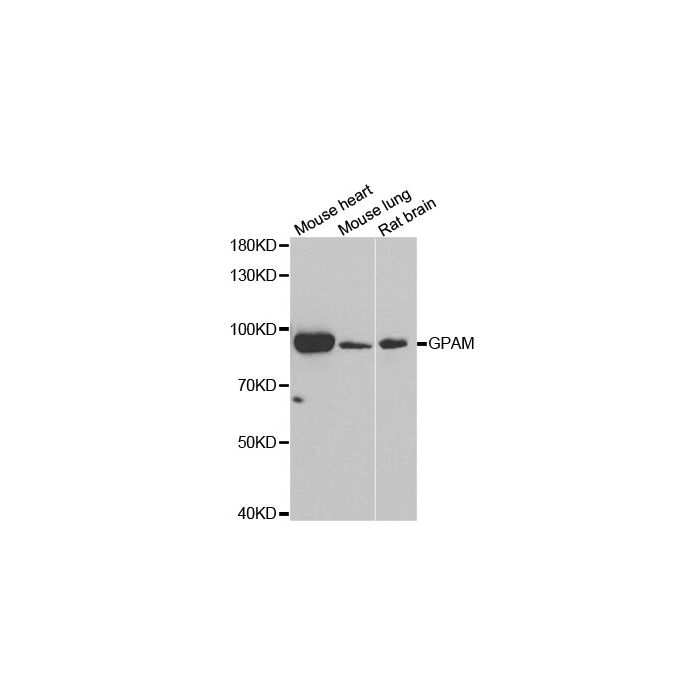
GPAM polyclonal, anti-human, mouse, rat
€388.00
In stock
SKU
BS8294
Background:
GPAM (glycerol-3-phosphate acyltransferase, mitochondrial), also known as GPAT1, GPAT or KIAA1560, is an 828 amino acid multi-pass membrane protein that localizes to the outer membrane of the mitochondria and is involved in phospholipid metabolism. More specifically, GPAM functions to catalyze the first and committing step in the biosynthesis of glycerolipid, namely the conversion of Acyl-CoA and sn-glycerol 3-phosphate to CoA and 1-acyl-sn-glycerol 3-phosphate. Via its catalytic activity, GPAM plays an essential role in the regulation of cellular triacylglycerol and phospholipid levels. The gene encoding GPAM maps to human chromosome 10, which houses over 1,200 genes and comprises nearly 4.5% of the human genome. Defects in some of the genes that map to chromosome 10 are associated with Charcot-Marie Tooth disease, Jackson-Weiss syndrome, Usher syndrome, nonsyndromatic deafness, Wolman’s syndrome, Cowden syndrome, multiple endocrine neoplasia type 2 and porphyria.
Alternative Name:
Glycerol-3-phosphate acyltransferase 1, mitochondrial, GPAT-1, GPAM, GPAT1, KIAA1560
Application Dilution: WB: 1:500~1:2000, IHC: 1:50~1:200
Specificity: GPAM polyclonal antibody detects endogenous levels of GPAM protein.
Immunogen:
Recombinant full length Human GPAM.
MW: ~ 94 kDa
Swis Prot.: Q9HCL2
Purification & Purity:
The antibody was affinity-purified from rabbit antiserum by affinity-chromatography using epitope-specific immunogen and the purity is > 95% (by SDS-PAGE).
Format:
1mg/ml in PBS with 0.1% Sodium Azide, 50% Glycerol.
Storage:
Store at 4°C short term. Aliquot and store at -20°C long term. Avoid freeze-thaw cycles.
For research use only, not for use in diagnostic procedure.
GPAM (glycerol-3-phosphate acyltransferase, mitochondrial), also known as GPAT1, GPAT or KIAA1560, is an 828 amino acid multi-pass membrane protein that localizes to the outer membrane of the mitochondria and is involved in phospholipid metabolism. More specifically, GPAM functions to catalyze the first and committing step in the biosynthesis of glycerolipid, namely the conversion of Acyl-CoA and sn-glycerol 3-phosphate to CoA and 1-acyl-sn-glycerol 3-phosphate. Via its catalytic activity, GPAM plays an essential role in the regulation of cellular triacylglycerol and phospholipid levels. The gene encoding GPAM maps to human chromosome 10, which houses over 1,200 genes and comprises nearly 4.5% of the human genome. Defects in some of the genes that map to chromosome 10 are associated with Charcot-Marie Tooth disease, Jackson-Weiss syndrome, Usher syndrome, nonsyndromatic deafness, Wolman’s syndrome, Cowden syndrome, multiple endocrine neoplasia type 2 and porphyria.
Alternative Name:
Glycerol-3-phosphate acyltransferase 1, mitochondrial, GPAT-1, GPAM, GPAT1, KIAA1560
Application Dilution: WB: 1:500~1:2000, IHC: 1:50~1:200
Specificity: GPAM polyclonal antibody detects endogenous levels of GPAM protein.
Immunogen:
Recombinant full length Human GPAM.
MW: ~ 94 kDa
Swis Prot.: Q9HCL2
Purification & Purity:
The antibody was affinity-purified from rabbit antiserum by affinity-chromatography using epitope-specific immunogen and the purity is > 95% (by SDS-PAGE).
Format:
1mg/ml in PBS with 0.1% Sodium Azide, 50% Glycerol.
Storage:
Store at 4°C short term. Aliquot and store at -20°C long term. Avoid freeze-thaw cycles.
For research use only, not for use in diagnostic procedure.
| Is Featured? | No |
|---|
Write Your Own Review