
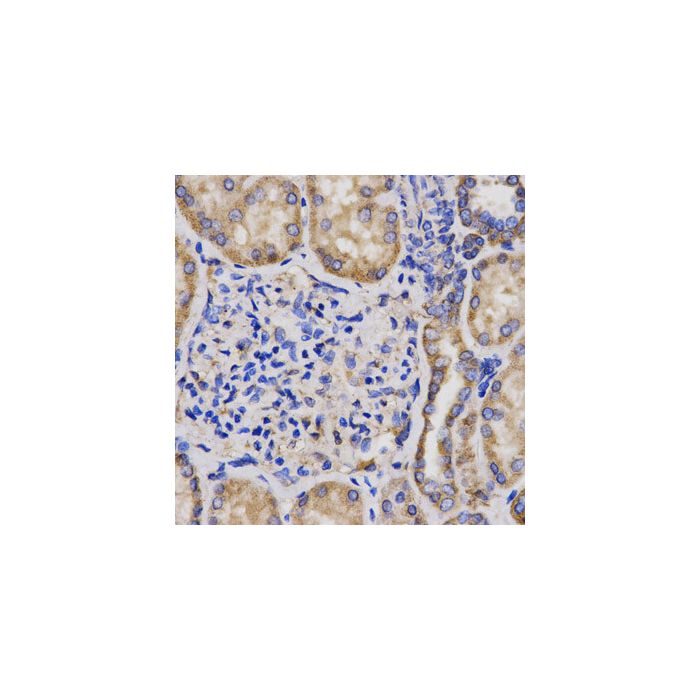
GPC3 polyclonal, anti-human, mouse
€388.00
In stock
SKU
BS7410
Background:
Cell surface heparan sulfate proteoglycans are composed of a membrane-associated protein core substituted with a variable number of heparan sulfate chains. Members of the glypican-related integral membrane proteoglycan family (GRIPS) contain a core protein anchored to the cytoplasmic membrane via a glycosyl phosphatidylinositol linkage. These proteins may play a role in the control of cell division and growth regulation. The protein encoded by this gene can bind to and inhibit the dipeptidyl peptidase activity of CD26, and it can induce apoptosis in certain cell types. Deletion mutations in this gene are associated with Simpson-Golabi-Behmel syndrome, also known as Simpson dysmorphia syndrome. Alternative splicing results in multiple transcript variants.
Alternative Name:
DGSX, Glypican proteoglycan 3, Glypican-3 [Precursor], Gpc3, GPC3_HUMAN, GTR2 2, GTR2-2, Heparan sulphate proteoglycan, Intestinal protein OCI 5, Intestinal protein OCI-5, MXR7, OCI 5, OCI-5, OCI5, SDYS, Secreted glypican-3, SGB, SGBS, SGBS1,
Application Dilution: WB: 1:500~1:2000, IHC: 1:50~1:200
Specificity: GPC3 polyclonal antibody detects endogenous levels of GPC3 protein.
Immunogen:
Recombinant full length Human GPC3.
MW: ~66 kDa
Swis Prot.: P51654
Purification & Purity:
The antibody was affinity-purified from rabbit antiserum by affinity-chromatography using epitope-specific immunogen and the purity is > 95% (by SDS-PAGE).
Format:
1mg/ml in PBS with 0.1% Sodium Azide, 50% Glycerol.
Storage:
Store at 4°C short term. Aliquot and store at -20°C long term. Avoid freeze-thaw cycles.
For research use only, not for use in diagnostic procedure.
Cell surface heparan sulfate proteoglycans are composed of a membrane-associated protein core substituted with a variable number of heparan sulfate chains. Members of the glypican-related integral membrane proteoglycan family (GRIPS) contain a core protein anchored to the cytoplasmic membrane via a glycosyl phosphatidylinositol linkage. These proteins may play a role in the control of cell division and growth regulation. The protein encoded by this gene can bind to and inhibit the dipeptidyl peptidase activity of CD26, and it can induce apoptosis in certain cell types. Deletion mutations in this gene are associated with Simpson-Golabi-Behmel syndrome, also known as Simpson dysmorphia syndrome. Alternative splicing results in multiple transcript variants.
Alternative Name:
DGSX, Glypican proteoglycan 3, Glypican-3 [Precursor], Gpc3, GPC3_HUMAN, GTR2 2, GTR2-2, Heparan sulphate proteoglycan, Intestinal protein OCI 5, Intestinal protein OCI-5, MXR7, OCI 5, OCI-5, OCI5, SDYS, Secreted glypican-3, SGB, SGBS, SGBS1,
Application Dilution: WB: 1:500~1:2000, IHC: 1:50~1:200
Specificity: GPC3 polyclonal antibody detects endogenous levels of GPC3 protein.
Immunogen:
Recombinant full length Human GPC3.
MW: ~66 kDa
Swis Prot.: P51654
Purification & Purity:
The antibody was affinity-purified from rabbit antiserum by affinity-chromatography using epitope-specific immunogen and the purity is > 95% (by SDS-PAGE).
Format:
1mg/ml in PBS with 0.1% Sodium Azide, 50% Glycerol.
Storage:
Store at 4°C short term. Aliquot and store at -20°C long term. Avoid freeze-thaw cycles.
For research use only, not for use in diagnostic procedure.
| Is Featured? | No |
|---|
Write Your Own Review