
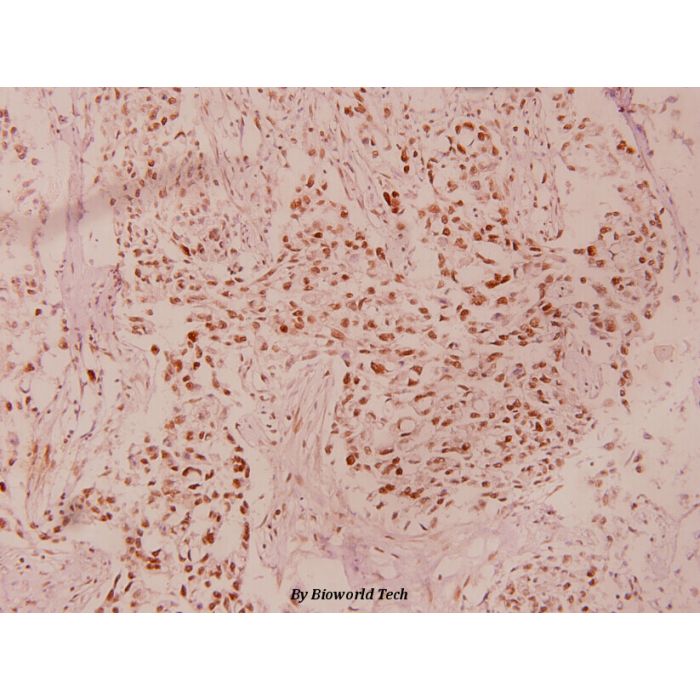
GSK3β (phospho-S9) polyclonal, anti-human, mouse, rat
€328.00
In stock
SKU
BS4084
Background:
Glycogen synthase kinase 3, or GSK-3, is a serine/threonine, proline-directed kinase involved in a diverse array of signaling pathways, including glycogen synthesis and cellular adhesion, and has been implicated in Alzheimer’s disease. Two forms of GSK-3, designated GSK-3α and GSK-3β, have been identified and differ in their subcellular localization. Tau, a microtubule-binding protein which serves to stabilize microtubules in growing axons, is found to be hyper-phosphorylated in paired helical filaments (PHF), the major fibrous component of neurofibrillary lesions associated with Alzheimer’s disease. Hyperphosphorylation of Tau is thought to be the critical event leading to the assembly of PHF. Six Tau protein isoforms have been identified, all of which are phosphorylated by GSK-3. This presents the possibility that miscues in GSK-3 signaling contribute to the onset of Alzheimer’s disease.
Alternative Name:
Glycogen Synthase Kinase 3 Beta, Glycogen synthase kinase-3 beta, GSK 3 beta, GSK-3 beta, GSK3B, GSK3B, GSK3beta isoform, Serine/threonine-protein kinase GSK3B,
Application Dilution: WB: 1:500~1:1000, IHC: 1:50~1:200, IP: 1:50~1:200
Specificity: p-GSK3β (S9) polyclonal antibody detects endogenous levels of GSK3β protein only when phosphorylated at Ser9.
Immunogen:
Synthetic phosphopeptide derived from human GSK3β around the phosphorylation site of Serine 9.
MW: ~ 46 kDa
Swis Prot.: P49841
Purification & Purity:
The antibody was affinity-purified from rabbit antiserum by affinity-chromatography using epitope-specific immunogen and the purity is > 95% (by SDS-PAGE).
Format:
1 mg/ml in Phosphate buffered saline (PBS) with 0.05% sodium azide, approx. pH 7.2.
Storage:
Store at 4°C short term. Aliquot and store at -20°C long term. Avoid freeze-thaw cycles.
For research use only, not for use in diagnostic procedure.
Glycogen synthase kinase 3, or GSK-3, is a serine/threonine, proline-directed kinase involved in a diverse array of signaling pathways, including glycogen synthesis and cellular adhesion, and has been implicated in Alzheimer’s disease. Two forms of GSK-3, designated GSK-3α and GSK-3β, have been identified and differ in their subcellular localization. Tau, a microtubule-binding protein which serves to stabilize microtubules in growing axons, is found to be hyper-phosphorylated in paired helical filaments (PHF), the major fibrous component of neurofibrillary lesions associated with Alzheimer’s disease. Hyperphosphorylation of Tau is thought to be the critical event leading to the assembly of PHF. Six Tau protein isoforms have been identified, all of which are phosphorylated by GSK-3. This presents the possibility that miscues in GSK-3 signaling contribute to the onset of Alzheimer’s disease.
Alternative Name:
Glycogen Synthase Kinase 3 Beta, Glycogen synthase kinase-3 beta, GSK 3 beta, GSK-3 beta, GSK3B, GSK3B, GSK3beta isoform, Serine/threonine-protein kinase GSK3B,
Application Dilution: WB: 1:500~1:1000, IHC: 1:50~1:200, IP: 1:50~1:200
Specificity: p-GSK3β (S9) polyclonal antibody detects endogenous levels of GSK3β protein only when phosphorylated at Ser9.
Immunogen:
Synthetic phosphopeptide derived from human GSK3β around the phosphorylation site of Serine 9.
MW: ~ 46 kDa
Swis Prot.: P49841
Purification & Purity:
The antibody was affinity-purified from rabbit antiserum by affinity-chromatography using epitope-specific immunogen and the purity is > 95% (by SDS-PAGE).
Format:
1 mg/ml in Phosphate buffered saline (PBS) with 0.05% sodium azide, approx. pH 7.2.
Storage:
Store at 4°C short term. Aliquot and store at -20°C long term. Avoid freeze-thaw cycles.
For research use only, not for use in diagnostic procedure.
| Is Featured? | No |
|---|
Write Your Own Review